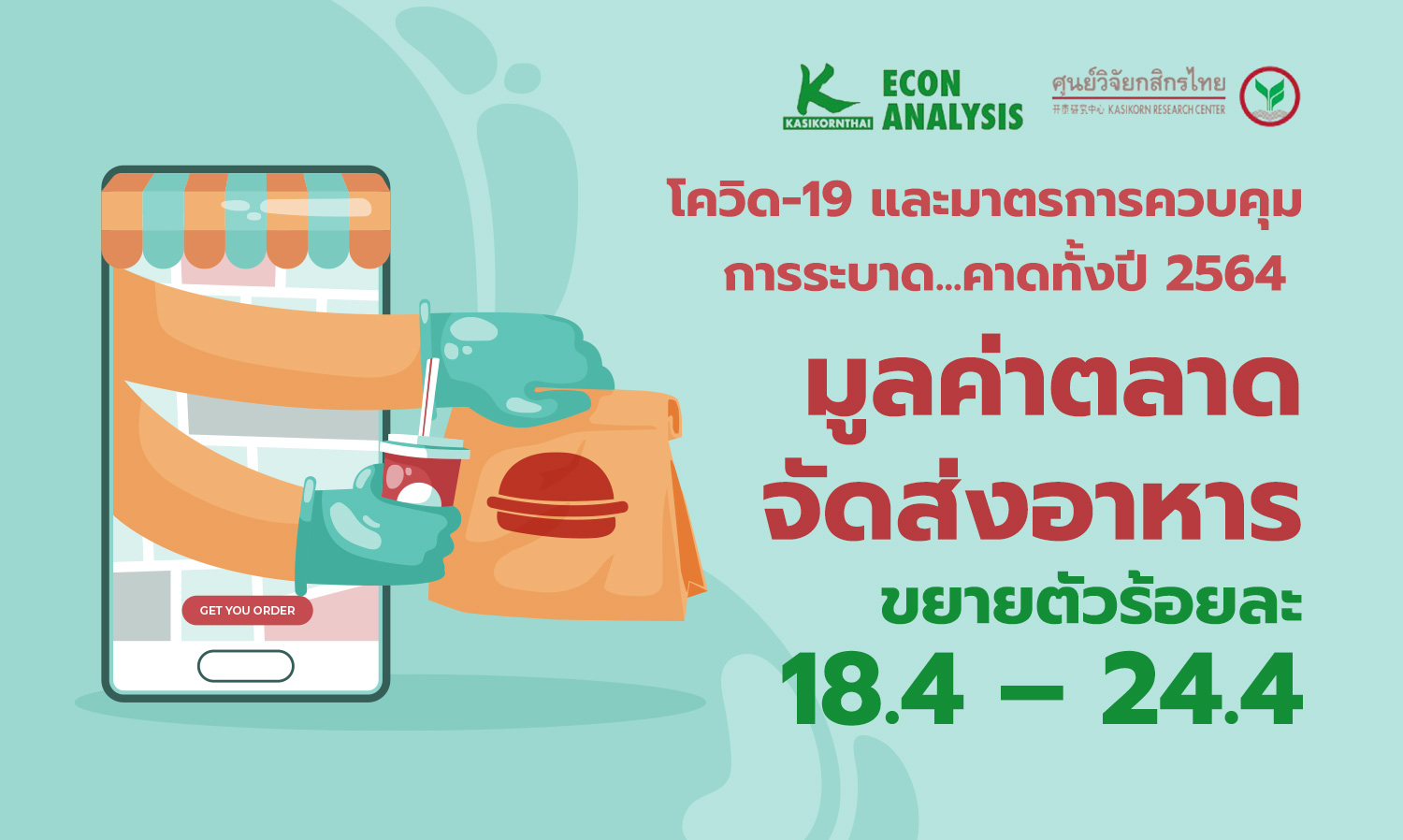
COVID-19 and Outbreak Control Measures: Food Delivery Market Expected to Grow by 18.4% - 24.4% in 2021
Analysis by Kasikorn Research Center
The prolonged COVID-19 outbreak, intense competition in the food delivery business, and new consumer behaviors are expected to drive home food delivery orders to no less than 120 million times in 2021.
The ongoing COVID-19 situation in the country, with a consistently high number of daily new infections, has forced the government to enhance outbreak control measures. This includes limiting restaurant services to only takeout orders and orders through food delivery applications. These restrictions have impacted the revenue of restaurant operators, with an estimated total loss of at least 60 billion baht in restaurant business revenue for the entire year of 2021.
With limited revenue-generating channels, food delivery services have become the primary source of income for restaurant operators. Additionally, many online food delivery platform providers have accelerated marketing efforts, offering promotions, discounts, and waiving delivery fees to support restaurant operators and attract new consumers to try their platforms, as well as increase the frequency of existing consumers' usage. As a result, the Kasikorn Research Center estimates that home food delivery orders will likely reach no less than 120 million times in 2021, representing more than a threefold increase compared to the pre-COVID-19 period in 2019, which had approximately 35 to 45 million orders.
Furthermore, the lifestyle changes amidst the COVID-19 outbreak have influenced consumer behavior regarding food delivery services. The Kasikorn Research Center has summarized some interesting changes in consumer behavior trends as follows:
• The average price per order has decreased by 20-25% compared to the previous year due to purchasing power factors and promotional pushes from operators. Consumers are now ordering food at price levels that align with their purchasing power. At the same time, high competition in the restaurant business has led operators to create special price promotions and adjust menu formats.
• Street food has become increasingly significant and is expected to account for more than 40% of the total revenue of the food delivery business, up from approximately 29% in 2020. This change results from a shift in consumer segments and food types towards more affordable menu options, leading to an increase in the frequency of orders from street food vendors.
• The area for food orders has expanded to the outskirts of Bangkok and connecting areas between Bangkok and its suburbs. This aligns with the shift in business operations to work from home and hybrid working models. A survey by the Kasikorn Research Center found that after the outbreak in April 2021, employees in Bangkok and its suburbs working in both formats accounted for as much as 83%. As consumers increasingly order food from nearby locations, this not only reduces the average delivery distance but also prompts food delivery platform providers to collaborate more with partners, including restaurants and food couriers in those areas.
Given the changing factors and business environment, the Kasikorn Research Center predicts that the food delivery business in 2021 will have a total value of 53.1 to 55.8 billion baht, representing a growth of 18.4% to 24.4% compared to the previous year.

The growth in revenue and the number of stakeholders in the business attracts players from various industries to join the food delivery platform battlefield, while restaurants are adjusting their models to be more flexible in response to uncertainties.
The Kasikorn Research Center views that the COVID-19 situation has significantly driven the growth of the food delivery business and rapidly influenced consumer behavior to increasingly use food delivery services. With a growing number of restaurants and food couriers, this has attracted both existing restaurant operators and those outside the restaurant business to invest in the food delivery market. This trend further compels stakeholders in the industry to adapt quickly to cope with intensifying competition. Notable changes among players that will impact the business environment of food delivery include:
- Operators expanding their business base to food delivery platforms, creating diverse changes for stakeholders.
Business competition in the digital age pushes major operators in nearly every industry to expand their business ecosystem to encompass a wider range of products and services, including food delivery services, which have attracted interest from platform providers in various industries such as financial institutions, e-commerce platforms, and logistics businesses. These players have entered the market with marketing promotions, providing more options for stakeholders such as consumers, restaurants, and food couriers. Meanwhile, the concentration of consumers remains in Bangkok and a few key cities, creating challenges and prompting food delivery platform providers to rapidly adjust strategies to maintain market share. Therefore, even though the business revenue is growing, achieving positive net profitability for food delivery platform providers competing fiercely remains a challenging task.
- Restaurant businesses are adjusting their investment models to be smaller, increasing flexibility and addressing the growth of the food delivery market.
In a situation where the COVID-19 outbreak remains highly uncertain, along with continuously changing consumer behavior trends, the Kasikorn Research Center believes that restaurant operators will continue to focus on being cautious and shifting their investment models towards smaller restaurants. This not only helps limit investment risks but also reduces operating costs and better meets consumer usage behaviors. The small restaurant formats expected to gain interest include non-store restaurants (Cloud kitchens), such as multi-brand cloud kitchens that consolidate restaurant brands under major operators, and delivery app-owned cloud kitchens that integrate well-known restaurants into their cloud kitchens, as well as kiosk/corner restaurants that not only provide more options for consumers but also help reduce the average delivery distance, consequently lowering costs and delivery times from restaurants to consumers.
In summary, the ongoing uncertainty of the COVID-19 outbreak and its impact on dining activities means that food delivery will remain an important channel for consumers and restaurant operators. The Kasikorn Research Center predicts that the value of the food delivery business in 2021 will continue to grow from the previous year, primarily driven by the increasing number of orders, even though the average price per order has decreased.
In the near future, while the food delivery business is expected to continue expanding in market value, stakeholders in the industry will still face significant challenges, such as competition among restaurant operators on food delivery platforms, a decrease in the average number of daily orders per food courier due to the increasing number of food couriers, and competitive pricing promotions that keep most food delivery platform operators facing challenges in achieving positive net profits. This situation is expected to persist over the next 1-2 years and poses a significant challenge for both existing and new food delivery platform providers entering the market.
..............................
[1] From the financial statements of six food delivery platform providers operating in Thailand between 2017 and 2020, there has been a continuous net loss situation. In 2020, five food delivery platform providers recorded a combined loss of over 4 billion baht.