Real Estate Signals Post-COVID: Krung Thai Bank Predicts Foreign Purchasing Power Will Return with Full Tourism Reopening
The high-rise residential market, or condominiums, has faced numerous negative factors over the past 2-3 years. The impact of the COVID-19 pandemic, particularly the third wave, severely affected the real estate market, especially foreign buyers, who nearly disappeared due to travel restrictions. This resulted in a 25.5% decline in the transfer of condominium ownership to foreigners in Thailand in 2020 compared to the same period the previous year.
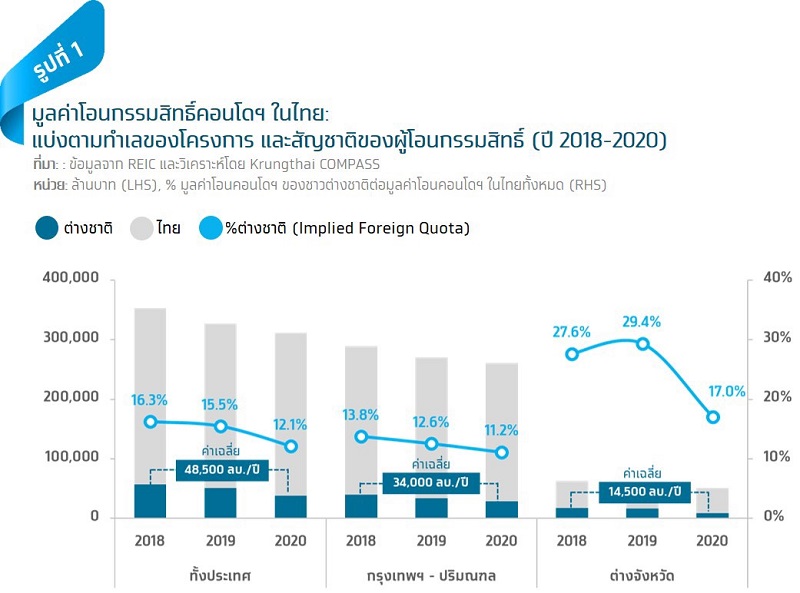
Mr. Kanit Amaskul, an analyst at Krung Thai Bank's research center (Krungthai COMPASS), revealed that over the past three years (2017-2020), the Thai condominium market sold to foreigners averaged 48.5 billion baht per year, accounting for 12.1-16.3% of the total condominium ownership transfers nationwide. This is divided into a market value of 34 billion baht per year in the Bangkok metropolitan area and 14.5 billion baht per year in provincial markets.
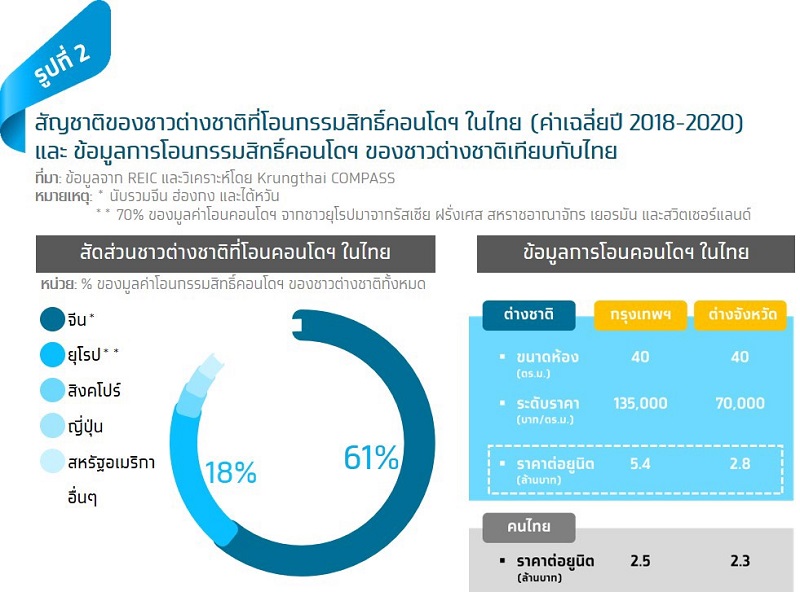
“China” is the main customer for Thai condominiums, holding about 60% of the market share of all foreign condominium transfers, followed by Europeans at 18%, Singaporeans at 3%, Japanese at 2%, and Americans at 2% respectively.
Foreign buyers tend to purchase higher-priced condominiums, with an average price of 5.4 million baht/unit in Bangkok and the surrounding area, which is 116% higher than the average price of 2.5 million baht/unit for Thai buyers. In provincial markets, the average transfer price for foreigners is 2.8 million baht/unit, which is 22% higher than the 2.3 million baht/unit for Thai buyers.
Market Signals for Condominiums Moving Forward
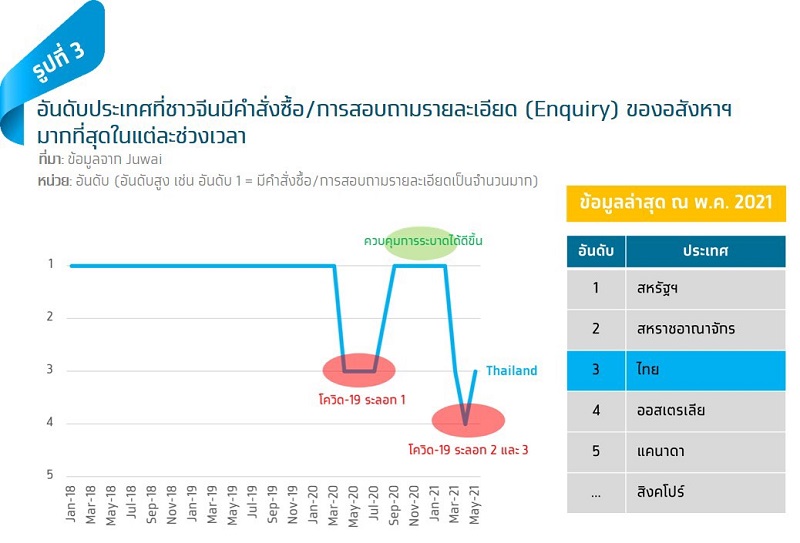
Data from Krung Thai Bank's research center (Krungthai COMPASS) indicates that recent data (May 2021) from the largest real estate trading website in China (referencing Bloomberg: Vancouver Tax Pushes Chinese to $1 Million Seattle Homes) shows that over the past three years, Thai real estate has consistently been the most popular among Chinese buyers. The number of orders and inquiries ranks in the Top 3 on Juwai.com, which aligns with Anjuke.com, another Chinese real estate trading site, stating that Thai real estate is the second most popular in the world and the first in Southeast Asia.
Additionally, the Krung Thai Bank research center has developed a model to calculate the “attractiveness score of condominiums in each country” based on four factors influencing Chinese buyers. These factors, derived from data collection and interviews with Thai real estate agents catering to foreigners, especially Chinese buyers, include affordable pricing, familiarity of locals with Chinese people, healthcare quality, and rental yield. These four factors are crucial for Chinese buyers when selecting real estate in different countries.
Thai condominiums received the second-highest attractiveness score at 3.6, due to affordable pricing, familiarity of Thai people with Chinese, and good healthcare systems, surpassing condominiums in the U.S., Canada, the U.K., and Singapore, which scored 2.9, 2.4, 2.0, and 1.8 respectively.
Only Australian condominiums scored higher at 3.6. Therefore, it is believed that once Thailand can fully reopen to foreign tourists, the Thai condominium market will benefit from the returning foreign purchasing power.
“Sukhumvit, Sathorn, Asoke, Ratchada-Rama 9” Remains a Prime Location for Foreign Buyers
Following the return of foreign buyers, it is expected that condominiums in Sukhumvit, Sathorn, Asoke, Ratchada, and Rama 9 will be popular among foreign buyers due to the area's rich real estate offerings suitable for foreigners, including convenient access to public transportation and the presence of specific community hubs.
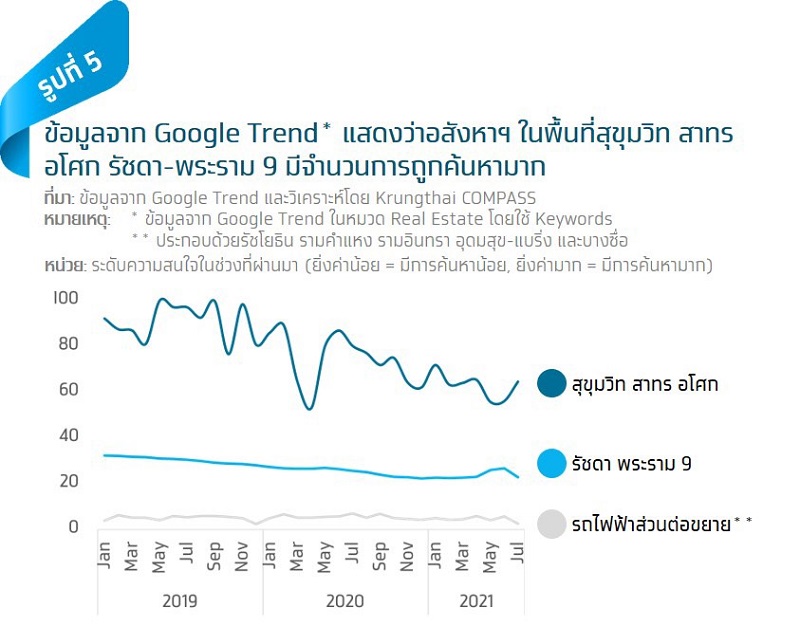
According to Google Trends data, real estate in Sukhumvit, Sathorn, and Asoke is being searched globally and is highly popular, especially among Japanese buyers, due to the presence of shops and Japanese communities in the area.
Ratchada and Rama 9 follow in popularity, being favored by Chinese buyers due to the presence of the Chinatown Huai Khwang community and the Chinese embassy. Meanwhile, areas on the outskirts of the city, such as the extended BTS lines like Ramkhamhaeng, Ramindra, Udomsuk-Bearing, and Bang Sue, have not yet gained much popularity among foreigners.
“Chonburi, Phuket, Chiang Mai, and Prachuap” Condominiums Recovering from Foreign Tourism Boost
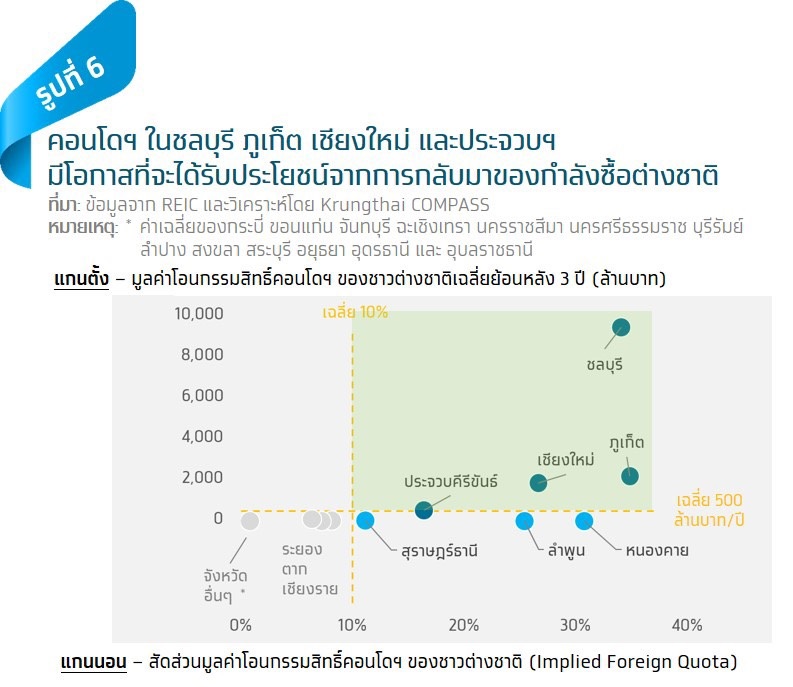
In provincial areas, it is expected that “Chonburi, Phuket, Chiang Mai, and Prachuap” will be the first four provinces to benefit from foreign purchasing power, as they are popular tourist destinations. This is reflected in the implied foreign quota over the past three years, averaging 16-35%, significantly higher than the provincial market average of 10%. Additionally, the market value from foreign condominium ownership transfers ranges from 530 to 9.3 billion baht per year, exceeding the provincial market average of 500 million baht.
However, whether foreign purchasing power can return quickly remains a crucial question, as condominiums are high-value products. Buyers typically require more information and take longer to decide. Most buyers prefer to visit and view the actual locations or projects in Thailand before making a purchase decision, which is quite challenging currently due to international travel restrictions from the COVID-19 pandemic. Therefore, it is anticipated that the Thai condominium market may take until the latter half of 2022 to gradually benefit from the returning foreign purchasing power once Thailand can reopen to foreign tourists again.
- Data from Krung Thai Bank's Research Center (Krungthai COMPASS)