2021-2022: Private Hospital Businesses Dependent on Medical Tourism Continue to Struggle Amid Ongoing COVID-19
• Private hospital businesses are among those severely impacted by COVID-19, particularly those relying on income from international patients through Medical Tourism, who are unable to travel to the country for services like foreign tourists. According to Kasikorn Research Center, the ongoing severe outbreak of COVID-19 in the country is expected to lead to a continued contraction of Thailand's Medical Tourism market in 2021, shrinking by no less than 90% (YoY), translating to approximately 10,000-20,000 patients (visits). While in 2022, Medical Tourism may recover from the low base of the previous year, it is unlikely to return to pre-COVID normalcy, leading to a cautious outlook on revenue generation for businesses. The speed of recovery for the Medical Tourism market will depend significantly on the management of COVID-19 and vaccination efforts for the local population.
The ongoing severe COVID-19 outbreak in the country affects the public and various businesses, including private hospitals, especially those reliant on income from Medical Tourism. In 2020-2021, COVID-19 caused revenues of publicly listed private hospitals to shrink by approximately 12.5% and 11.9%, respectively. It is anticipated that in 2022, COVID-19 management in the country will remain a crucial factor influencing the operations of private hospitals, particularly those dependent on Medical Tourism.
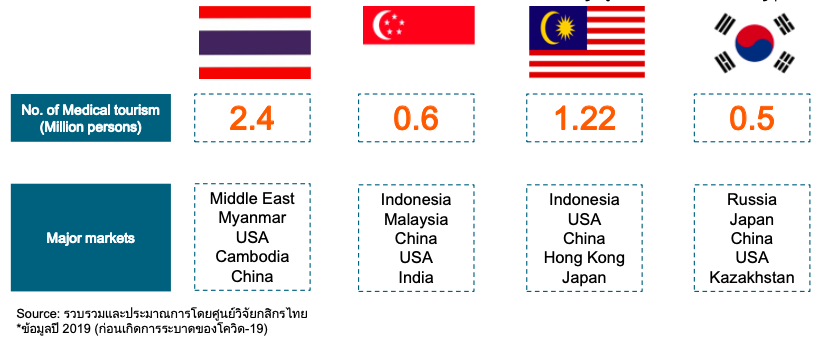
Before the COVID-19 outbreak, Thailand was a leader in health tourism or Medical Tourism in the Asia region, based on the number of Medical Tourists traveling to receive medical care and health services in Thailand, particularly for health check-ups, cosmetic surgery, dental care, and orthopedic and cardiac surgeries, which showed an increasing trend and generated revenue of no less than 39 billion baht annually, accounting for about 24% of total revenue for private hospitals.
Comparison of the number of Medical Tourists traveling for medical treatment in key countries
However, following the COVID-19 outbreak, which has continued to the present and is showing signs of worsening, with new infections averaging no less than 10,000 per day, this has impacted the decision-making of foreign tourists, including international patients who are part of Medical Tourism. This trend is expected to affect the revenues of private hospitals for the second consecutive year, particularly those heavily reliant on foreign patients. Given the ongoing uncertainty, Kasikorn Research Center maintains a cautious outlook on the recovery of the tourism sector and the number of Medical Tourists traveling to receive medical services in Thailand.
Moreover, the ongoing severe COVID-19 outbreak in the country is likely to continue impacting private hospitals, especially those dependent on income from international patients who cannot travel to receive services like foreign tourists. Kasikorn Research Center predicts that the overall Medical Tourism market in Thailand in 2021 will continue to contract by no less than 90% (YoY), amounting to around 10,000-20,000 patients (visits). The patient market expected to shrink the most is likely from the Middle East (e.g., UAE, Kuwait, Oman, Saudi Arabia), China, and ASEAN countries (Myanmar, Cambodia, Laos), which contribute about 30% of total foreign patient revenue, as these countries have both direct medical travelers (Direct Fly-in) and those who choose to combine medical services with leisure travel. The medical services chosen are mostly uncomplicated, do not require recovery time, and allow for continued travel, such as basic health check-ups and dental care. However, the COVID-19 outbreak over the past two years has made international travel for Medical Tourism difficult and has halted it, leading to a continuous decline in business revenues. Meanwhile, foreign patients working and residing in the country or EXPATS, such as those from Japan or long-stay Europeans in Thailand, are also expected to be affected, albeit to a lesser extent than Medical Tourists.
In 2022, it is expected to remain a challenging year for private hospitals targeting the Medical Tourism market. The speed of recovery for the Medical Tourism market will still depend on the management of COVID-19 and vaccination efforts for the local population. Kasikorn Research Center believes that if the current outbreak of COVID-19 can be controlled by the end of 2021 (with daily infection numbers not exceeding 1,000 and no new clusters), there is a possibility that health tourists (Medical Tourism) will gradually return to seek medical services. It is estimated that the number of Medical Tourists in 2022 could be around 130,000-180,000 patients (visits), mostly comprising returning patients who have previously received medical care or health services through Thai private hospitals, including those from the Middle East, Myanmar, and China. However, it will be essential to closely monitor the outbreak situation and COVID-19 management in the country, as prolonged uncertainty could lead to concerns and result in fewer Medical Tourists traveling to receive medical care in Thailand than initially estimated.
Summary table of estimated Medical Tourism patients traveling to receive medical treatment in Thailand

Source: Estimates based solely on private hospitals listed on the Stock Exchange of Thailand (SET), compiled and estimated by Kasikorn Research Center
1. The figures are preliminary estimates and may change depending on the COVID-19 situation in the country.
2. Calculated only for Medical Tourism patients, excluding EXPAT patients.
In summary, Kasikorn Research Center believes that private hospital businesses, particularly those dependent on income from Medical Tourism patients, are expected to continue facing impacts from COVID-19 in 2021-2022. The return of Medical Tourism and Thailand's status as a Medical Hub will depend on the management of the COVID-19 outbreak in the country and vaccination efforts for the local population, especially in key tourist areas of Thailand, where most Medical Tourism patients choose to receive medical services, such as Bangkok, Phuket, Chiang Mai, and Chonburi (Pattaya). Additionally, the management of COVID-19 in the originating countries of significant Medical Tourism patients may also affect their decision to travel to receive medical care in Thailand.
Furthermore, Kasikorn Research Center notes that the upcoming situation may pose risks, especially with the emergence of new diseases that could impact business operations. While there seems to be an opportunity for businesses as consumers become more health-conscious and seek health-related services, on the other hand, if the situation worsens and expands uncontrollably, it could also adversely affect business operations.
Therefore, business operators may need to prepare to handle potential situations, such as considering the adoption of medical technology or Health Tech to manage and facilitate patients more effectively, especially in cases where patients cannot travel to receive treatment in the country. Additionally, diversifying customer bases across various segments or seeking new customer groups could help mitigate risks, alongside offering new medical services, such as treating more complex diseases and comprehensive preventive health care programs for patients.