Bank of Thailand Introduces 3 Debt Relief Measures for 'Housing, Cars, and Credit Cards' Amid COVID-19 Impact
The COVID-19 outbreak continues to require ongoing vigilance, with the new wave affecting Thailand's economic activities, leading to a decrease in citizens' incomes while their debt burdens remain unchanged. To alleviate the resulting impacts and prevent widespread defaults, the government has implemented measures to relieve the debt burden on citizens.
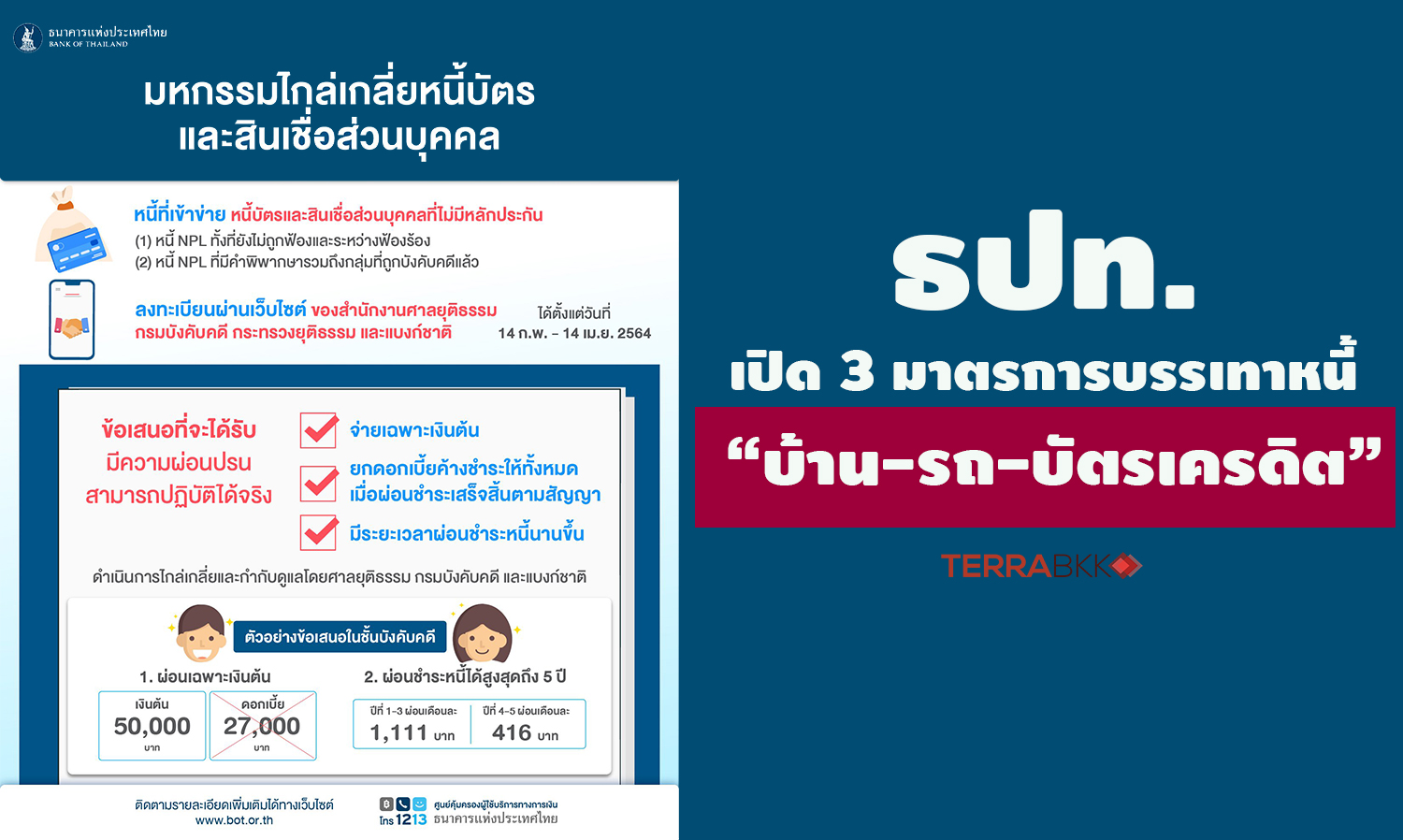
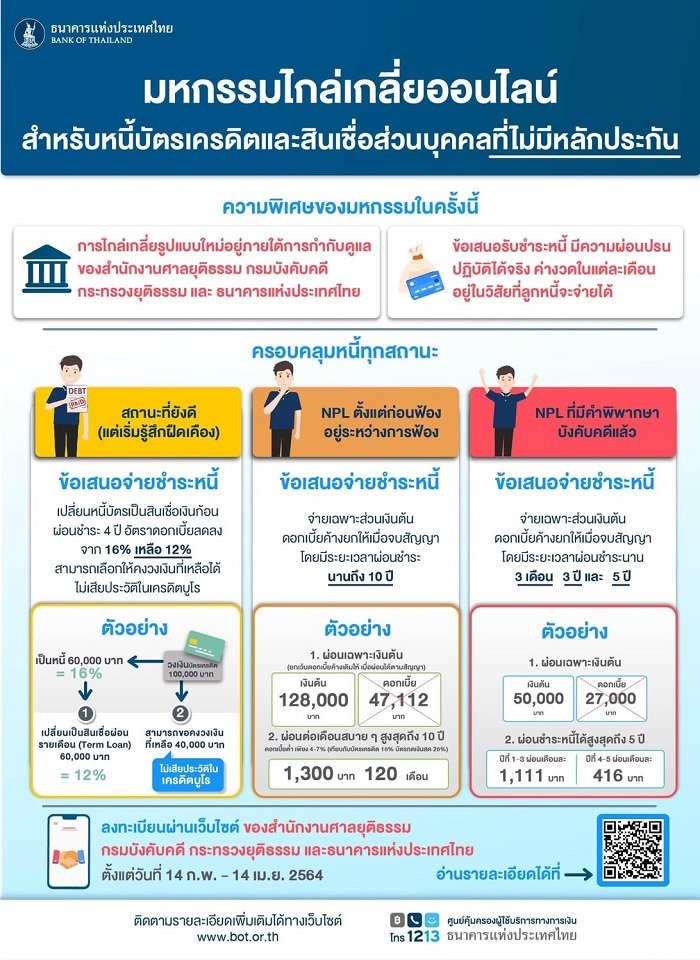
Ms. Kulaya Tantitemit, Director of the Fiscal Policy Office and spokesperson for the Ministry of Finance, stated that the Bank of Thailand (BOT), the Office of the Judiciary, the Ministry of Justice, and the Office of the Consumer Protection Board (OCPB), along with several financial service providers, have jointly organized a debt mediation event to provide debtors with more flexible and suitable proposals. All debtors, including those with Non-Performing Loans (NPLs) that have begun enforcing collateral, can participate in mediating their issues with creditors, covering three types of debt:
1) Credit card and unsecured personal loans - 26 financial service providers are participating, and debtors can register from today until June 30, 2021.
2) Unsecured debt sold to asset management companies (AMC) - 4 AMCs are participating, and debtors can register from today until July 31, 2021.
3) Car hire purchase debt - 12 financial service providers are participating, and debtors can register from today until July 31, 2021.
Those interested can register through the BOT's website (www.bot.or.th or www.1213.or.th), with participating financial service providers, or contact the Financial Consumer Protection Center for advice and assistance in filling out information by calling 1213 during business hours or emailing [email protected] for staff to follow up.
The third phase of debt relief measures for individual debtors, implemented by the BOT in collaboration with financial service providers, aims to enhance existing measures to respond to the worsening situation, focusing on long-term debt burden reduction, offering options, flexibility, and clear practices, covering four types of loans:
1) Credit cards and personal loans - Focus on alleviating debt burdens by extending repayment periods. For cases exceeding 48 installments, interest rates should be reviewed to be lower than the ceiling rates (12% for credit cards and 22% for personal loans) from the first installment, reducing installment amounts, and consolidating debts with housing loans and other personal loans.
2) Car and motorcycle title loans - Options to reduce installment amounts, defer payments, or consolidate debts with housing loans and other personal loans. Debtors with severe impacts can choose to return their vehicles, and if there is remaining debt from auction sales, financial service providers can help reduce the debt burden according to the debtor's status.
3) Car and motorcycle hire purchases - Options to reduce installment amounts or extend repayment periods. Debtors with severe impacts can choose to defer payments or return their vehicles, including controlling the Effective Interest Rate (EIR) throughout the contract duration not to exceed the original interest rate. Additionally, debts can be consolidated with housing loans and other personal loans, and if debtors can repay the entire hire purchase amount, interest should be reduced by no less than 50%.
4) Housing loans and loans secured by housing - Additional options to defer principal payments and pay partial interest, allowing debtors to repay in a step-up manner according to their repayment capacity.
Debtors affected can express their desire for assistance from today until December 31, 2021, through various channels of financial service providers.
Moreover, the government has other policies and programs to help alleviate the debt burden on citizens, such as the 'Doctor Debt for the People' project, which provides information and advice on resolving personal and business debts, a debt relief hotline for citizens to request assistance with debt repayments. The BOT will forward the information received to the relevant service providers or government agencies, a debt clinic to assist NPLs, credit cards, and unsecured personal loans, etc. Additionally, there is a policy for specialized financial institutions to extend principal payment deferrals for voluntary debtors until December 31, 2021, and a policy to extend debt repayment deferral measures until the end of 2021 for qualifying debtors. Debtors can directly contact their creditor financial institutions for assistance.
For more information:
Financial Consumer Protection Center Phone: 1213 Email: [email protected]
'Doctor Debt for the People' project www.bot.or.th/app/doctordebt
Debt Relief Hotline www.1213.or.th/App/DebtCase
Debt Clinic www.debtclinicbysam.com