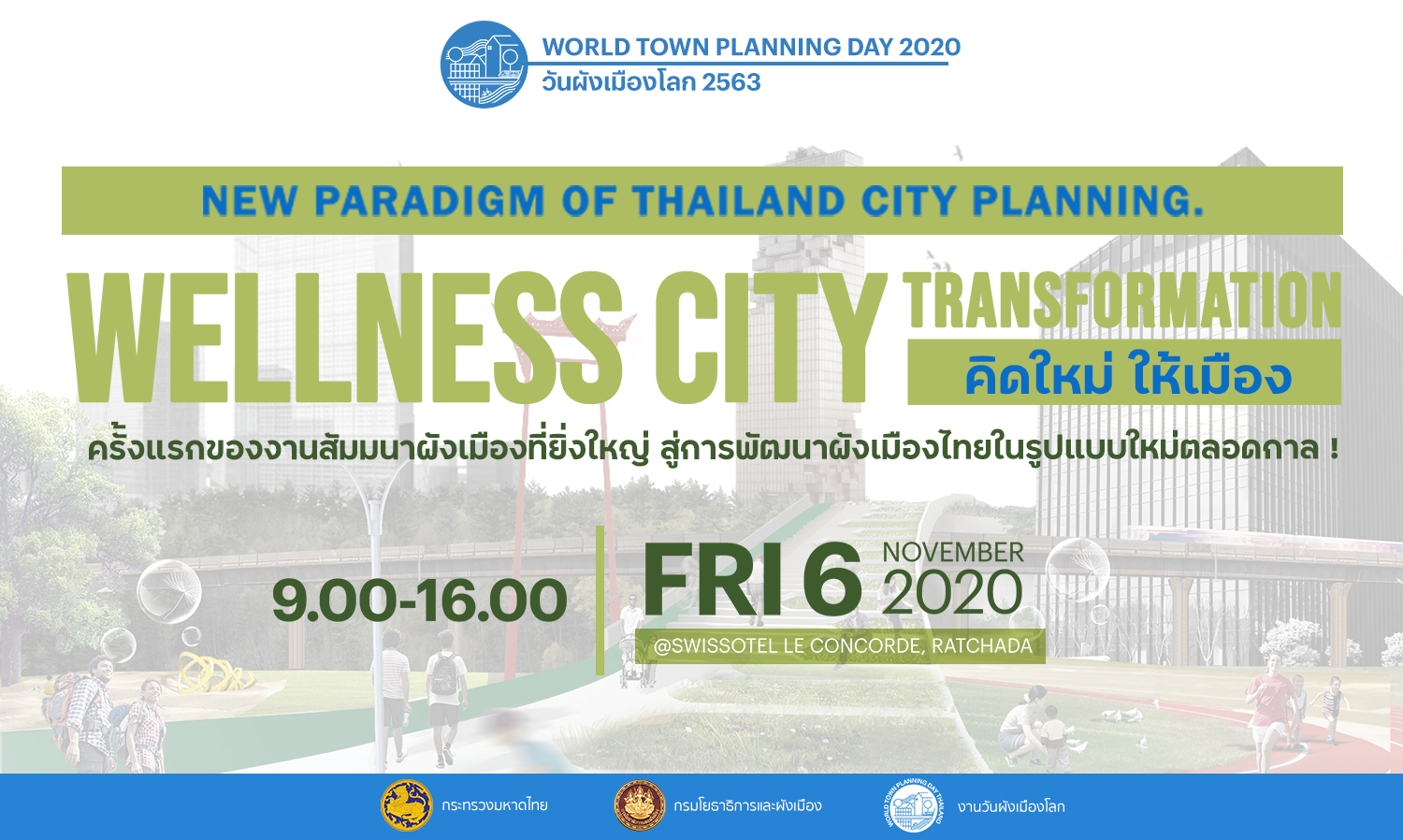
WELLNESS CITY TRANSFORMATION: A New Paradigm in Thailand's City Planning "Think Again for the City" - A Perspective on Sustainable Urban Development on World Town Planning Day 2020
WELLNESS CITY TRANSFORMATION: A New Paradigm in Thailand's City Planning
"Think Again for the City"
A Perspective on Sustainable Urban Development on World Town Planning Day 2020
Because Urban Planning is the Foundation of City Development
In light of the COVID-19 pandemic, countries worldwide have faced significant challenges in managing the outbreak. Almost every nation has undergone major adjustments, seeking new approaches in both policy and physical urban planning and design, with the primary goal of ensuring the well-being of citizens, allowing them to live safely and happily.
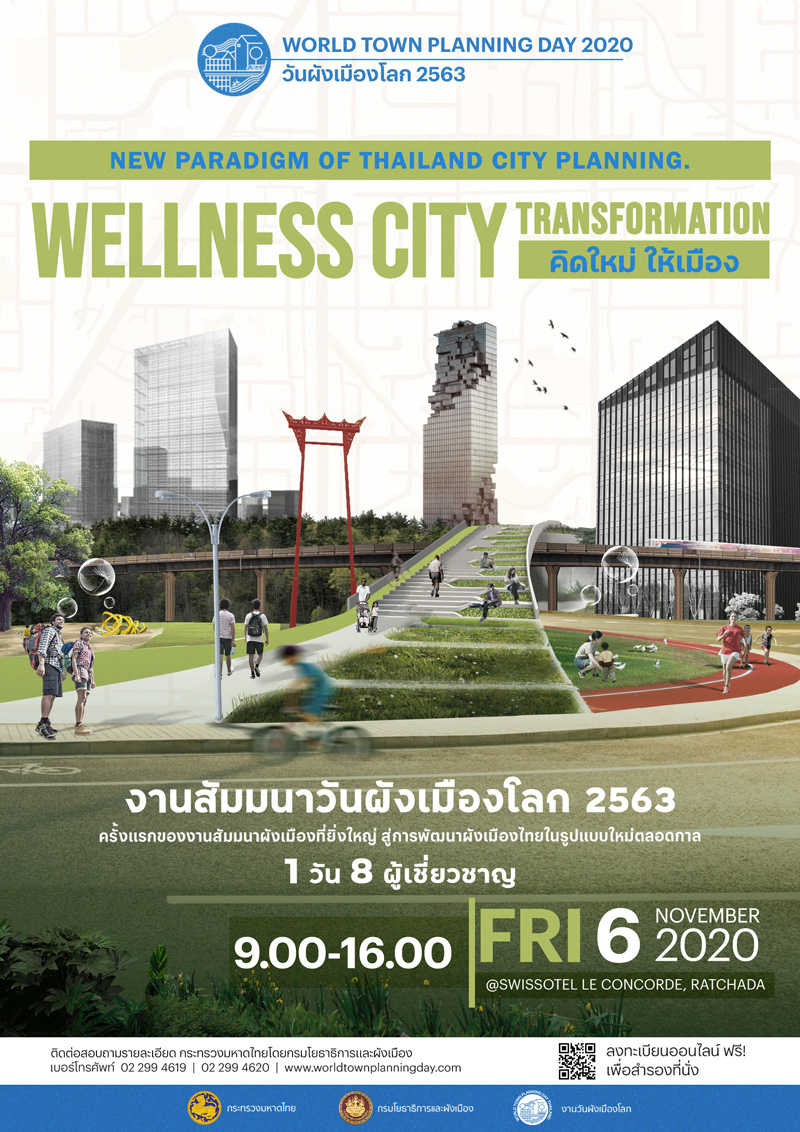
Therefore, on the occasion of World Town Planning Day 2020, the Ministry of Interior, through the Department of Public Works and Town & Country Planning, organized an academic seminar titled WELLNESS CITY TRANSFORMATION: A New Paradigm in Thailand's City Planning "Think Again for the City" to disseminate and exchange knowledge in urban planning, as well as to promote and support all sectors, including the public, to recognize the role and importance of urban planning, focusing on developing urban planning work in alignment with national strategic initiatives.
Event Details
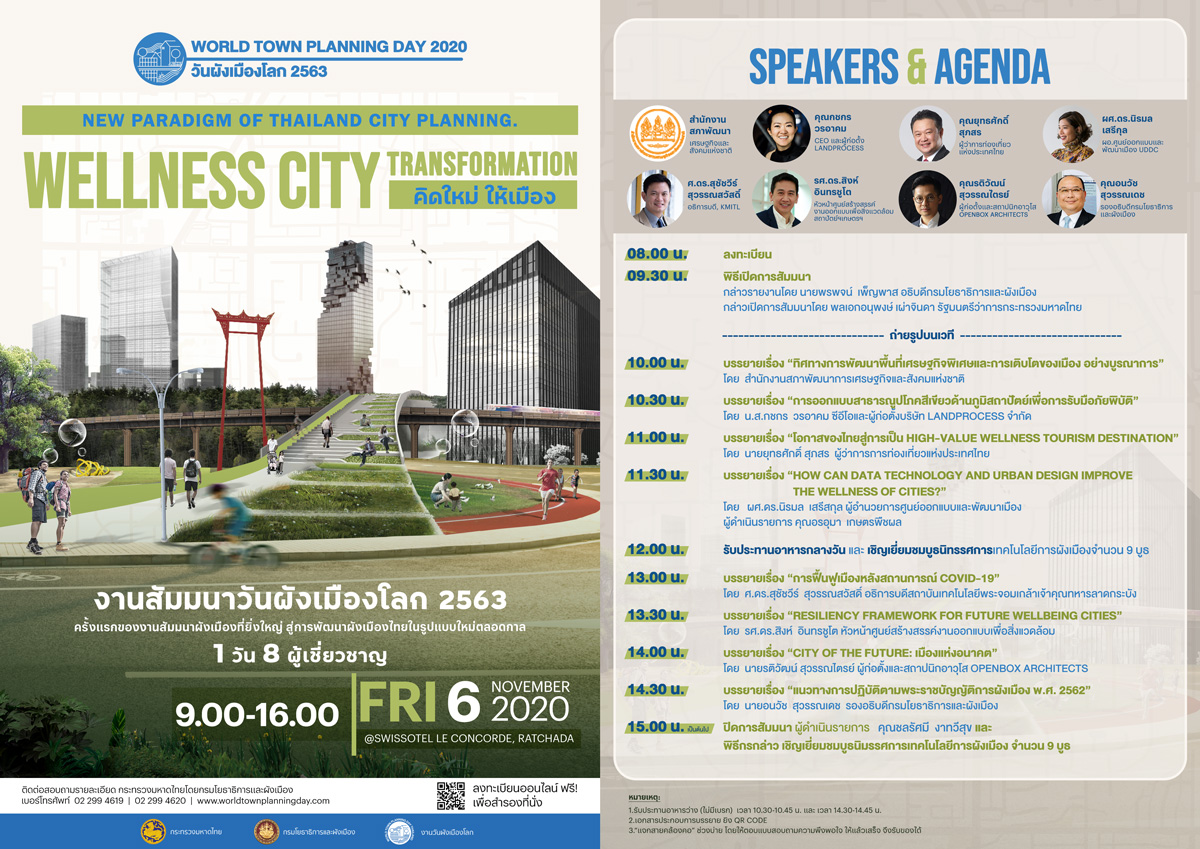
Date: November 6, 2020
Time: 8:00 AM - 4:00 PM
Location: Swissotel Bangkok Ratchada
Cost: Free of charge (limited seats)
Inquiries: 02 299 4619 and 02 299 4620 or www.worldtownplanningday.com
Registration: Register online to reserve a seat for the free seminar! Just scan the QR code.
Or watch the seminar for free via Facebook Live

Who Should Attend This Seminar
- Policy makers and those involved in driving urban planning
- Urban planners, engineers, architects, and stakeholders in city development
- Students and the general public interested in the topic
Agenda
08:00 - 09:00 AM Registration
09:00 - 10:00 AM Official opening ceremony
10:00 - 12:00 PM Start of presentations
12:00 - 1:00 PM Lunch break
1:00 - 3:00 PM Continuation of presentations
3:00 - 4:00 PM Exhibition of advanced urban planning technologies from various organizations
Objectives of the Event
- To disseminate and exchange knowledge in urban planning, promoting awareness of the role and importance of urban planning among all sectors, including the public
- To foster collaboration between public and private sectors in planning urban development, local areas, and communities
- To introduce new perspectives on urban development to keep pace with changing social contexts
Seminar Details
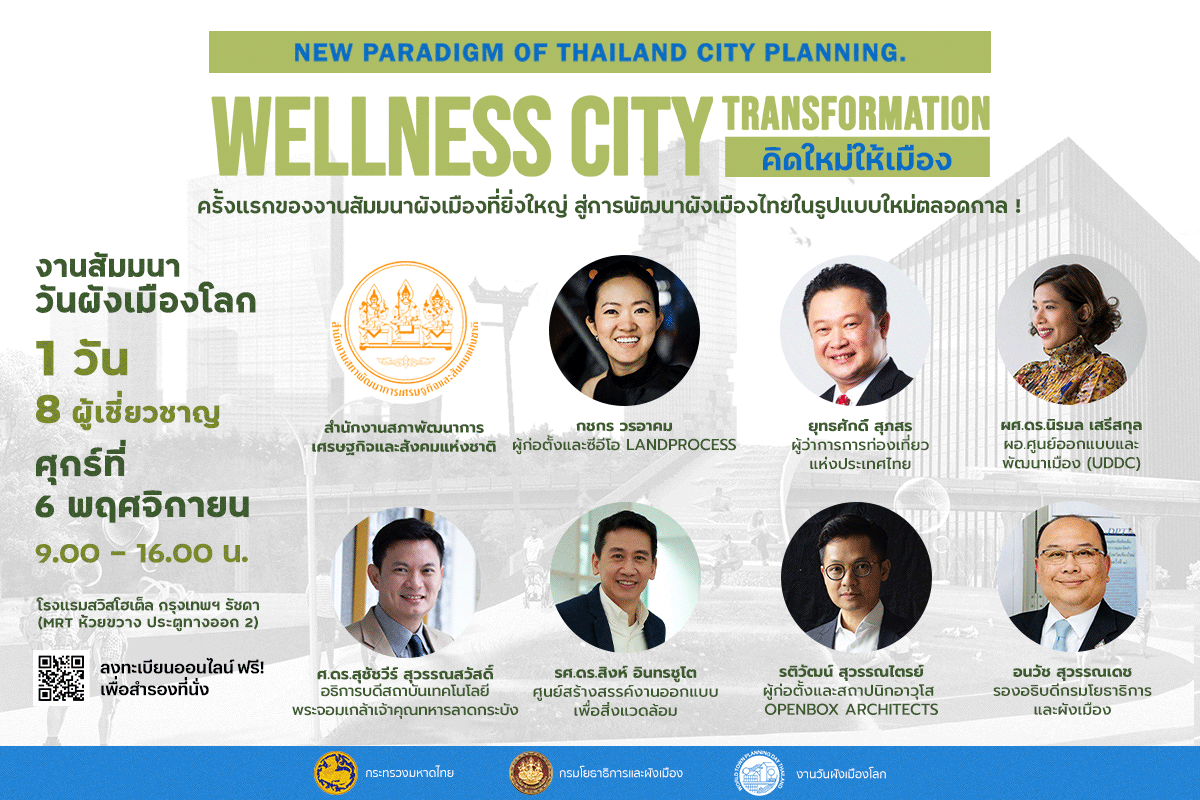
10:00 - 10:30 AM Direction of Special Economic Zone Development and Integrated Urban Growth by the National Economic and Social Development Council
10:30 - 11:00 AM Designing Green Infrastructure with Landscape Architecture for Disaster Resilience
by Kachakorn Woraakham, Landscape Architect, Founder and CEO of Landprocess Co., Ltd. who is interested in applying landscape architecture knowledge to address urban issues concretely, especially in the context of "Urban Pore Operations", the mastermind behind numerous large public space projects such as the 100th Anniversary Puay Learning Park, the Sky Healing Garden, Ramathibodi Hospital, the 100th Anniversary Chulalongkorn University Park, and the longest river-crossing public park, Chao Phraya Sky Park.
"Today, civil engineering is not just about building dams, constructing buildings, creating green spaces, or walkways. Concrete engineering is not the answer to modern city building. Often, we create cities without considering ecosystems and urban resilience. Here, resilience means designing cities to align with diverse ecosystems, addressing anticipated urban challenges and helping to solve various problems."
11:00 - 11:30 AM Opportunities for Thailand to Become a High-Value Wellness Tourism Destination
by Yuthasak Supasorn, Governor of the Tourism Authority of Thailand
11:30 AM - 12:00 PM How Can Data Technology and Urban Design Improve the Wellness of Cities?
by Assoc. Prof. Dr. Niramon Serisakul, Director of the Urban Design and Development Center, Chulalongkorn University (UddC), a city explorer and urban development advocate tailored to local contexts, or in another role as the project leader of Walkable City or GoodWalk, aimed at promoting walking in daily life for urban residents.
When discussing Wellness Cities, one must mention the concept of ‘walking’ because walking is individual health. However, it is strange that having a city designed for longevity often results in residents spending more money. As we know, walking 10,000 steps a day contributes to good health, but does the city have pedestrian paths suitable for walking? It turns out that Thailand currently has travel costs accounting for 20% of per capita expenses, ranking among the highest in the world.
"The foundation of a Wellness City or a good city is one where people turn to public transport, but that system must be convenient and cost-effective. We must create walkable cities; this is the most challenging and crucial task if Thailand is to move forward."
1:00 - 1:30 PM Urban Recovery Post-COVID-19
by Prof. Dr. Suchatchavee Suwansawat, President of King Mongkut's Institute of Technology Ladkrabang, National Urban Planning Committee Member, and President of the Engineering Council
Because cities and urban planning are one and the same, Bangkok faces numerous pressing issues, but they are not insurmountable. For instance, Tokyo has resolved problems through engineering principles, despite having a population and vehicle count far exceeding that of Bangkok. Why does Tokyo rarely experience flooding? This demonstrates that these issues can be addressed.
"As the President of the Engineering Council and an engineering academic, I believe that applying engineering principles to solve urban problems can be done comprehensively, whether through road tunnels or underground retention basins. Even without COVID-19, urban planning has always been a challenging task for Bangkok. However, post-COVID-19, do we need to address additional issues? Should we prioritize safety and cleanliness?"
1:30 - 2:00 PM Resiliency Framework for Future Wellbeing Cities
by Assoc. Prof. Dr. Sing Intarachuto, Head of the Creative Design Center for the Environment, Faculty of Architecture, Kasetsart University
If we know what will happen, we can design cities that respond to those situations, such as flooding, drought, air pollution, extreme heat, energy shortages, food insecurity, and increasing accident rates, among others.
"Thus, future cities should anticipate and develop solutions for these phenomena before they occur, planning master plans or urban layouts, and establishing various guidelines. Ultimately, we cannot compete with robots or AI in terms of efficiency and accuracy. Therefore, future cities must foster creativity among people; nurturing creativity is the city's responsibility moving forward."
2:00 - 2:30 PM CITY OF THE FUTURE: The City of Tomorrow
by Ratiwat Suwantrai, Founder of OPENBOX ARCHITECTS and CEO of OPENBOX GROUP, an award-winning architect
After the COVID-19 pandemic, normal life has transformed into a new form, becoming our new normal, referred to as The Next Normal, which may affect cities and people's lives. Therefore, Ratiwat's presentation emphasizes solutions for developing the City of the Future that will meet the demands of this new way of life under the S-E-N-S-E concept, which includes:
- S - Space Efficiency: Maximizing space management
- E - Energy Sharing: Efficient energy use
- N - Nature & Green: Prioritizing nature and green spaces
- S - Synchronization of Multi-Functions: Designing to meet diverse situations
- E - Explorations of Innovations: Creating innovative living solutions to enhance quality of life
2:30 - 3:00 PM Compliance with the Town Planning Act B.E. 2562
by Anawat Suwandet, Deputy Director-General of the Department of Public Works and Town & Country Planning
3:00 - 4:00 PM Visit the exhibition booths showcasing advanced urban planning technologies from 9 organizations
Including: German International Cooperation (GIZ), Bangkok Metropolitan Administration, Japan International Cooperation Agency (JICA), Eastern Economic Corridor Policy Committee (ECC), National Innovation Agency (NIA), Geo-Informatics and Space Technology Development Agency (GISTDA), Pisuth Technology Co., Ltd., Urban Space Co., Ltd., and City Plan Professional Co., Ltd.