
Finance Ministry Hides Debt of Nearly 1 Trillion Baht Owed to State Banks and Social Security
The Public Debt Management Office (PDMO) anticipates that by 2022, public debt will exceed fiscal discipline limits, revealing that the ministry has concealed populist debts and outstanding social security contributions totaling over 9.5 trillion baht. The Budget Bureau is preparing to allocate a budget to repay state banks over the next four years amounting to 450 billion baht.
In the past eight years, the government led by Prime Minister Gen. Prayuth Chan-o-cha has had more budget (central budget) at its disposal than any other ministry, employing various strategies including three mid-year budget adjustments, reallocating regular budgets to the central budget, and making emergency or necessary reserve payments five times. Particularly in the fiscal year 2020, following the COVID-19 outbreak, the government issued a 1 trillion baht emergency loan decree to stimulate the economy and support citizens. This year, it also transferred 88.453 billion baht from the regular budget to the central budget, the highest in history, to reserve funds for the government and the Prime Minister to use in emergencies to address COVID-19 and other disasters.
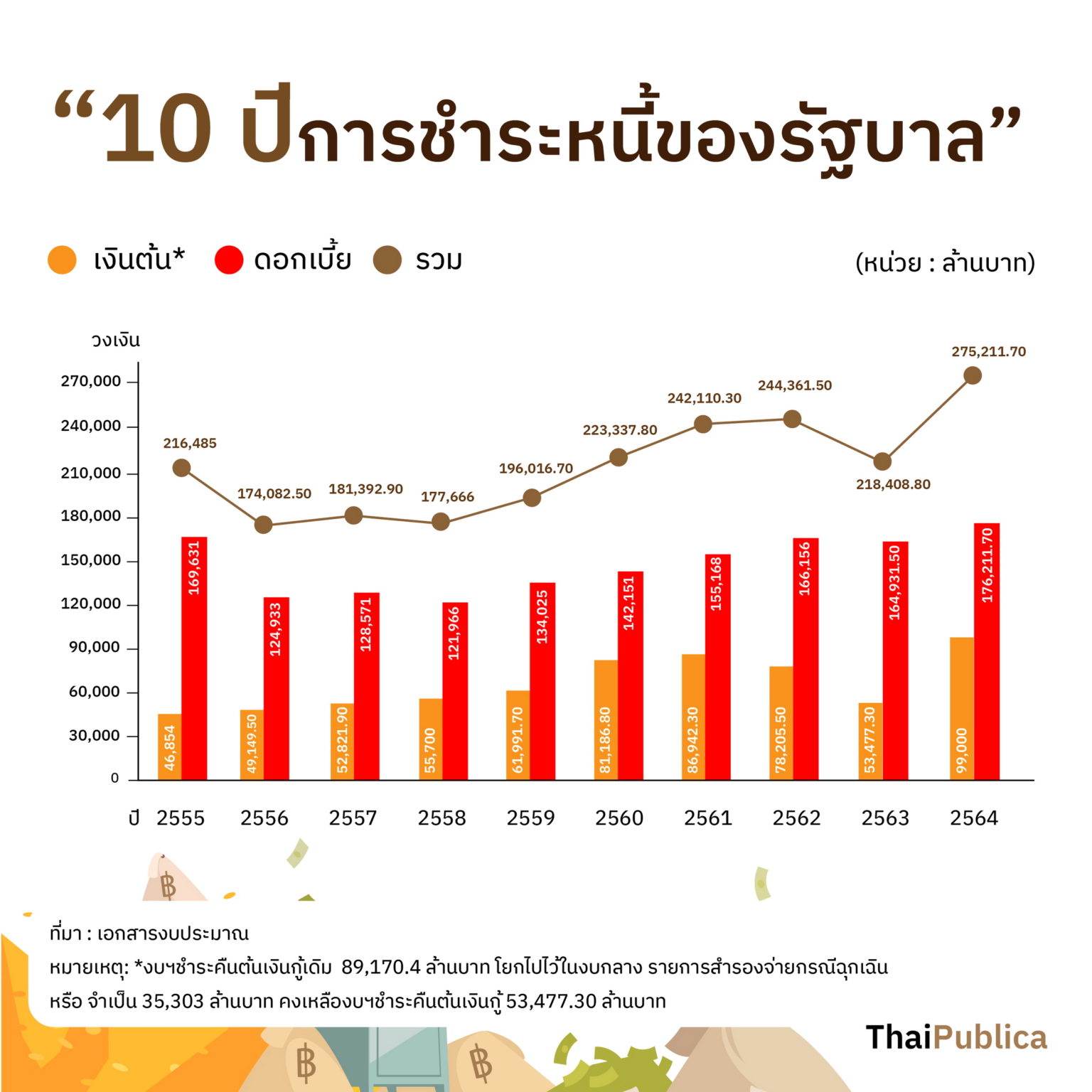
Interestingly, this year's operation to transfer the regular budget included reallocating funds for debt repayment on loans taken by the government. In the fiscal year 2020, a total of 88.78 billion baht was allocated for principal repayment, with 35.303 billion baht transferred to the central budget, leaving 53.477 billion baht for loan principal repayment, which accounts for 1.7% of the total budget of 3.2 trillion baht. Meanwhile, the fiscal discipline law mandates a minimum principal repayment ratio of 2.5% of the total budget for that year.
The central budget for emergency or necessary reserve payments is legally capped at a maximum of 3.5% of the total budget each year. The transfer of 88.453 billion baht from the regular budget to the central budget for emergency or necessary reserve payments has increased the central budget's ratio to the overall budget to 5.76%, exceeding the legal limit.
Therefore, before the government submits the 2020 budget transfer bill for parliamentary approval, the Prime Minister must preside over a meeting to issue a resolution from the State Financial and Fiscal Policy Committee amending the fiscal discipline framework in two areas: expanding the ceiling for the central budget for emergency or necessary reserve payments from 3.5% to 7.5% of the total budget each year, and reducing the minimum principal repayment ratio from 2.5% to 1.5% of the total budget.
However, in such circumstances, using funds for economic relief or stimulation is essential. “Thai Publica” presents factual information that has occurred.
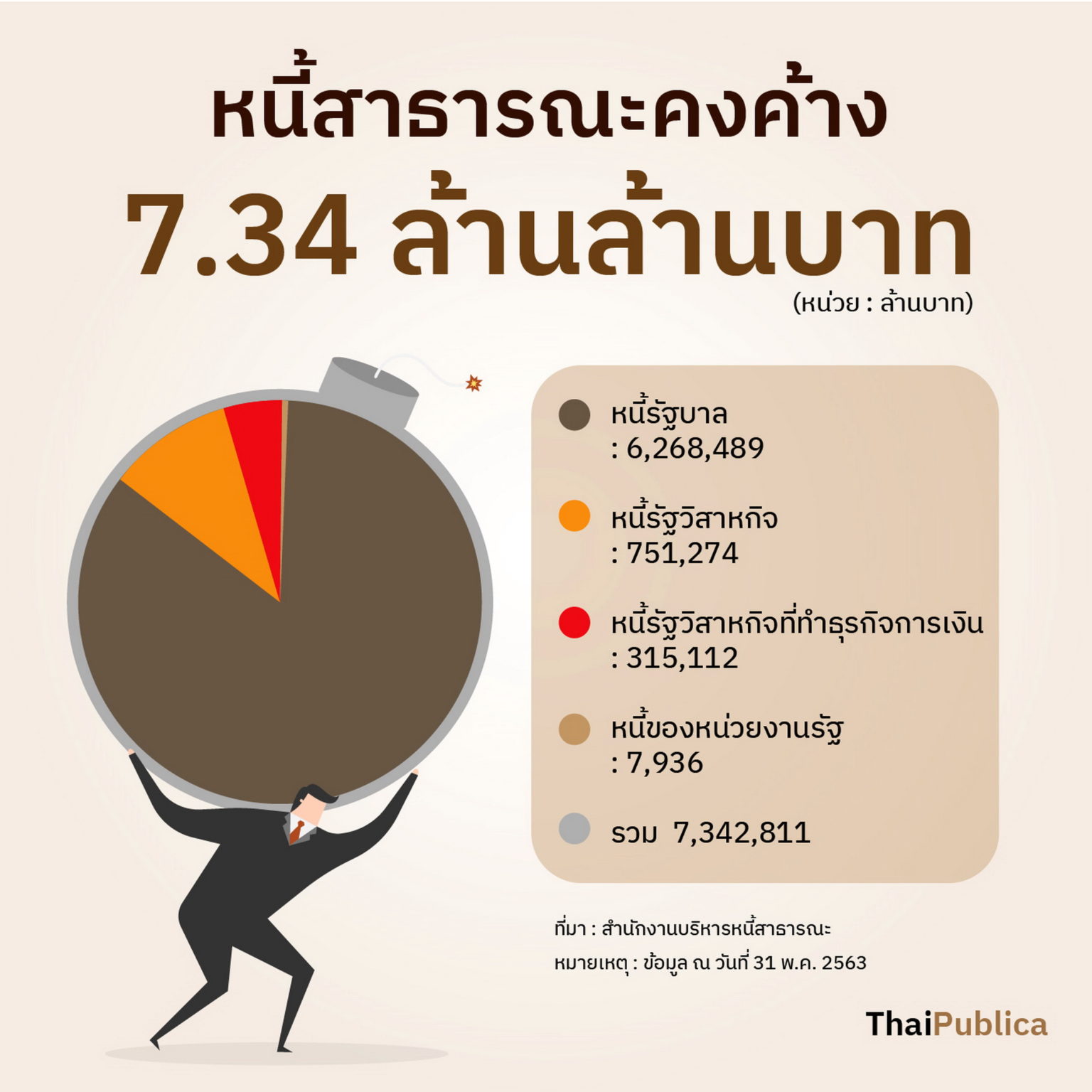
Now, let’s look at Thailand's public debt figures, which are published on the Public Debt Management Office (PDMO) website. As of May 31, 2020, the outstanding public debt stood at 7.34 trillion baht, or 44% of GDP. Many readers have inquired whether this amount includes the 1 trillion baht loan decree. The answer is that it is gradually being included in public debt as the Ministry of Finance borrows funds.
In 2020, an Additional 1.49 Trillion Baht Borrowed
According to the government's new borrowing plan for the fiscal year 2020 (ending September 30, 2020), presented by the PDMO at the second meeting of the Public Debt Management Policy and Supervision Committee on April 22, 2020, it is expected that within the fiscal year 2020, the government will incur new debt or “additional borrowing” totaling 1,497.498 billion baht, an increase of 603.493 billion baht from the original plan. This includes 1,331.677 billion baht borrowed by the government, 163.829 billion baht by state enterprises, and 1.992 billion baht by other state agencies. The additional borrowing of 600 billion baht is primarily under the 1 trillion baht loan decree, with the remaining 400 billion baht expected to be borrowed in the fiscal year 2021.
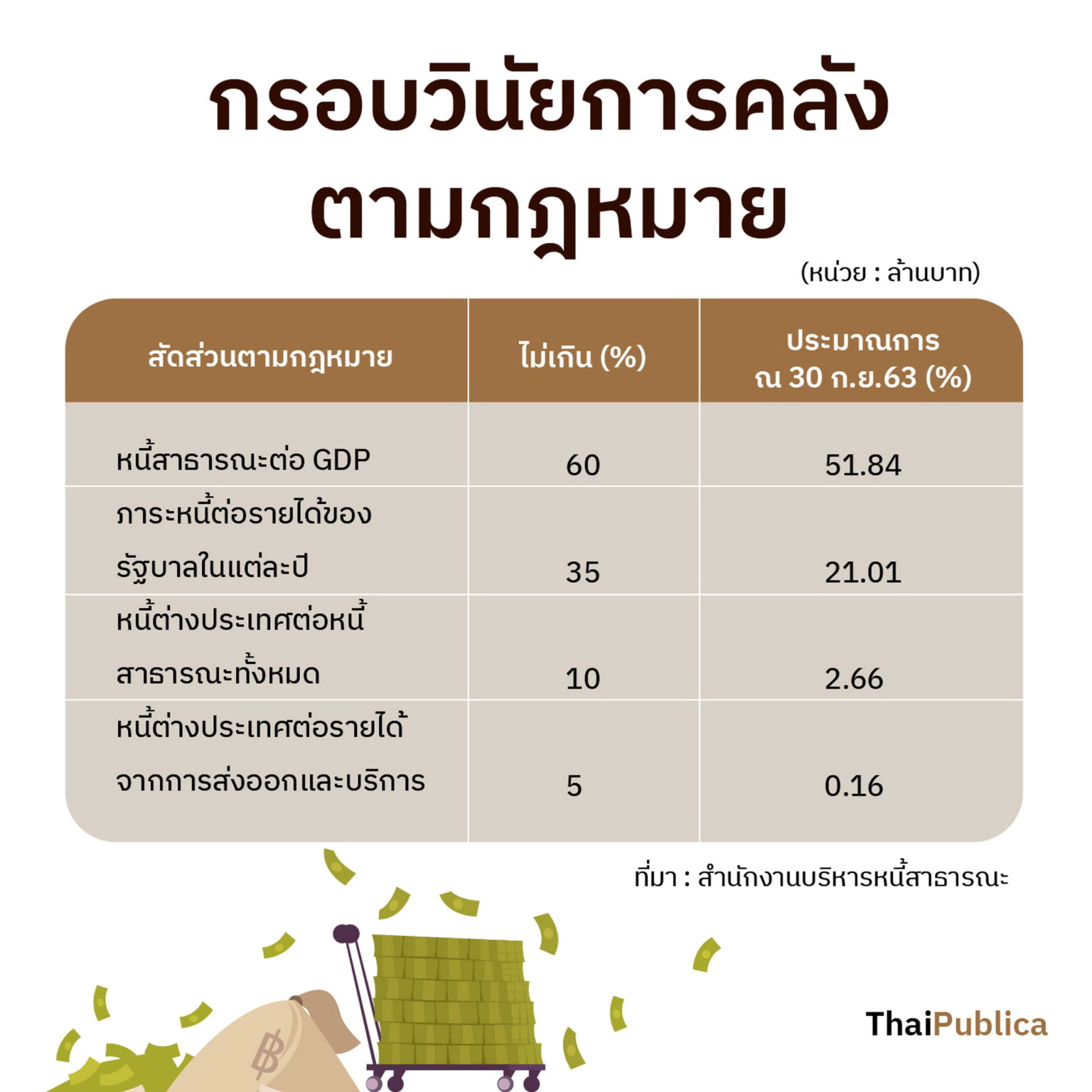
If the government borrows the full amount specified in the new borrowing plan of 1,497.498 billion baht, the PDMO estimates that public debt to GDP by the end of September 2020 will be 51.84%, which remains within the legal limit of public debt to GDP not exceeding 60%.
PDMO Predicts Public Debt Will Exceed Fiscal Discipline by 2022
However, according to graphs presented by the Public Debt Management Office to the Public Debt Management Policy and Supervision Committee, it is evident that the ratio of public debt to GDP will begin to exceed fiscal discipline limits (over 60% of GDP) during the fiscal year 2022. In this forecast, the PDMO used economic estimates from the Bank of Thailand (BOT), predicting that the Thai economy will contract by 5.3% in fiscal year 2020 and grow by 3.0% in fiscal year 2021. However, if GDP contracts more than the BOT estimates, it will result in a higher public debt to GDP ratio exceeding the legal fiscal discipline limits.
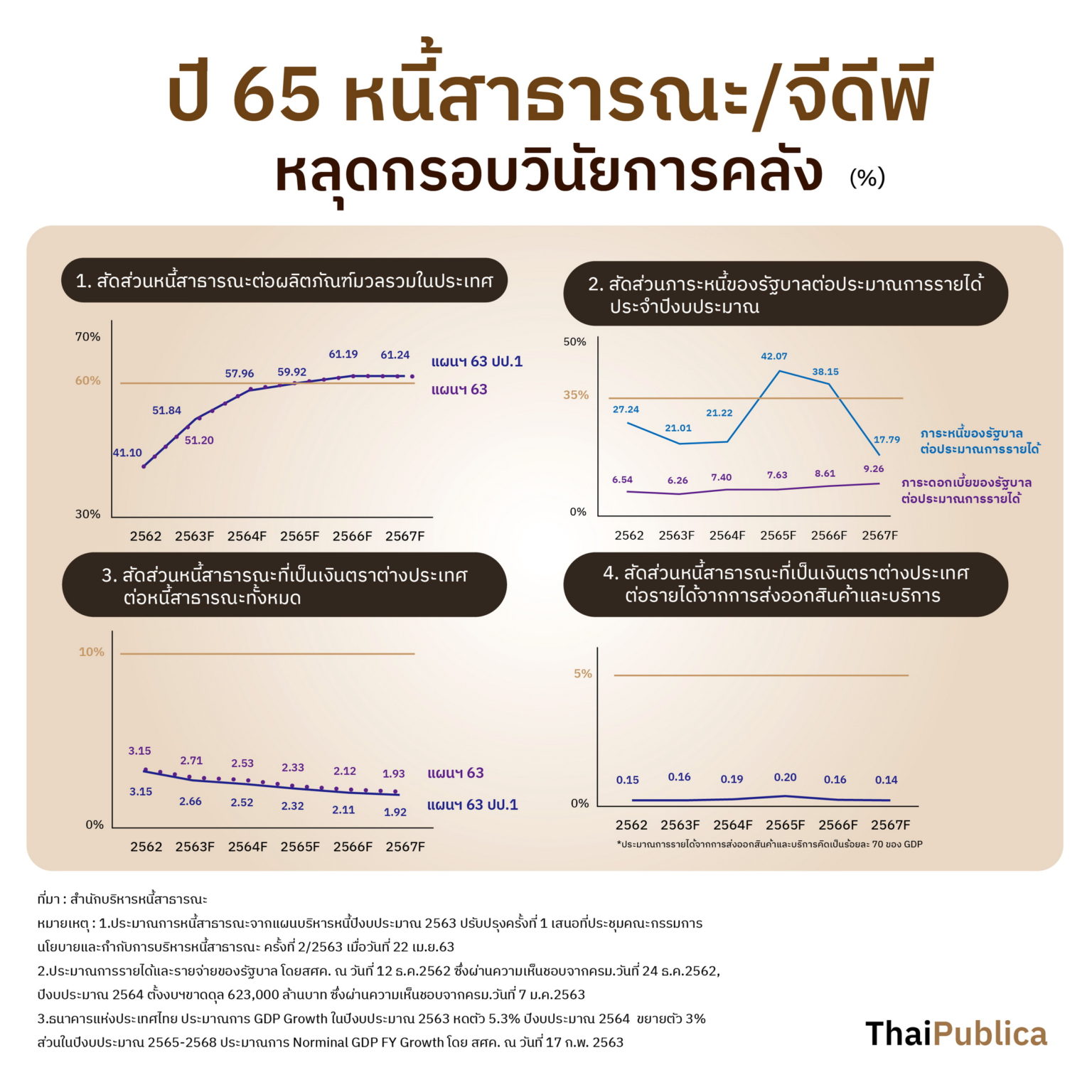
Furthermore, as the government continues to borrow large amounts from fiscal year 2020 to fiscal year 2021, even though market interest rates are low, the substantial borrowing will increase the government's interest payment burden, while government revenue collection is expected to decline due to the economic contraction caused by COVID-19. This will result in the government's debt burden ratio to projected revenue exceeding the legal fiscal discipline limit of 35%. In fiscal year 2021, the debt burden ratio is expected to be 21.22%, and in fiscal year 2022, it will rise to 42.07%, if the PDMO's estimates hold true. It is anticipated that the government may need to amend the fiscal discipline law again.
In addition to the rising public debt problem, the government has budgetary burdens from providing state financial institutions (state banks) to implement past state policy projects, known as “populism,” to assist low-income individuals, farmers, and SMEs, by allowing state banks to advance payments, with the government later allocating budgets to reimburse them.
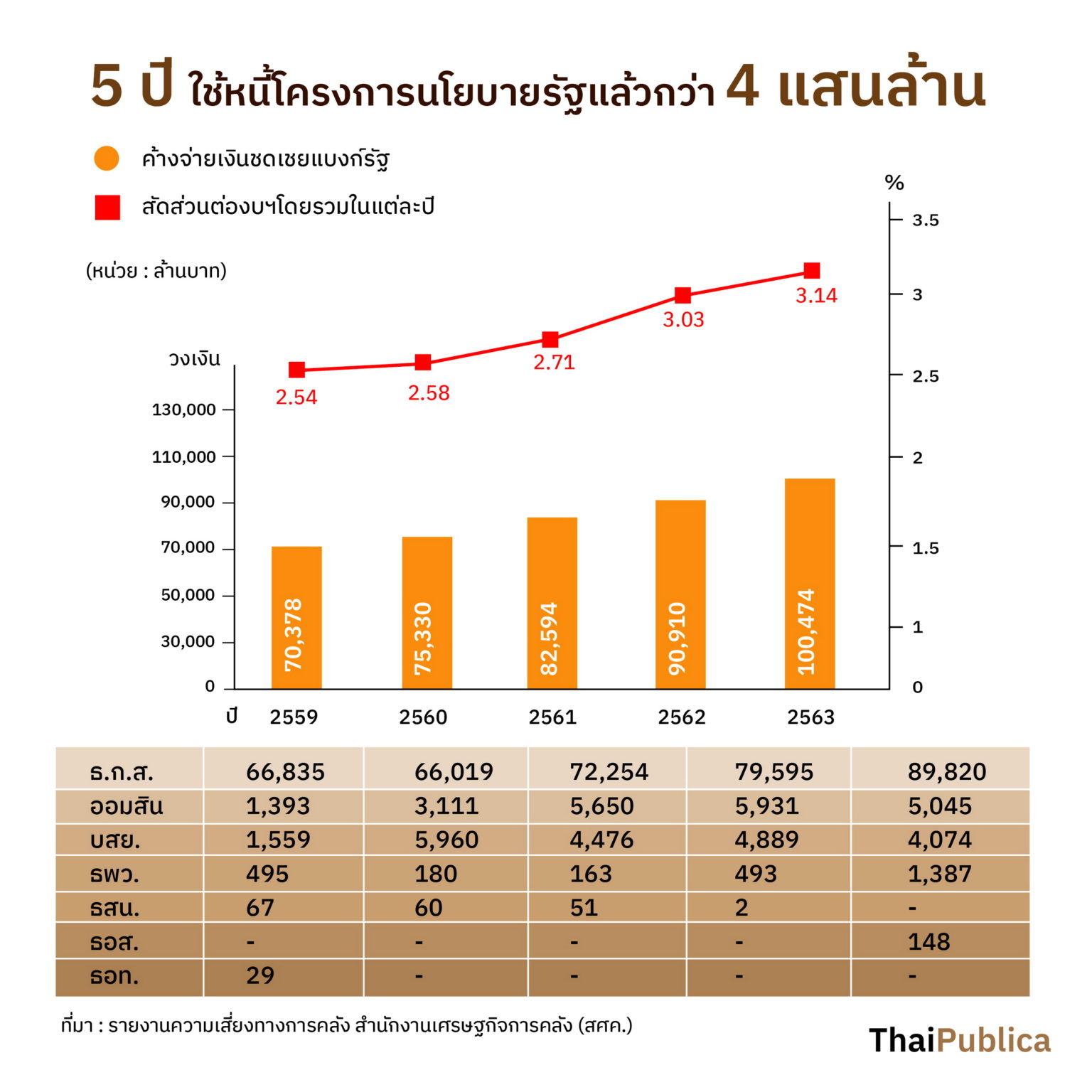
Over 400 Billion Baht Used for Populism Debt in 5 Years, with 800 Billion Baht Still Outstanding
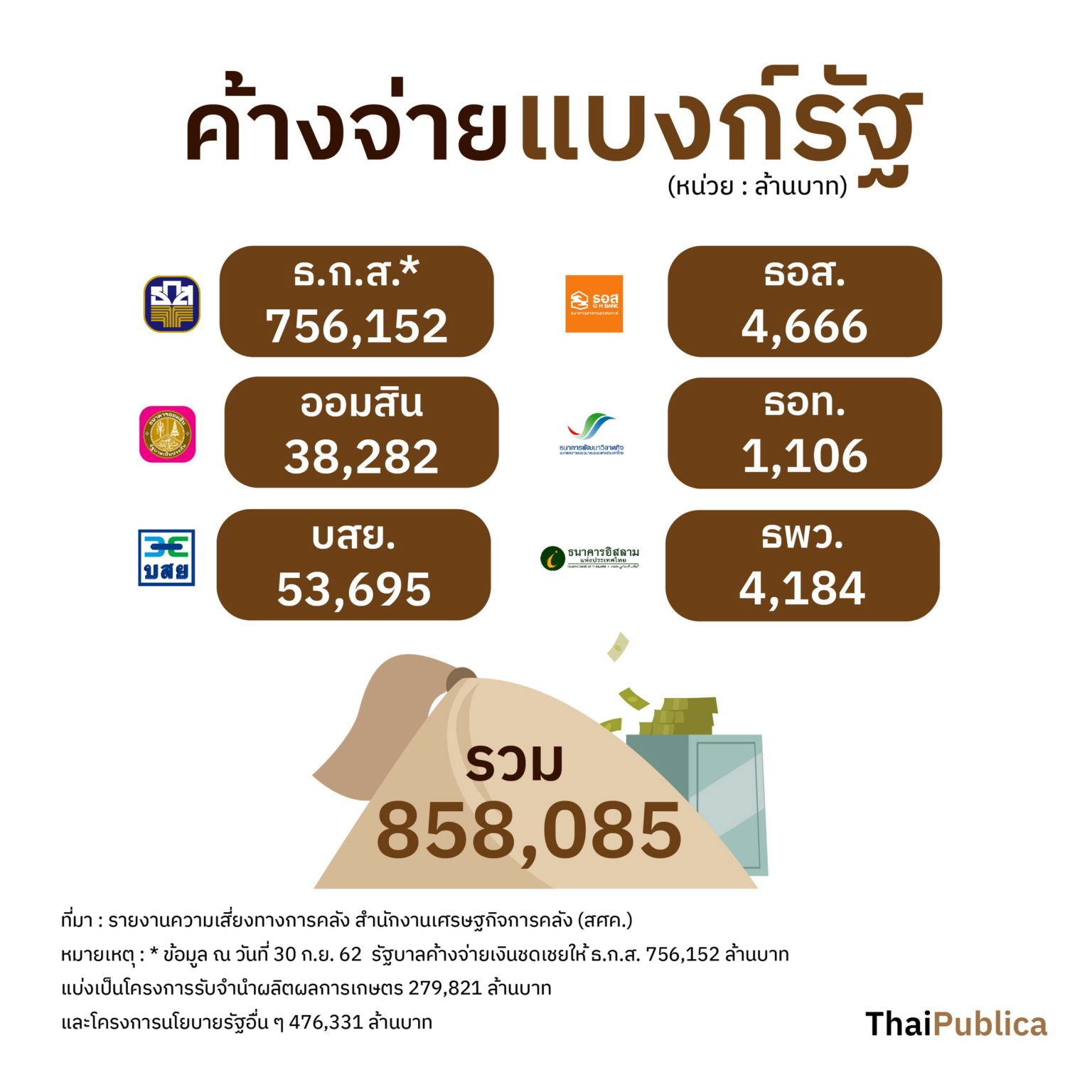
According to the fiscal risk report for the fiscal year 2019 prepared by the Fiscal Policy Office (FPO), it is evident that the government has continuously increased its budget allocation for state policy implementation every year. Over the past five years, the government has allocated a total of 419.686 billion baht to state banks. As of September 30, 2019, there remains an outstanding reimbursement of 858.085 billion baht owed to state banks for implementing state policy projects, accounting for 28.60% of the annual expenditure budget for 2019 (3 trillion baht). According to the fiscal discipline framework, the government is required to reimburse state agencies for implementing various measures under state policies, not exceeding 30% of the annual expenditure budget.
Debt Owed to BAAC Exceeds 700 Billion Baht
The financial institution with the largest outstanding reimbursement owed by the government for implementing state policy projects is the Bank for Agriculture and Agricultural Cooperatives (BAAC), totaling 756.152 billion baht. This includes 279.821 billion baht for the agricultural product pledging project and 476.331 billion baht for other state policy projects. Next is the Small Industry Credit Guarantee Corporation (SICGC) with outstanding reimbursements of 53.695 billion baht, followed by the Government Savings Bank with 53.695 billion baht, the Government Housing Bank with 4.666 billion baht, the Small and Medium Enterprise Development Bank of Thailand (SME Bank) with 4.184 billion baht, and the Islamic Bank of Thailand with 1.106 billion baht.
Budget Bureau Prepares to Allocate 450 Billion Baht for State Bank Debt Over 4 Years
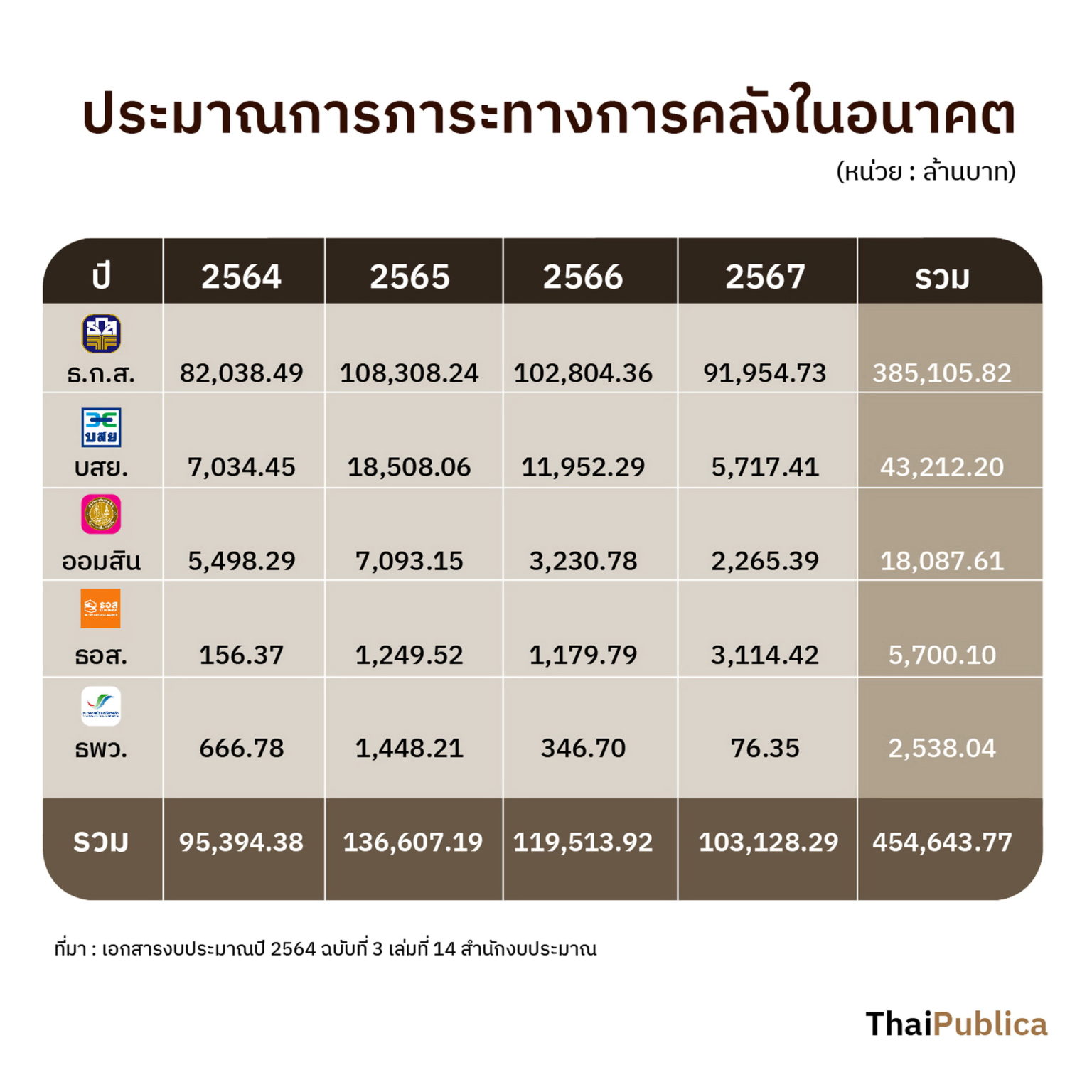
The Budget Bureau has estimated the budgetary burden that must be reimbursed to state banks for implementing state policy projects over the next four years, totaling 454.643 billion baht. In fiscal year 2021, the government will need to allocate 95.394 billion baht to reimburse state banks, in fiscal year 2022, 136.607 billion baht, in fiscal year 2023, 119.514 billion baht, and in fiscal year 2024, another 103.128 billion baht.
Total Outstanding Debt to State Banks and Social Security Approaches 1 Trillion Baht
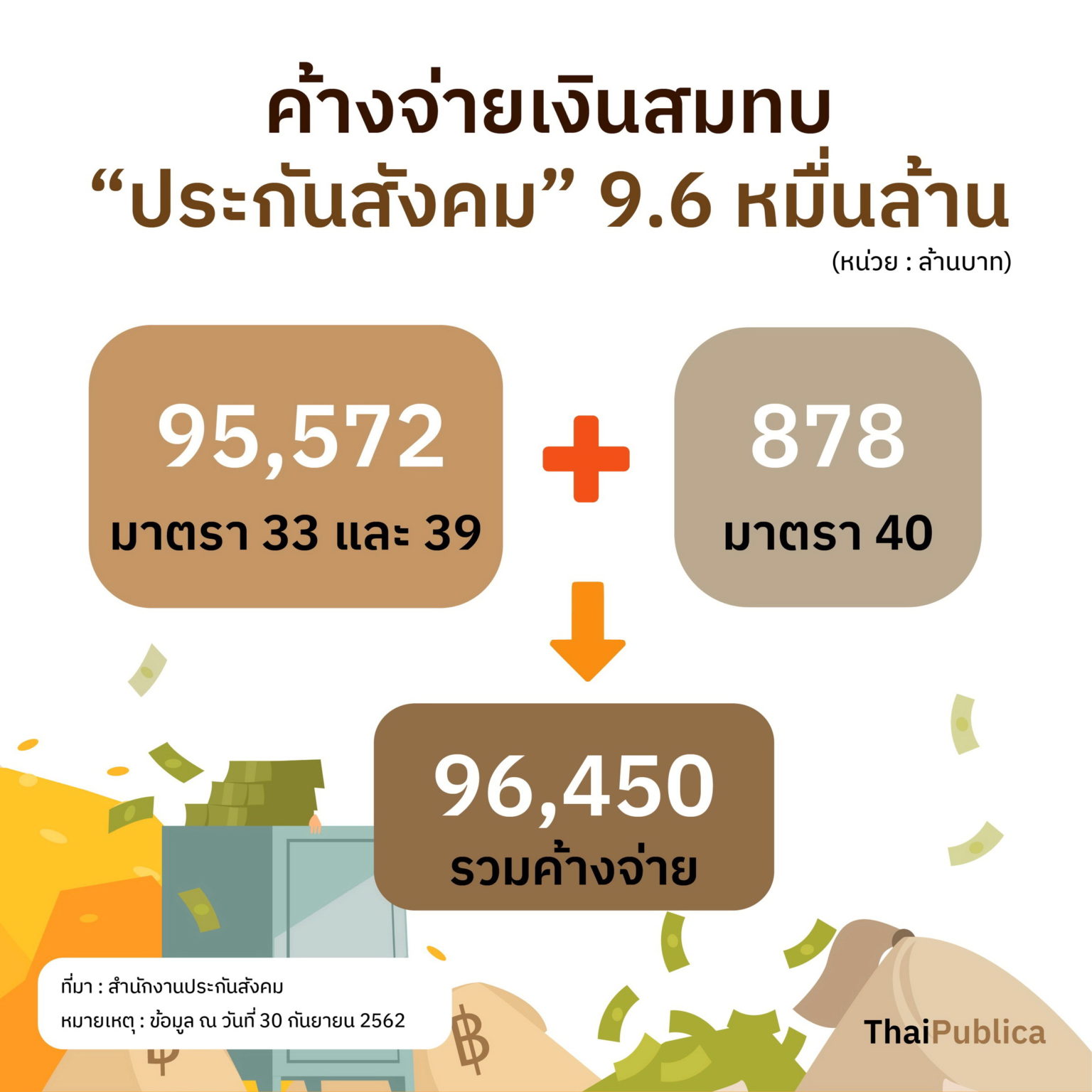
Additionally, the government has outstanding contributions to the Social Security Fund. According to the Social Security Act of 1990, contributions must be made by three parties: employers, employees, and the government, each time wages are paid. It has been found that the government has not allocated the budget to contribute to the Social Security Fund as legally required. According to the fiscal risk report from the FPO, as of September 30, 2019, the government had outstanding contributions to the Social Security Fund amounting to 96.450 billion baht, which includes outstanding contributions under Sections 33 and 39 of approximately 95.572 billion baht and outstanding contributions under Section 40 of 878 million baht. If combined with the outstanding reimbursement owed to state banks of 858.085 billion baht as of the end of September 2019, the government will have a total outstanding budgetary burden of approximately 954.535 billion baht. This does not include the debts of state enterprises, such as the State Railway of Thailand (SRT) and the Mass Rapid Transit Authority of Thailand (MRTA), which the government must bear according to Cabinet resolutions, amounting to another 239.893 billion baht, and it is currently unknown when the government will allocate a budget to reimburse these agencies.
Therefore, before the government pushes out new populist projects, it should consider old debts and various obligations to reduce future fiscal management risks.
SOURCE: thaipublica.org