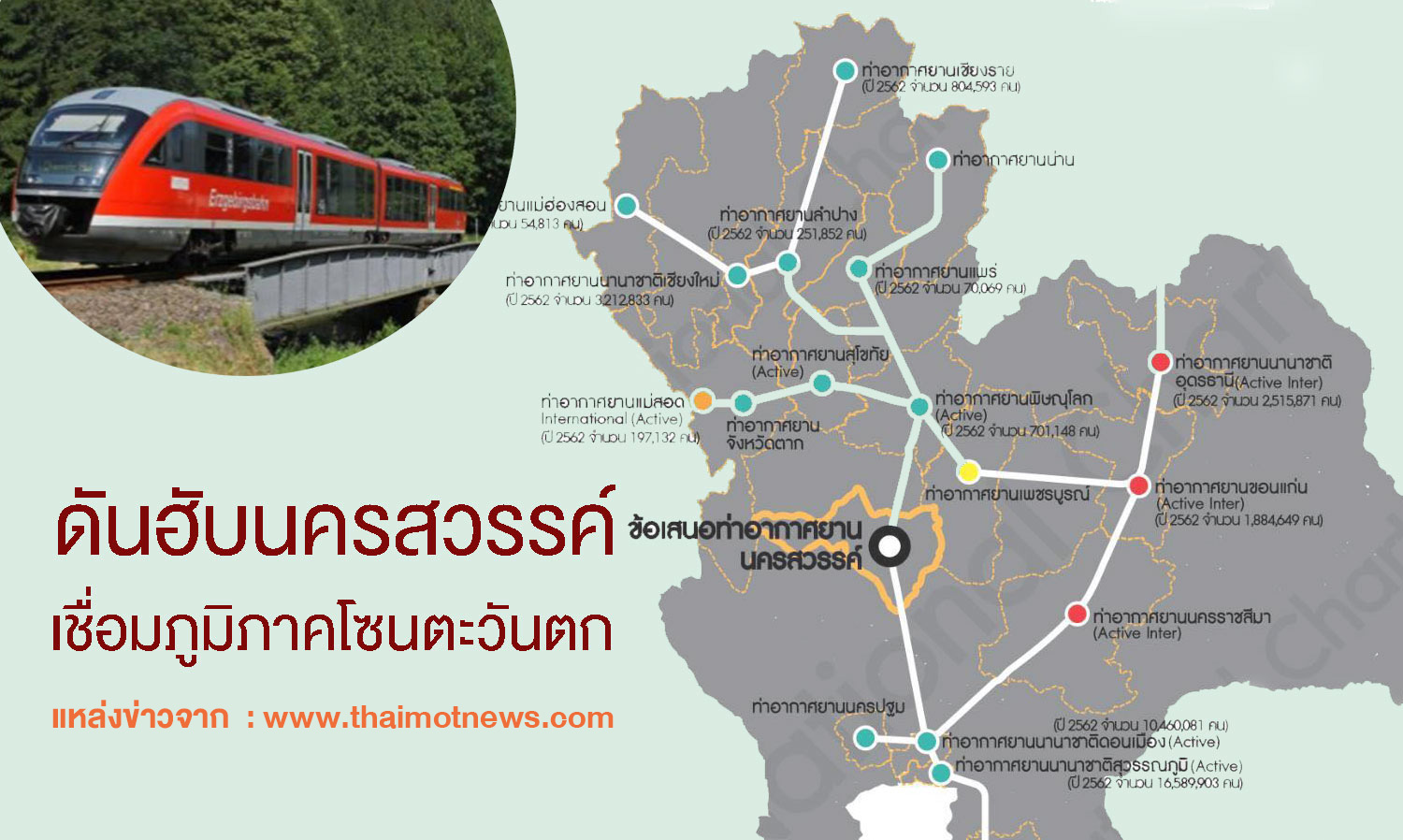
Nakhon Sawan Hub to Connect the Western Region
National Charter ignites the economic corridor in the western region, accelerating collaboration from all sectors to push Nakhon Sawan-Suphanburi as a central hub connecting rail and air systems. A new electric railway line connecting Nakhon Sawan-Uthai Thani-Chai Nat-Ang Thong-Sing Buri-Suphanburi-Ratchaburi to the south is being proposed to enhance the logistics system.
Mr. Thapana Boonyapravit, President of the Thai Town Planning Association and Secretary of the National Charter, revealed to UCD News that the meeting on the western economic corridor regarding the planning of rail transport infrastructure was held by the National Charter, Nakhon Sawan Municipality, and local industrial and commerce networks on August 26, 2020. The meeting summarized proposals for the development of the rail network, economic development, and driving progress as follows: In terms of transportation infrastructure, the meeting approved the proposal for relevant agencies to study, design, and develop two rail transport lines and an airport, including:
1.1 Dual-track railway from Phitsanulok-Sukhothai-Tak, connecting with the Nakhon Sawan-Mae Sot railway network at the Tak province junction (developing the connection point into a transport station linking rail and road travel).
1.2 Dual-track railway from Nakhon Sawan-Uthai Thani-Chai Nat-Sing Buri-Ang Thong-Suphanburi, connecting with the Suphanburi-Ratchaburi railway network as planned by the State Railway of Thailand (SRT), and 1.3 Nakhon Sawan Airport, covering 7,000 rai near Mahidol University, Nakhon Sawan campus.
The proposed network for study and design will promote urban and economic development in the western central region and the lower northern region, addressing the lack of rail transport in five provinces and enhancing connectivity for logistics in the western part of the country.
Regarding economic development, the focus is on elevating the provincial economic centers of 11 provinces, including Tak, Sukhothai, Phitsanulok, Phichit, Nakhon Sawan, Kamphaeng Phet, Uthai Thani, Chai Nat, Sing Buri, Ang Thong, and Suphanburi, as centers with potential for job creation, emphasizing innovative employment, reducing economic disparities, land utilization, and opportunities for improving quality of life. The mission to enhance the potential of economic centers will collaborate with chambers of commerce and industrial councils.
For tourism development, the focus is on various categories, including heritage city tourism, old towns and traditional communities, nature tourism, eco-agriculture tourism, conference tourism, and health tourism. Initial support has been requested from the Health Charter and the Safe Food Agriculture Charter of Nakhon Sawan to provide data and drive early development in collaboration with relevant agencies and local municipalities.
Currently, Nakhon Sawan Municipality is rapidly developing the Khamnan Song Rice Mill building (5,000 square meters) into a small conference center with 1,500 seats to serve as an MICE center.
In terms of health, agriculture, and food safety development, the National Charter will integrate the Health Charter with the Safe Food Agriculture Charter, intensively developing in three target municipalities: Nakhon Sawan, Chai Nat, and Suphanburi (with the possibility of considering Phitsanulok and Mae Sot municipalities). The health promotion area will be developed into a safe food zone along with smart city initiatives, involving hotel operators, accommodations, hospitals, and smart city service providers.
Additionally, the National Charter will collaborate with partner organizations to present information to local municipal executives, community leaders, and private sector leaders, along with submitting opinions to members of parliament and responsible ministers.
“In addition to the route connecting Nakhon Sawan to the Nong Pladuk junction in Ratchaburi, which will enhance logistics from the north to the southern gateway through maritime routes in Ranong, Chumphon, and Prachuap Khiri Khan, it is also necessary to develop the route from Ban Phachi station to connect to Suphanburi. This will open the southern maritime gateway from the northeastern region. Once everything is clear, we will present the driving plan to the responsible agencies, such as the State Railway of Thailand (SRT) and the Department of Airports. In September, there will be a meeting of local members of parliament, after which we will present to Mr. Saksayam Chidchob, the Minister of Transport, regarding both the railway and airport routes. Although the SRT has conducted preliminary feasibility studies, we still need to review the study results to clarify how they relate to the economic corridor research and what additional potential can be realized,”
Engaging Local MPs in Driving Progress
Mr. Thapana also mentioned that on August 31, Mr. Sorachat Sujit, a member of parliament for District 1 in Suphanburi, will discuss with the governor of Suphanburi and heads of government agencies to introduce the Sukuldee Innovation Group's electric train project, as planned by the National Charter to connect Suphanburi with provinces along the western economic corridor, especially from Pak Nam Pho station in Nakhon Sawan to Nong Pladuk junction in Ban Pong, Ratchaburi. Initially, electric locomotives, which the Sukuldee Group specializes in producing, will be used to create awareness of the comprehensive development plan.
“The dual-track railway connecting from Ban Pong to Suphanburi and from Nakhon Sawan to Suphanburi will pass through Phichit, Chai Nat, Ang Thong, and Sing Buri, creating a new route in the area. The desired model is for the locomotives to use electric power for urban development, connecting all provinces to stimulate the economy effectively, serving both freight and passenger transport. Discussions with local MPs have already taken place in several provinces, and by September, the regional MPs of the western economic corridor will request a meeting with the Minister of Transport to push this matter forward,”
National Charter Focuses on Four Dimensions
Mr. Marut Siriko, Managing Director of AMR Asia Co., Ltd., added that the National Charter sees “Nakhon Sawan” as suitable to be the transportation hub of the region (upper central region-lower northern region) that can develop railway routes connecting to Suphanburi, extending to Ratchaburi and Kanchanaburi towards the south, and connecting to the deep-sea port in Dawei, Myanmar, which already has development plans in place.
Nakhon Sawan is suitable as a regional hub, as well as a trade gateway connecting to other countries through various routes. The provinces in the western zone have numerous economic products, so utilizing the rail system to maximize benefits beyond the current road system, which has significantly higher costs, is essential. The rail system can carry more, thus there is a collective idea to push for tangible results.
Igniting the “Health Hub” Concept
“This route, if connected to Mae Sot, Tak, and Kamphaeng Phet from Nakhon Sawan, can then extend to Ban Phai in Khon Kaen and further to Nakhon Phanom. When it connects with Chai Nat, Sing Buri, Ang Thong, Suphanburi to Ratchaburi, it will open a gateway to the south without passing through Bangkok to reach Laem Chabang. Additionally, there is another dimension beyond being an economic hub; it can also serve as a health service hub or medical center, accommodating both Thai and foreign patients. Thus, this will drive the economic recovery through four dimensions: Dimension 1 as a health (wellness) economic center, Dimension 2 as a center for agricultural trade products, Dimension 3 as a center for related industries, such as agricultural industries, and Dimension 4 as a transportation hub, allowing Nakhon Sawan to connect to those regions without relying solely on Don Mueang or Suvarnabhumi airports,”
Supporting Development of the Pak Nam Pho Hub
Importantly, it is believed that if the focus is on the health center, the rail system will emphasize passenger transport more. The agricultural strengths of many provinces in this zone can also progress by reducing logistics costs as much as possible. Therefore, having dual-track railways and connecting railways, such as high-speed trains, would be an ideal solution.
“Pak Nam Pho station, covering several thousand rai, is well-suited for developing a distribution center. It is only 2 km from Nakhon Sawan city. Thus, the hub at Pak Nam Pho is crucial as it can connect to various other routes. Therefore, having the high-speed train station in Chai Nat would mean losing the opportunity for Nakhon Sawan to be an economic center. If Pak Nam Pho becomes the connection point for the high-speed train and the dual-track railway from Mae Sot, Tak, and Kamphaeng Phet passing through Nakhon Sawan, and the route from Nakhon Sawan to Suphanburi-Ratchaburi, it would create three highly potential economic connection points. Importantly, the western economic corridor will also create logistical capabilities to both coasts without wasting budget on extensive canal or canal construction, thus using the rail system along the western economic corridor to address those issues would be a better solution,”
Thank you for the information from www.terrabkk.com/%20https: www.thaimotnews.com/01-30-08/