Warning for Thai Economy: Prepare for Changes in 'Global Wealth'
The Department of International Trade Promotion is closely monitoring the rapidly growing Chinese market, pushing for exports and seeking high-tech products to supply the market, positioning Thailand as a global supply base in both agriculture and industry. Meanwhile, the private sector in the electronics group indicates that Chinese capital is rapidly entering Thailand to escape the impacts of the trade war.
The Department of International Trade Promotion is closely monitoring the rapidly growing Chinese market, pushing for exports and seeking high-tech products to supply the market, positioning Thailand as a global supply base in both agriculture and industry. Meanwhile, the private sector in the electronics group indicates that Chinese capital is rapidly entering Thailand to escape the impacts of the trade war, benefiting Thai exports in terms of capital, technology, and revenue.
The engine driving Thailand's economy, namely "exports," which account for 70% of GDP, is currently in a coma. However, amidst various concerns, it has been found that the Chinese market has shown a high and continuous growth rate in exports for several months, which may be a hope to revive the export engine and drive the economy.
Mr. Somdej Susomboon, Director-General of the Department of International Trade Promotion revealed that the Chinese market has a consistently good export trend and is expected to be one of the markets with positive growth this year, although it is currently not possible to determine the exact growth rate.
The reasons for the improving export trend to China can be divided into two parts: first, the increased demand for goods following the lifting of lockdowns, leading to a continuous rise in exports of food, agricultural products, fresh vegetables and fruits, and daily necessities. The second reason is that international supply chains are now operational again, leading to a resurgence in demand for raw materials and equipment across various industries, particularly in electronics and automotive parts.
"We are looking at whether the new materials and equipment that China is importing can be developed into export products, as the increase in imports from Thailand is due to supply issues from some countries that are still unable to produce and export, unlike Thailand, which has received orders first."
China Still Not Fully Engaging in Exports
However, even though the export trend to China is improving, it cannot replace overall exports, as China accounts for an average of 11% of total exports. Therefore, other markets in the same group, such as South Korea, Japan, and Taiwan, are being considered, as the COVID-19 situation is improving and there is increasing demand from consumption, with production of various goods starting to resume. Factories are reopening, presenting an opportunity for Thailand not only to export finished goods but also to integrate into the supply chains of these countries. Initially, the focus will be on new technology products, including electronics and automotive parts, while continuing to maintain agricultural and food products.
Mr. Suphap Suwanpimolkul, Secretary-General of the Electrical and Electronics Industry and Telecommunications Group, Federation of Thai Industries (FTI) stated that in the electronics sector, exports are expected to grow by no less than 5% this year, which is a continuous growth. If there were no COVID-19, it is believed that growth would be even higher.
This is because major electronic component manufacturers, such as hard disk drive producers, have closed factories in Malaysia and expanded production capacity solely in Thailand in this region, leading to significant growth in hard disk drive exports to meet the demand of the New Normal, where communication is increasingly conducted via the internet. Other electronic devices are relatively stable, following a global market slowdown, while electrical appliances are expected to see a nearly 10% decline in exports this year due to the global market slowdown.
Chinese Capital Boosting Thai Exports
However, due to the trade war between China and the United States and the relocation of production bases due to COVID-19 impacts, it is expected to positively affect Thailand's electrical and electronics industries in both the short and long term, particularly regarding investment. Many Chinese entrepreneurs are expanding their production bases into Thailand, with large companies establishing production bases in Thailand, either through joint ventures with Thai partners or investing independently. This will lead to the establishment of their own supply chain component manufacturers setting up factories in Thailand, both for high-tech equipment and general electronic devices.
Additionally, this will positively impact the export of electrical appliances and electronics from Thailand, as China's expansion of production bases into Thailand will also lead to growth in Thai exports. China is rapidly investing in Thailand, with some companies hastily relocating machinery from China to Thailand, enabling production to commence within six months to supply products to U.S. customers before losing existing clients. There are also increasing orders from the U.S. because products exported from China to the U.S. face a high tariff of up to 25%, necessitating the import of electronic components from Thai manufacturers to replace goods from China.
The entry of Chinese electronic component manufacturers following their parent companies into Thailand has significantly impacted Thai component manufacturers. Therefore, the government should implement measures to support Thai SMEs to enhance their competitiveness and technology against foreign investors, such as providing tax incentives for Thai SMEs across all industries.
Concerns About SMEs Competing Against Chinese Capital
Currently, the Board of Investment (BOI) grants maximum tax incentives only to industries in the new S-curve category, while non-target industries receive fewer tax exemptions. If the government assists SMEs in this regard, it will help them elevate from small to medium and large businesses in the future.
"Chinese investors are eager to expand their production bases in Thailand, bringing both technology and investment into the country, which will elevate Thailand's technology, as Chinese investors are usually not protective of technology and feel comfortable and secure investing in Thailand."
Mr. Wisit Limluecha, Vice President of the Thai National Shippers' Council (TNSC) and President of the Ready-to-Eat Food Association stated that exports to China in the second half of the year are expected to grow by no less than 5% due to China's relaxation of lockdown measures from the COVID-19 situation, with the production and business sectors in China starting to reopen, leading to increased demand for consumer goods and raw materials. This presents an opportunity for Thai products to be exported to China.
Warning of Negative Factors in the Second Half of the Year
However, even though the Chinese market looks bright in the second half of the year, other factors that may impact it must be considered, such as a potential second wave of COVID-19 and the ongoing trade war between the U.S. and China, which may provide Thailand with some benefits, such as the creation of new supply chains within ASEAN, particularly in the electronics industry. This can be seen from the increasing trade value, direct investment, and shipping to ASEAN countries.
Additionally, the recent trade agreement adjustments between China and ASEAN since October have reduced barriers between them in terms of rules regarding product origin, exchange rates, services, investment, and others, which may support trade and exports to China.
For the food industry exporting to China, it is considered very prominent and continues to grow well, especially in the categories of fresh vegetables, fresh fruits, chilled, frozen, and processed foods, due to the advantage of popularity among Chinese consumers. Furthermore, the transportation distance from Thailand to China is relatively short, allowing fresh fruits or foods to maintain good quality. Although there have been several border checkpoints closed, these issues have been resolved.
"It is expected that in the second half of the year, the opportunity for food exports will continue to grow well, similar to the first half, with the potential for further expansion due to consumer demand, especially as the online market in China is rapidly expanding, allowing consumers to conveniently order food online through various platforms."
Chinese FDI Rises to Number 1
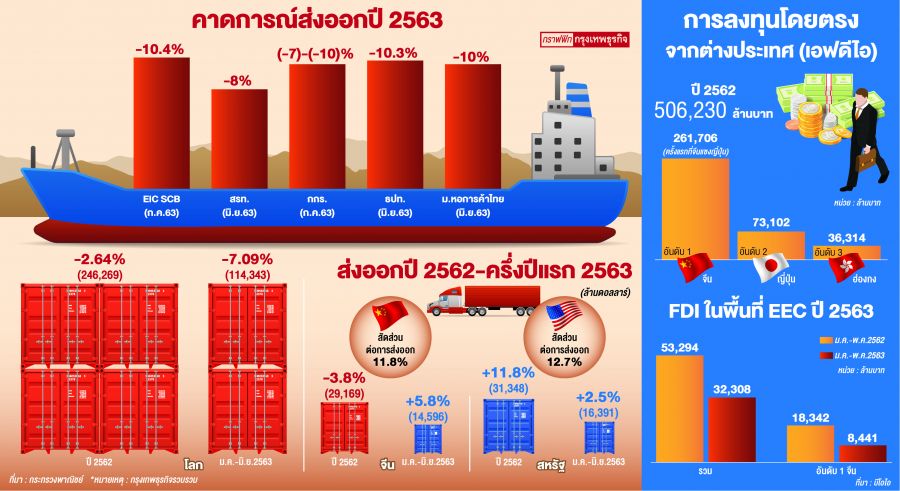
Previously, the meeting of the Eastern Economic Corridor (EEC) Policy Committee, chaired by Prime Minister Prayuth Chan-o-cha, acknowledged the investment situation in Thailand, noting that investment in the EEC area during the first five months of the year (January-May 2020) was affected by the COVID-19 outbreak, resulting in a 10% decrease in investment promotion applications compared to 2019, but this decline was less than the overall national investment promotion applications, which dropped by 27%.
The total value of investment promotion applications in the EEC during the first five months of this year was 32 billion baht, down from 53 billion baht during the same period last year. The top five countries applying for investment promotion in the EEC are: 1. China 8.441 billion baht, 2. Japan 8.114 billion baht, 3. Singapore 6.632 billion baht, 4. Netherlands 6.301 billion baht, and 5. Taiwan 6.126 billion baht.
SOURCE : www.bangkokbiznews.com