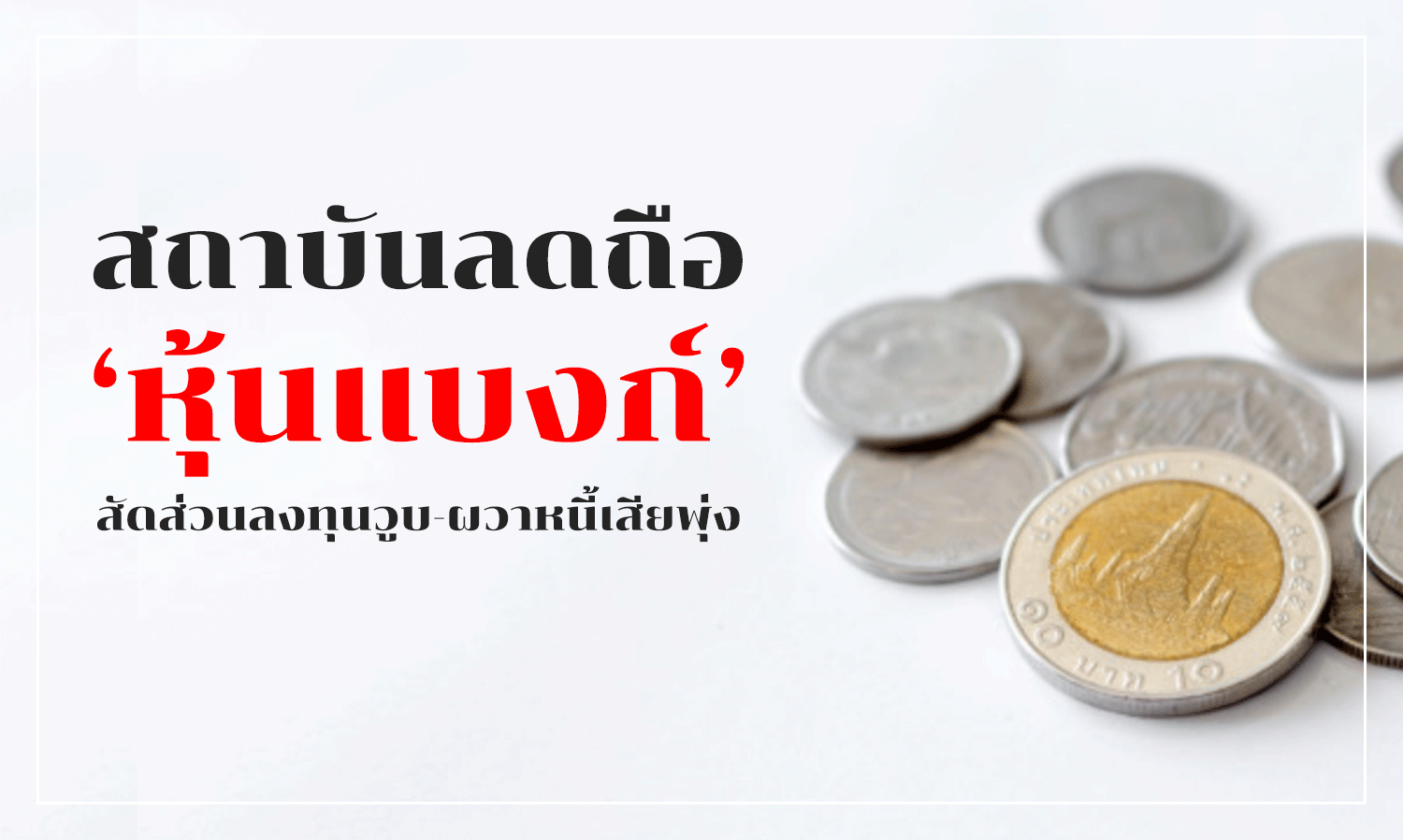
Institutions Reduce 'Bank Stocks' as Investment Proportions Plummet Amid Rising Bad Debt Fears
The commercial banking sector continues to be the most significantly declining business group in terms of average stock prices this year. As of July 20, 2020, the banking index was down 36.62%, compared to the SET index, which decreased by 14.02% across all 11 companies in the sector.
Only CIMB Thai Bank Public Company Limited (CIMBT) saw its stock price remain positive at 11.32%, while the stock prices of major banks fell by 30 – 40%. Overall, this has caused the market capitalization of the banking sector to drop to 1.23 trillion baht, a decrease of 700 billion baht.
The continuous decline in bank stock prices reflects persistent selling pressure that has weighed on stock prices recently, particularly among larger banks.
An examination of major shareholders in each bank as of the latest book closing date in 2020, compared to the last book closing date in 2019, revealed that TISCO Financial Group Public Company Limited (TISCO) experienced the largest reduction in shareholding proportions, from 505.76 million shares to 408.49 million shares, a decrease of 19.23%, affecting both domestic and foreign investors.
Domestic institutional investors who sold TISCO shares include the Social Security Office, which reduced its stake to 1.86% from 3.13%, and the Krungsri Long-Term Dividend Fund, which decreased to 1.95% from 2.78%. Foreign investors also reduced their stakes, with Thai NVDR decreasing to 11.17% from 13.34%.
Meanwhile, the proportion of major shareholders in Bangkok Bank (BBL) decreased significantly, ranking second, from 1.16 billion shares to 1.01 billion shares, a drop of 13.01%. This was primarily due to a reduction by Thai NVDR, which decreased its holding from 31.12% to 23.5%. However, the second and third largest shareholders, South East Asia UK and the Social Security Office, increased their stakes to 5.17% and 4.5%, respectively.
Additionally, among medium and large banks, Siam Commercial Bank (SCB), Kasikorn Bank (KBANK), and Kiatnakin Bank (KKP) also saw reductions in major shareholder holdings, primarily due to selling pressure from foreign investors, especially through Thai NVDR, while the Social Security Office increased its holdings in SCB and KBANK.
Banks that saw an increase in major shareholder holdings include Krung Thai Bank (KTB), which increased by 2.64%, Thai Military Bank (TMB), which rose by 46.48%, and TMBThanachart Bank Public Company Limited (TCAP), which increased by 3.23%, mainly due to mergers. Meanwhile, LH Financial Group Public Company Limited (LHFG) increased by 1.6%, while Krungsri Bank (BAY) and CIMBT maintained their proportions.
Korakot Sawetkruat, Assistant Director of Securities Analysis at Kasikorn Securities, stated that the current proportion of institutional investor holdings is relatively low, reducing the likelihood of heavy selling. Although the business outlook remains risky, current stock values are also quite low.
In terms of business, it is believed that pre-provision profits have likely passed their lowest point during the lockdown, suggesting some recovery in the second half of the year. However, when considering net profits, it is necessary to look at two groups: banks that have already made significant provisions in the second quarter may see a recovery in the second half, while banks that have not provisioned much may experience a decline in profits in the second half once debt moratorium measures end.
"It can be seen that bank stock prices have not dropped significantly even after announcing poor profits, partly because current stock prices are already quite low, trading at 0.5 times book value or around -2.5 standard deviations. If the situation worsens, bank stock prices could face a downside risk of about 10-15%. Conversely, if the situation does not deteriorate significantly, there is a chance that bank stock prices could trade back at -2 standard deviations, offering an upside of 30-35%."
SOURCE : www.bangkokbiznews.com