'What Can the Thai Economy Do to Compete with Vietnam?'
The median GDP growth forecast for Thailand from Bloomberg this year is -6.0%, the lowest in Southeast Asia. The only country expected to see economic growth is Vietnam. Therefore, the question of what Thailand can do to compete with Vietnam should shift to how we can survive with the least damage possible.
Recently, global economists surveyed by Bloomberg estimated Thailand's GDP growth for 2020 to be -6.0%, with a projected recovery to +4.0% next year. The most pessimistic forecast comes from Krungsri, predicting a decline of -10.3%, while Standard Chartered is the most optimistic at -5.0%.
- Is a decline of -5.0% to -10.3% considered bad?
We should compare this with other countries surveyed by Bloomberg, which shows that Thailand's economy is indeed in a concerning position. The median GDP growth of -6.0% is the lowest in Southeast Asia, while Singapore, currently facing a second wave of COVID-19, is projected to have a lesser decline at -5.7%.
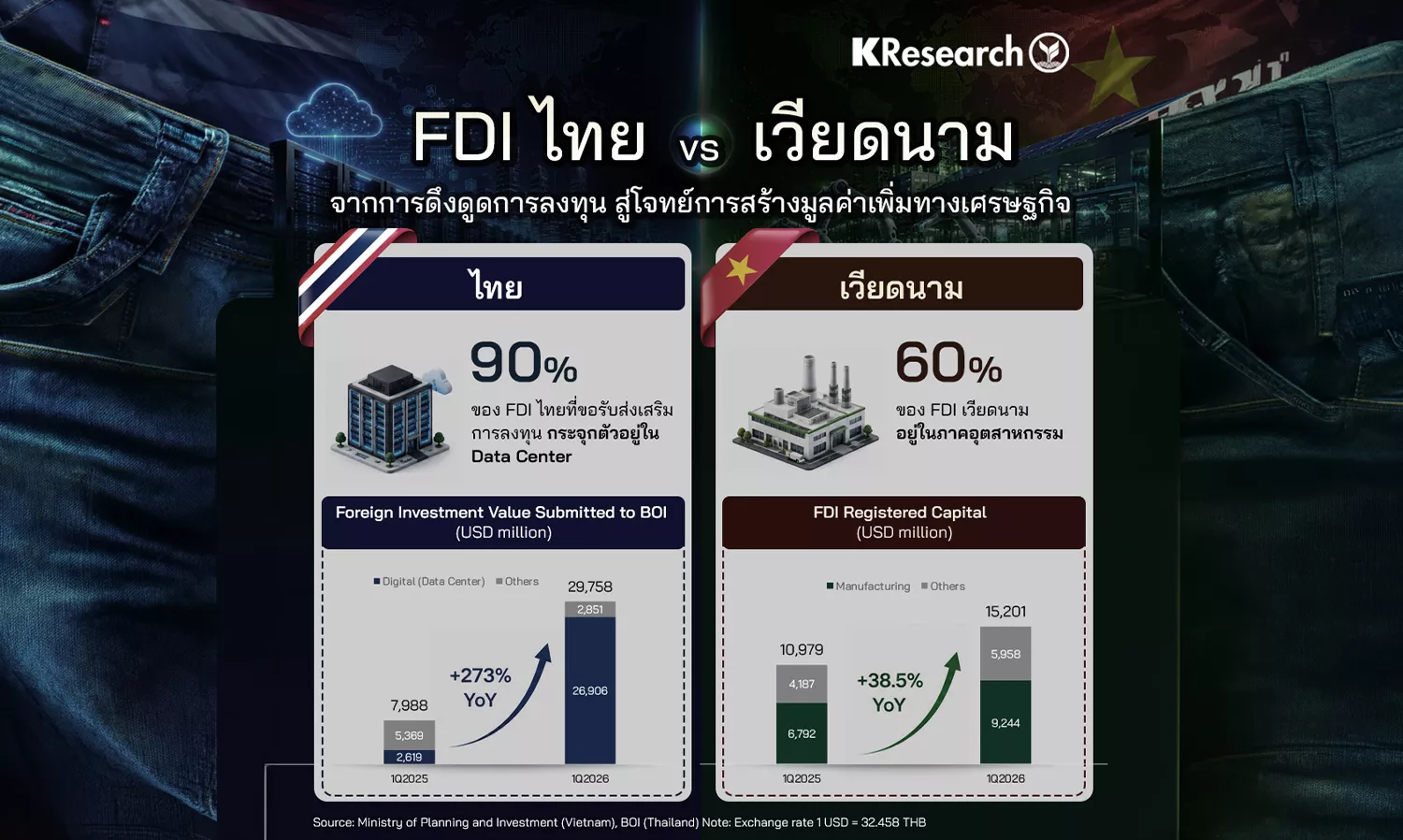
The only country in the region expected to experience positive economic growth this year is Vietnam, with economists predicting a growth of +2.8% and +8.1% in 2021.
- What differentiates Thailand's economy from Vietnam's, especially in a crisis like the current one?
Vietnam has fully benefited from the trade conflict between the U.S. and China, as well as the emergence of COVID-19, prompting businesses to change their supply chains and relocate production from China to other countries. They find better tax incentives and lower labor costs compared to relocating to Thailand, along with a large, skilled workforce.
- What are the reasons behind Thailand's severe economic decline this year?
The Thai economy relies heavily on exports, accounting for nearly 70% of GDP. With the global COVID-19 pandemic causing supply chain issues, transportation and production have become increasingly difficult. As lockdowns extend and the outbreak worsens, consumer spending has decreased, leading to a slowdown in demand for goods and services. This is the first issue.
Another factor exacerbating exports is that, although the Thai baht has weakened from 30.80 THB/USD to 31.39 THB/USD (as of July 13, 2020), it has actually strengthened since early April, rising from a low of 33.09 THB/USD by more than -5%. This means our exported goods are not cheaper in the eyes of buyers.
Another major concern is the tourism sector. With COVID-19 still spreading, even if the situation improves in the future, Thailand is likely to maintain a 14-day quarantine for international travelers, resulting in fewer tourists in the near future.
Combined with the global decline in tourism due to the impending global recession, it will take at least two years for the number of tourists to return to the pre-COVID level of 39.79 million by the end of 2019.
Regarding supply in the tourism industry, there are also concerns. Airlines have downsized their operations, reducing staff, cutting costs, and decreasing the number of aircraft. This means that when recovery begins, it will take longer to reach pre-COVID levels. Safety measures like social distancing will further reduce flight capacity. A short-term solution many airlines are adopting is to raise ticket prices, but with passenger numbers down by nearly half, this may not lead to profitability.
Households and the private sector, especially SMEs, which are the backbone of the economy, are facing financial challenges due to pre-existing high debt levels. As debt repayment measures come to an end in Q3, will bank customers (debtors) be able to resume payments?
The decline in domestic demand makes it difficult for businesses to raise prices to increase margins. They may need to lower prices to attract customers, but it is easier for them to cut costs by reducing rental space and staff. However, mass layoffs will further decrease purchasing power.
At this point, regarding the question of what the Thai economy can do to compete with Vietnam, I think we should pause and instead ask how we can survive with the least damage possible. This is the challenge we need to address and find ways to sustain ourselves.
SOURCE: www.bangkokbiznews.com