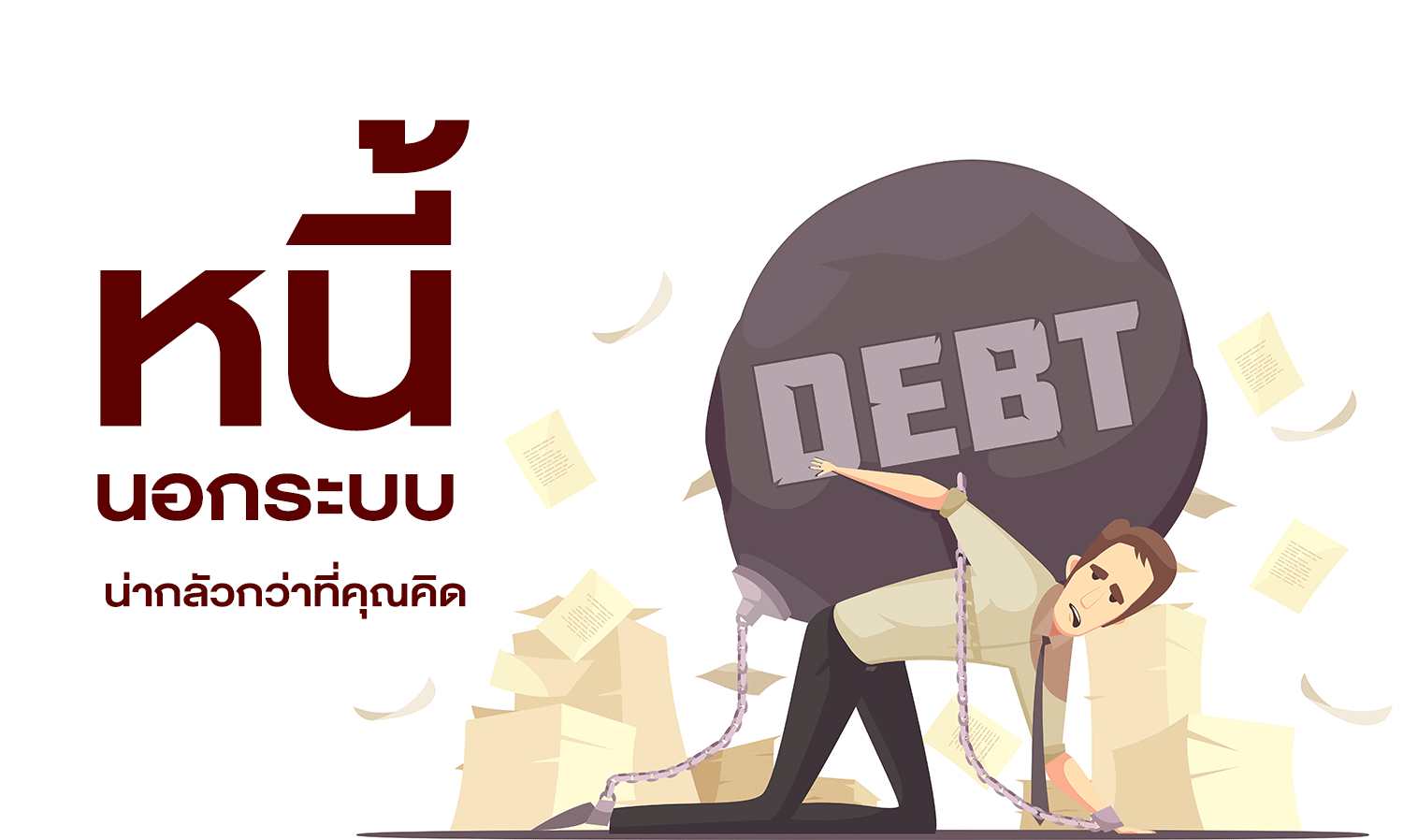
"Informal Debt" Is Scarier Than You Think
"Quick cash, easy loans, no credit check, no documents required, get cash immediately, contact 08X-XXXXXXX" Easy access to loans, but you might end up dead before you can pay it off! With the economy struggling and many unable to manage their finances, many fall victim to the traps of informal debt. Even though they may know it’s dangerous, a significant number still get ensnared, becoming slaves to the informal debt system, ruining their lives and potentially dragging their families and loved ones down with them. According to the Debt Relief Center and the Department of Special Investigation, there have been numerous complaints about unfair practices related to informal debt. From January 1, 2018, to November 24, 2019, there were 4,748 complaints made to the Prime Minister's Office via the hotline 4444. The central region had the highest number of complaints at 1,926, with Bangkok alone accounting for 663. Other regions included the Northeast with 766, the North with 516, the South with 449, the East with 414, and 677 complaints without specified provinces. Today, let’s take a closer look at the terrifying aspects of informal debt so that you don’t fall for the illusion of easy money, only to end up as a slave living in fear of ruthless debt collectors.
Extremely High Interest Rates
Think about it carefully; they advertise interest rates of only 20% per month. Daily payments seem manageable at just a few hundred baht. But wait! When you do the math, that translates to 240% annually, outpacing the principal by 3-4 times! Such high interest rates not only make it impossible to pay off the debt, but many end up borrowing more just to cover the interest, becoming lifelong slaves to debt. Let’s compare the interest rates of formal and informal loans, assuming a loan of 10,000 baht.
Formal debt: 1.75% interest per month, repaid over 12 months, total principal and interest = 12,100 baht (interest = 2,100 baht).
Informal debt: 20% interest per month, repaid over 12 months, total principal and interest = 34,000 baht (interest = 24,000 baht).
Floating Interest
Floating interest can occur if the debtor cannot repay the entire amount at once and can only pay the interest, causing the total amount owed to increase as both principal and interest accumulate. This financial burden grows over time, and what started as a few thousand baht can balloon into tens or hundreds of thousands when the debtor cannot repay.
No Clear Contracts
Informal loan agreements are often untraceable, lacking clear terms, and borrowers cannot negotiate with lenders. Additionally, borrowers receive no legal protection. In contrast, while formal loans may require more documentation and steps (which have become much easier and quicker in recent times), they offer more reliability and confidence in repayment for the borrower.
Potential Involvement in Illegal Activities
When borrowing from informal sources, you can never know where the lender's money comes from, which may be linked to illegal businesses. If you become entangled in such illegal activities, it may be difficult for the police or authorities to assist you promptly, as tracing informal loan networks is not easy.
The Lender Controls the Game
Lenders in the informal sector often know that borrowers are in desperate situations and will do anything to secure the loan on time. This leads to ambiguous or confusing loan conditions, leaving borrowers unaware of their actual debt. The lender is the only one who can interpret the agreement, turning the borrower into a mere pawn.
Harsh Debt Collection Practices
If a debtor defaults on payments, they often face threats, harassment, or humiliation. In many cases, physical harm, property damage, or even threats to family members or close friends occur.
Moreover, data from the Debt Relief Center and the Department of Special Investigation indicates that there are currently three types of scams from informal debt gangs:
1. Helmet Gang - This group lends money on a daily basis without contracts, often seizing credit cards, ID cards, or the guarantor's documents. They primarily lend to vendors in markets and are spread across all provinces. Many of these gangs share the same large funding source. Their frightening scams include:
- Charging "floating interest" - for example, lending 50,000 baht at 10% monthly interest, equating to 5,000 baht per month. The debtor must keep paying 5,000 baht monthly until they can repay the full principal of 50,000 baht, which is extremely difficult, resulting in the debtor being unable to escape the debt cycle and having to pay back much more than they borrowed or take out new loans to cover old debts, often at higher amounts.
- "Fall, 24-day payment" - for instance, borrowing 10,000 baht with 2,000 baht interest, totaling 12,000 baht, to be repaid over 24 days at 500 baht per day. If the debtor fails to pay on any given day, the lender cancels all previous payments, resetting the debtor's obligation to zero, forcing them to start over, making it impossible for many to escape debt.
2. Exploitative Contract Lenders - Most borrowers are farmers with land. Previously, the common practice was to sell land with a buy-back agreement, leading to short-term contracts that made it impossible for borrowers to raise funds to redeem their land. The land, worth much more than the loan amount, would then belong to the lender. However, after a major crackdown by the government in 2018 and the introduction of the "Land Sale Act for Agriculture," which imposed many regulations, the practice of selling land to seize it has decreased. Unfortunately, lenders have now devised new scams, requiring borrowers to "transfer land" to them before receiving funds. When the redemption period arrives, the borrower must repay the debt to get their land back (under a sale agreement), but what the borrower doesn’t realize is that the "ownership" of the land has fully transferred to the lender from the moment the land was given in exchange for the loan. Given that land value often exceeds the loan amount significantly, borrowers are often unwittingly cheated out of their land. When the redemption period ends, lenders may avoid accepting payments, claiming to be unavailable when the borrower comes to settle the final payment.
3. Online Loans - Targeting online sellers, corporate employees, and students. For online sellers, this involves a "share circle" lending scheme, where loan sharks check the credit history of online sellers and potential participants to assess their repayment ability and reliability. They then build rapport through chats and invite them to join a share circle, acting as the "share facilitator." The method resembles typical share schemes, but if any participant fails to pay, the facilitator encourages them to join another share circle to "borrow" funds to pay off the first circle.
This leads to increased debt for the borrower. Importantly, the facilitator also acts as an "informal lender." If a participant cannot pay, they can borrow from the facilitator. If the borrower fails to repay on time, they may face public shaming on Facebook or harassment directed at their loved ones and friends on Facebook, compelling them to repay quickly out of fear of being exposed. The reason lenders are not afraid of borrowers deactivating their Facebook accounts is that studies show online sellers are reluctant to lose their customer base on Facebook, while regular borrowers are accustomed to their existing Facebook networks and are hesitant to add new friends.
Informal debt is both frightening and dangerous. Besides being exploited financially, you risk losing your home, land, reputation, suffering physical harm, or even risking your life. It’s best to avoid getting involved.
SOURCE: www.scb.co.th