REIC Reveals State University and LTV Relaxation Help Sustain Real Estate, May Boost Transfer Volume by -0.20 to 7.3%

Mr. Wijai Wiratkhapan, Inspector of the Government Housing Bank and Acting Director of the Real Estate Information Center (REIC) stated that the real estate market in 2020 is expected to remain relatively stable compared to 2019, but there is a chance for growth of up to 5-7% if the overall economy improves, which would lead to job creation and increased confidence among potential homebuyers in their purchasing decisions.
Positive factors include low and declining interest rates, government stimulus measures for real estate, and the relaxation of LTV criteria by the Bank of Thailand (BoT). However, negative factors include an economic slowdown in several key sectors, the trade war between the U.S. and China, and the impact of the novel coronavirus (COVID-19), which is estimated to affect property transfers by -0.2% due to delays from Chinese clients. It is initially expected that around 7 billion baht of the total transfer value nationwide, which previously averaged 29 billion baht per year, will be lost.
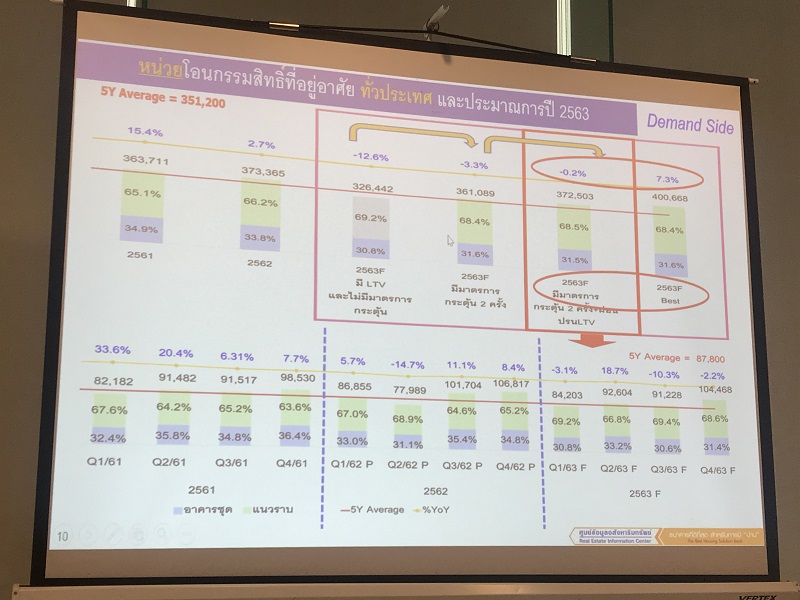
For the transfer of all types of residential properties nationwide, it is expected to be around 372,500-400,660 units, with growth ranging from -0.2% to 7.3%, and a total value of 853,100-917,100 million baht, reflecting growth of -2.5% to 4.8%. The transfers in Bangkok and its vicinity are expected to be around 197,500-214,300 units, growing between -0.2% to 8.3%, with a value of 571,200-614,000 million baht, reflecting growth of -0.2% to 7.3%. This represents 53% of the units and 67% of the total value of residential property transfers nationwide.
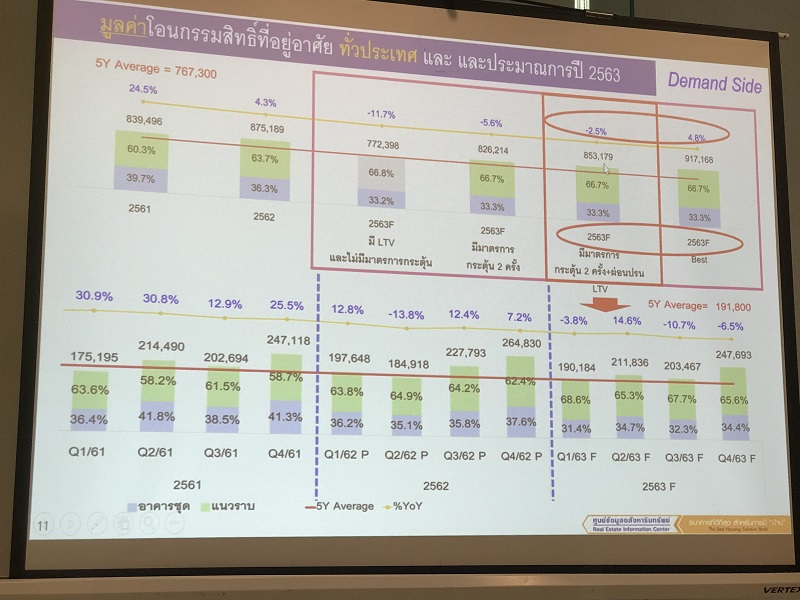
The transfer of condominium units nationwide is expected to be around 117,400-126,780 units, with a total value of approximately 284,360-305,700 million baht. In Bangkok and its vicinity, the proportion of condominium transfer units is 73.6%, and the value of transfers is 78.1%. In the first half of 2020, a slowdown in transfers from Chinese buyers is anticipated due to the virus outbreak, but the impact is expected to be minimal as Chinese buyers only account for 6% of all buyers.
The number of residential units from new project launches in Bangkok and its vicinity in 2020 is expected to be around 114,400-122,600 units, with condominiums making up about 55% or approximately 62,900 to 67,400 units. The number of nationwide allocation permits is expected to be similar to 2019, around 97,500 to 100,400 units, with approximately 58.4% in Bangkok and its vicinity.
The issuance of construction permits nationwide is estimated to be similar to 2019, around 292,100-300,900 units, with condominium construction permits making up approximately 27.4% or around 80,000 to 82,400 units. The number of construction permits in Bangkok and its vicinity is also expected to be similar to 2019 but may slightly exceed that, around 129,000 to 132,900 units, with condominium construction permits accounting for approximately 51.1% or around 65,900-67,900 units. This means that 82% of the condominium construction permits nationwide will be distributed in Bangkok and its vicinity.
As of the end of 2019, there were 258,000 units of available stock valued at approximately 1.37 trillion baht. If current measures remain in place (low and declining interest rates, along with government stimulus measures for real estate, including the relaxation of LTV criteria), it is expected that by the end of 2020, the stock will decrease to 218,000 units, with a total value of approximately 0.97 trillion baht.
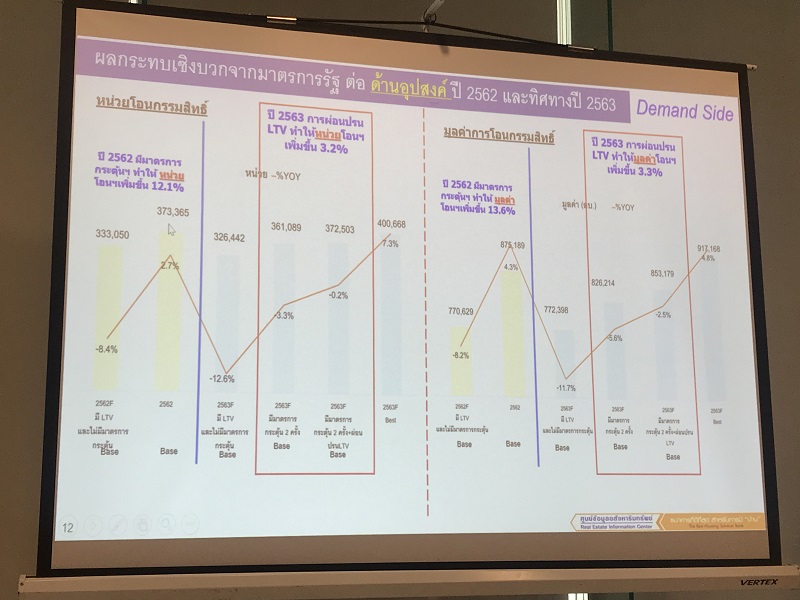

Mr. Parinya Patthanapakkadee, Chairman of the Real Estate Information Center stated that for 2020, the center will continue to provide information at three levels: policy level, real estate sector, and social level. The information and analysis results will be more aligned with the needs of data users. Recently, the center has utilized the data it has compiled to support all three levels continuously, as seen from the various government measures aimed at stimulating the real estate market in 2019, which yielded positive results. For instance, the value of property transfers in 2019 improved from a negative growth of -8.4% to a positive growth of 2.7%. In 2018, the center provided information to the public and real estate operators to clarify that there was no real estate bubble situation in Thailand at that time, and the trend for 2019 also indicated no bubble conditions.
Additionally, the center is preparing to elevate its role to become the National Real Estate Information Center, which will need to further develop in terms of "creating data connectivity to form a 'big data'" for multi-dimensional analysis and must serve as a Benefits Center to benefit all agencies and the general public from the data and analysis.