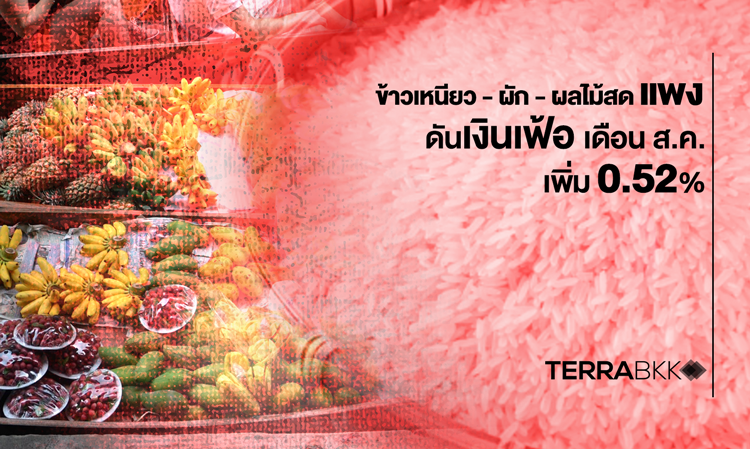
Sticky Rice and Fresh Fruits and Vegetables Drive Inflation Up 0.52% in August
The situation with agricultural products such as fresh vegetables and fruits, as well as sticky rice, has resulted in lower market supply, leading many to notice a significant increase in the prices of various fresh foods during this period.
Ms. Pimchanok Wonpattharak, Director of the Trade Policy and Strategy Office, Ministry of Commerce summarized the price situation of goods and services for August 2019, revealing that the Consumer Price Index (general inflation) compared to the same month last year increased by 0.52%, slowing down from 0.98% in the previous month. The fresh food category was a significant factor contributing to the inflation increase at a slowed rate of 5.15%, particularly for rice, sticky rice, pork, eggs, vegetables, and fruits. Meanwhile, the energy category continued to contract, decreasing by 5.16% due to the ongoing decline in global crude oil prices for four consecutive months. When excluding fresh food and energy, core inflation expanded at 0.49%. The average inflation for the first eight months (January-August) of 2019 compared to the same period in 2018 increased by 0.87%.
For the food and non-alcoholic beverage category, prices rose by 2.63%, with vegetables and fruits increasing by 7.23%. Fresh fruits (guava, mango, pineapple) saw an increase of 8.69%, while fresh vegetables (lime, fresh chili, raw papaya) rose by 4.99%. This is due to lower market supply combined with last year's relatively low price base, resulting in higher prices this year. Rice, flour, and flour products, particularly sticky rice and regular rice, increased by 7.06% due to low production volumes, contrasting with continuous demand. In terms of meat, duck, chicken, and seafood (pork, tilapia, grilled chicken) increased by 3.63%, while eggs and dairy products (chicken eggs, fresh milk, yogurt) rose by 1.82%, also due to lower market supply.
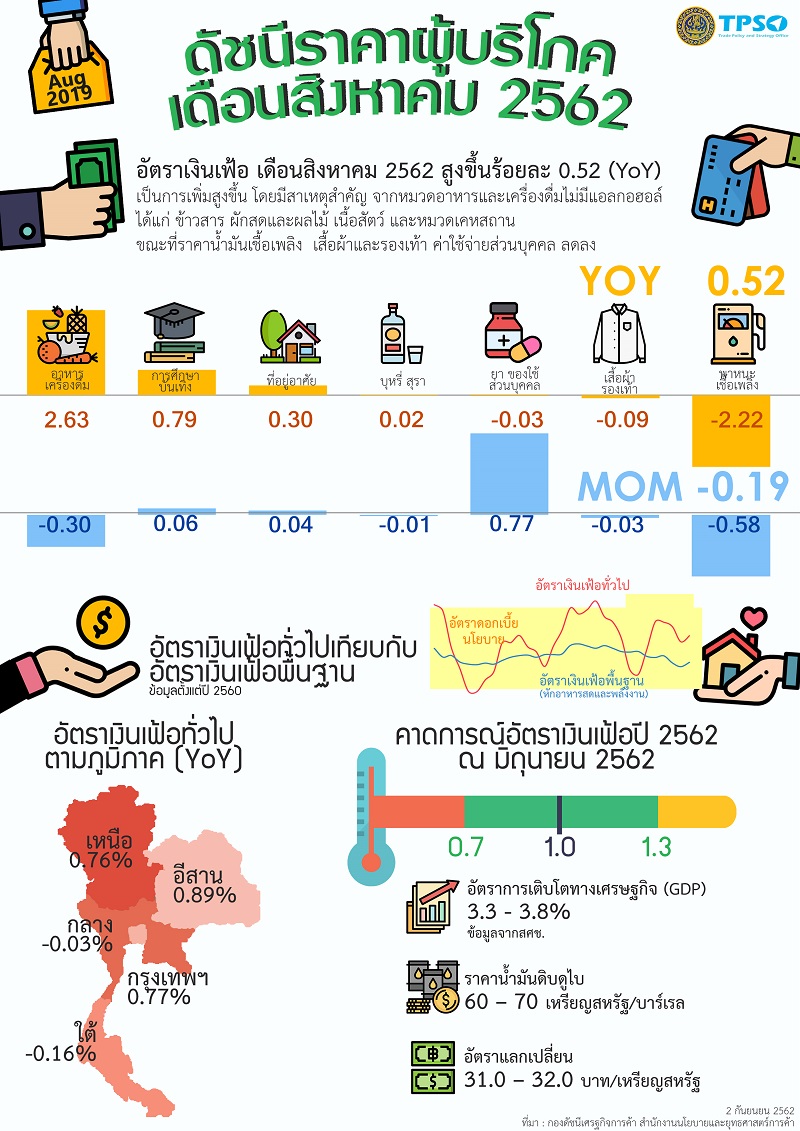
For food consumed at home and outside (ready-made dishes, breakfast, rice with curry), prices increased by 0.97% and 0.96%, respectively. Non-alcoholic beverages (hot/cold coffee, soft drinks, fruit juices) rose by 0.52%, while cooking ingredients decreased by 0.90%.
Other categories not related to food and beverages decreased by 0.67%, following a drop in all types of fuel prices, which fell by 8.15% (except for natural gas (NGV) and liquefied petroleum gas (LPG)). This led to a 2.22% decrease in transportation and communication categories, a 0.09% decrease in clothing and footwear (men's and women's shoes and clothing), and a 0.03% decrease in healthcare and personal services, particularly personal care items (body powder, soap, toothpaste) due to marketing promotions to boost sales.
Meanwhile, public transportation fares increased by 6.19%, housing costs (electricity bills, rent) rose by 0.30%, entertainment, reading, and education (travel expenses for visiting relatives and merit-making, tuition fees) increased by 0.79%, and tobacco and alcoholic beverages (liquor and beer) rose by 0.02%.
In total, among the 422 items used to calculate the inflation rate, 221 items saw price increases, while 112 items decreased in price, and 89 items remained stable. This resulted in an average inflation increase of 0.87% over the first eight months, remaining within the projected inflation range for the entire year of 0.7-1.3%. However, it is expected that this year’s inflation will grow by less than 1%, around 0.8-0.9%, as anticipated by the Bank of Thailand (BOT) and the Ministry of Finance, which expect growth of 1%. This is primarily due to the continuous decline in energy prices and relatively stable consumer goods prices, alongside signs of a slowdown in consumer demand or cautious spending behavior. However, there is no significant concern about deflation, as this decrease is attributed to falling fuel prices. Nevertheless, consumers still hold a positive outlook on the future economic situation, and the signs of economic slowdown are likely to have a limited impact on price stability.
It will be essential to monitor the government's economic stimulus measures in the second half of this year, with a budget of over 300 billion baht, including income guarantees for farmers and increased funds in the state welfare card, which are expected to stimulate both direct and indirect consumption, leading to better economic growth than in the first half of the year.