Thailand Hosts Major Meeting on 'ASEAN Smart Cities' to Develop 26 Smart Cities Aiming to Enhance Quality of Life with Technology
The Ministry of Digital Economy and Society (DE) in collaboration with the Ministry of Transport and the Ministry of Energy organized a meeting, bringing together 26 leading cities from 10 ASEAN countries, including Bangkok, Kuala Lumpur, Manila, and Singapore, to discuss key issues aimed at enhancing the quality of life for people in ASEAN through technology and innovation, while addressing challenges of rapid urban growth such as urban congestion, social inequality between urban and rural areas, and security.

Dr. Pichet Durongkaveroj, Minister of Digital Economy and Society stated that the development of smart cities has become a major topic of interest globally for economic and social development. Thailand has begun to seriously drive the development of smart cities and is committed to being a leader in this area in the region. However, in 2019, Thailand assumed the ASEAN chairmanship, and the Prime Minister expressed Thailand's intention to continue the ASEAN Smart Cities Network at the recent ASEAN Summit. Therefore, the Ministry, as the driver of smart city development policy in Thailand, organized the ASEAN Smart Cities Network (ASCN) Roundtable Meeting to align with Thailand's core concept of “Collaborate, Unite, Advance, Sustain” (Advancing Partnership for Sustainability).
Hosting the ASEAN Smart Cities Network (ASCN) Roundtable Meeting, held from June 6-7, 2019, aimed to reach a consensus among 26 leading cities from 10 ASEAN countries. This meeting continued from Singapore's presidency in 2018, selecting 26 leading cities to discuss standards for establishing smart cities, as well as exchanging knowledge, experiences, and successful case studies to serve as models for adaptation to each country's environment. The conclusions from this meeting will be analyzed by each country and brought back for further consensus at the ASCN Annual Meeting scheduled for August 2019, and reported at the 35th ASEAN Summit in November 2019, serving as a guideline for the ASCN cooperation framework moving forward.
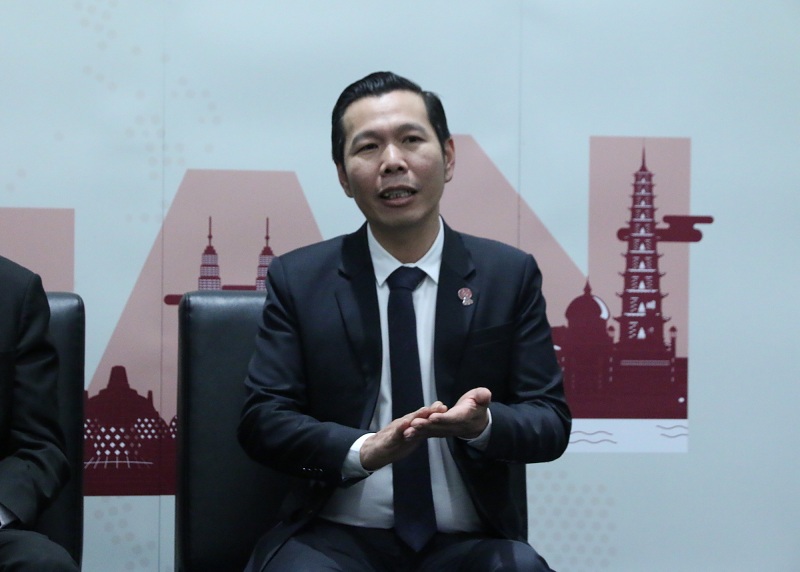
Dr. Natthaphol Nimmanphatcharin, Director of the Digital Economy Promotion Agency (DEPA) mentioned that the ASEAN Smart Cities Network (ASCN) is an initiative from Singapore during its ASEAN chairmanship in 2018, aimed at a common goal of sustainable smart city development. The main objective is to enhance the quality of life for people in ASEAN through technology and innovation to address rapid urban growth issues such as urban congestion, water and air quality, poverty, increasing inequality, and security for the people.
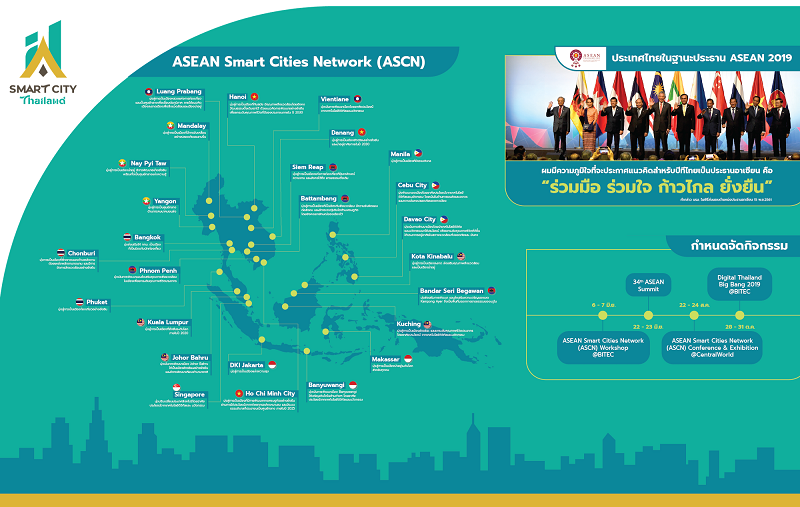
Currently, the ASCN comprises 26 cities from all ASEAN member countries, including Bandar Seri Begawan, Bangkok, Banyuwangi, Battambang, Cebu, Chonburi, Da Nang, Davao, Jakarta, Hanoi, Ho Chi Minh City, Johor Bahru, Kota Kinabalu, Kuala Lumpur, Kuching, Luang Prabang, Makassar, Mandalay, Manila, Naypyidaw, Phnom Penh, Phuket, Siem Reap, Singapore, Vientiane, and Yangon. This network of 26 cities is recognized for its potential for development, particularly in infrastructure, data connectivity, digital technology systems, and culture, with expectations for increased collaboration in these areas in the near future.