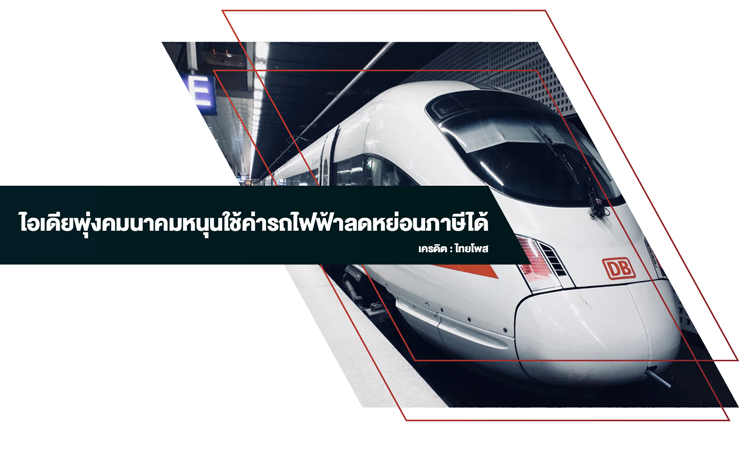
Ideas to Support Tax Deductions for Electric Train Fares
On March 25, 2019, Mr. Sarawut Songsivilai, Director of the Transport Policy and Planning Office (OTP), revealed that the electric train project is a crucial part of solving traffic problems in the capital. However, the cost of this transportation mode is significantly higher compared to the bus system, which may burden the public.
Nevertheless, the OTP has proposed a measure to encourage people to use electric trains by suggesting that electric train fares be eligible for tax deductions. In the case of private companies, if they provide monthly travel expenses for employees, they can deduct the electric train fares from their taxes. Similarly, general employees or civil servants should have special rights regarding electric train fares.
This approach is considered a win-win for all parties, as it reduces the financial burden on citizens while the government addresses traffic congestion and decreases the number of vehicles on the road, alleviating the burden on the private sector. Additionally, in the future, there should be promotional campaigns to encourage usage, with the government providing financial support (subsidies), such as offering free trials on routes during the initial service phase, as well as reducing fares by 5-10 baht to stimulate user numbers.
Mr. Sarawut further stated that he believes controlling electric train fare prices is something every government considers, including future administrations, regardless of the political party. If the goal is to promote usage, there must be incentives or special rights offered to encourage the public to change their behavior regarding personal vehicle use. With such promotional measures in place, he believes the proportion of electric train users will increase, as it currently accounts for only 3-4% of total users. Once Phase 1 of the electric train is completed, this figure is expected to rise to 10%, and further to 15% with the completion of Phase 2. In the future, there will also be a law governing the management of a joint system, or the Joint Ticket Act, and regulations regarding common fare calculations for the joint ticket system (Spider Card) to reduce travel expenses for the public.
A source from the Ministry of Transport stated that this approach should not be too difficult, as the government currently allocates a budget of no less than 100 billion baht annually for road construction and maintenance, yet there is still no budget to support the electric train system to address traffic congestion in Bangkok, which is ranked among the top cities for traffic issues. It is believed that the government can reduce unnecessary budget expenditures to support this initiative.
A study found that the electric train system has the highest average monthly cost at 2,500 baht, followed by public vans at an average of 2,100 baht per month. Next is the express boat on the Saen Saeb Canal with an average of 1,700 baht per month, while air-conditioned buses average 1,400 baht per month, and non-air-conditioned buses are at 1,200 baht per month. Similarly, the average fare for the Chao Phraya Express Boat is around 1,200 baht per month.
Thank you for the information from www.thaipost.net