SEC Warns of the Risks of Investing in Digital Assets
Mr. Rapee Sucharitakul, Secretary-General of the Securities and Exchange Commission (SEC), stated that as interest in fundraising through ICOs has increased, there has been a growing trend of inviting the public to invest in ICOs and cryptocurrencies. The SEC has continuously warned and provided information to the public that investing in digital assets, including ICOs and cryptocurrencies, requires a significant understanding and knowledge. This type of investment carries various risks, and if investors do not fully comprehend it, they can easily incur losses.
Additionally, there may be opportunists creating hype by promoting projects that utilize new technologies that have never been seen before as a selling point, or projects that lack a clear business plan to support the use of such technology, and/or using technology as a facade to deceive the public into investing.
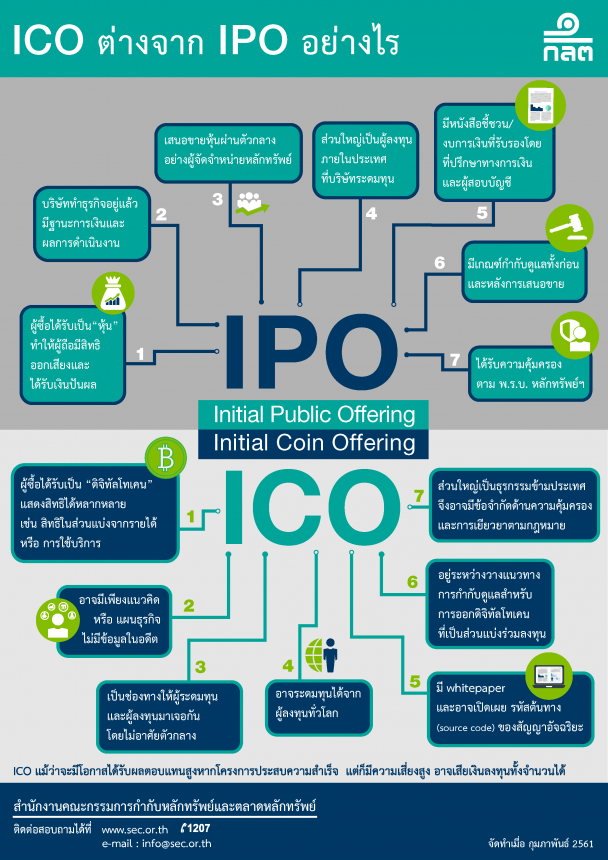
Those who are invited or considering investing in digital assets must understand the relevant details, including the assets they will invest in, the business itself, the rights of investors, and the structure of the tokens they will receive from the investment. They should always assess the suitability of the investment against their own risk tolerance, as well as be cautious of the risks associated with service providers that are not regulated and do not have established standards for cybersecurity and other protections.Currently, there are no regulatory standards governing ICOs, so investors do not receive any protection. Moreover, the fundraising projects may still be merely concepts, and the execution of the stated projects may not succeed or may succeed but differ from what was initially disclosed, as the information in the ICO offering documents (white paper) can be likened to an oral contract.
The regulatory framework under consideration by the authorities will allow for fundraising and transactions through this channel to proceed legitimately, but it will require transparency in information disclosure, the establishment of asset screening for digital assets to be traded, and oversight of the standards of the involved intermediaries.
However, investors should be aware that regulation can only mitigate certain risks, such as preventing fraud and Ponzi schemes, while other risks remain, such as the business risks of the enterprises, the volatility of digital asset prices, and the risk that the systems holding digital assets may be subject to cyber theft. Most importantly, investors should recognize that if losses occur, there is a high likelihood that they will not be able to claim compensation from anyone. Therefore, if you do not understand, do not invest, as digital assets are not suitable for everyone.
Thanks to information from thaipublica.org