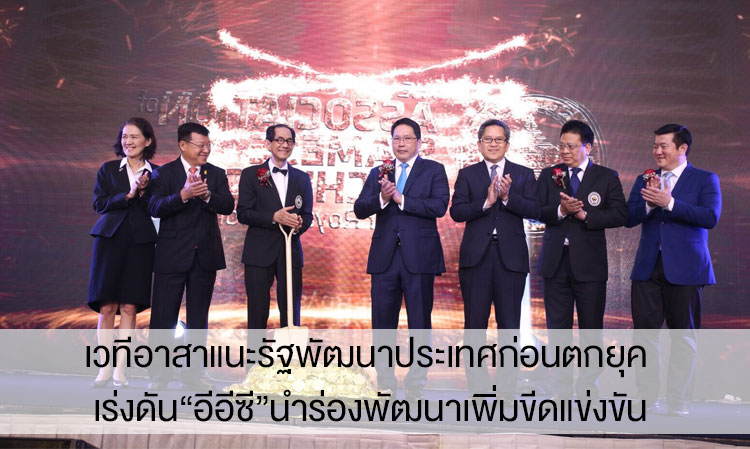
Volunteer Forum Advises Government to Develop the Country Before Falling Behind, Accelerate 'EEC' as a Pilot for Enhanced Competitiveness
The volunteer forum advises the government to develop the country before it falls behind, urging the acceleration of the 'EEC' as a pilot project for enhancing competitiveness. The discussion platform, 'Adjusting Homes, Improving Cities,' emphasizes that the country must expedite concrete development plans. The government is encouraged to push the EEC as a leading development initiative. 'Uttama' revealed that the latest draft of the Eastern Economic Corridor Development Act has passed the National Legislative Assembly in its third reading, allowing the government to fully advance five mega-projects to guide development in the eastern region.
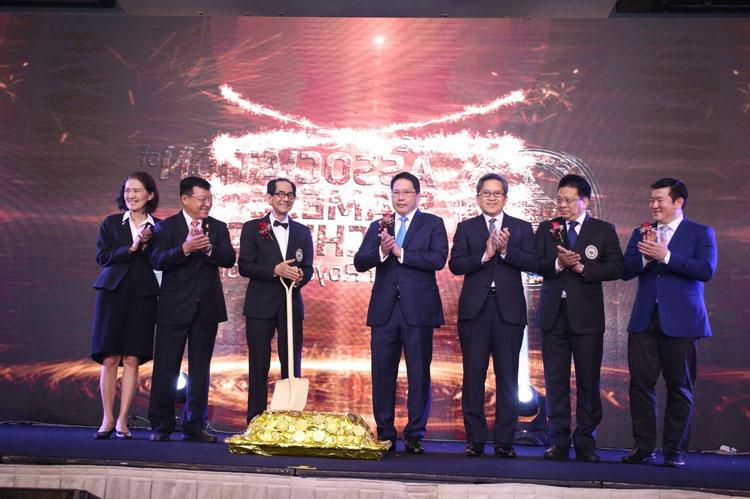
The Association of Siamese Architects under the Royal Patronage, in collaboration with Ultimate Property Corporation, organized a major seminar titled 'ASA Real Estate Forum 2018.'
The Real Estate Forum was held to gather stakeholders involved in various development sectors to update on progress and prepare the country for competition. The first topic discussed was Thailand as a new economic hub in the world, emphasizing the need for the country to establish a strong position and prepare infrastructure for competition with other nations.

Dr. Uttama Savanayana, Minister of Industry and Chairman of the Eastern Economic Corridor (EEC) Development Committee, stated that Thailand is at a pivotal point in its development. Economic indicators are showing positive signs, and the country is ready for change and problem-solving. For instance, export figures for 2017 grew by 10%, and the industrial confidence index reached 90, the highest in 35 months. Additionally, the EEC project is making clear progress, with the National Legislative Assembly passing the Eastern Economic Corridor Development Act on February 8, which will enable the EEC's development to move forward with clear categories.
This project focuses on enhancing existing developments in the area, allowing for substantial growth. The EEC development will require an EEC fund to oversee comprehensive development in areas such as healthcare and education, all under the legal framework for area development.
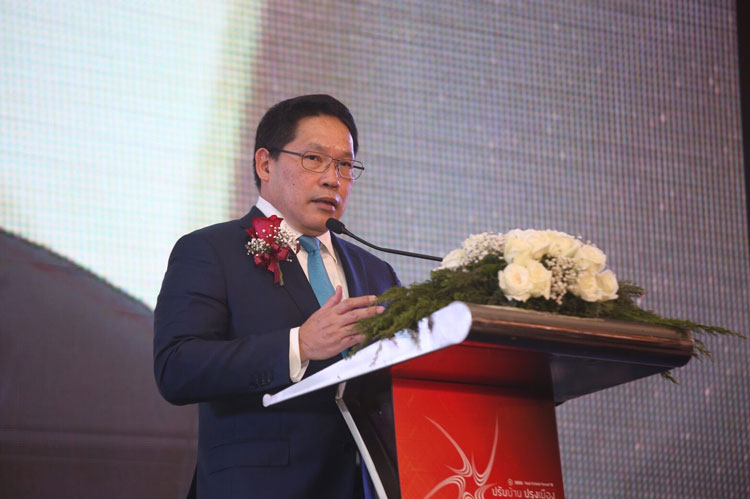
'The world has changed significantly today. Thailand must plan and have concrete development projects to enhance its competitiveness,' Dr. Uttama emphasized, stating that the country must establish development pathways with cooperation from all parties to achieve competitive capabilities. As technology evolves rapidly, if we fail to keep up or lack foundational technology, we cannot compete with other countries. This presents a challenge: will we fall behind or become a leader? Currently, despite growth, it is a bittersweet growth due to long-standing accumulated problems. Therefore, today's development must have a clear plan outlining our goals and how to achieve them, with a roadmap that addresses problem-solving. We must choose and collaborate as a national strategy over the next 20 years to resolve long-standing issues, laying the groundwork for solutions and pushing Thailand towards Thailand 4.0 with actionable roadmaps for each aspect. Development must progress inclusively; even if the economy is thriving, if farmers are still struggling, we cannot improve homes and cities. As problems remain concentrated, we must plan development and problem-solving simultaneously. The EEC development project includes five foundational projects to promote visible development within this year, which will be joint ventures under a PPP model, reducing timelines to 10 months, thus driving clear EEC initiatives this year and fostering new ideas in the EEC, continuing the development of the Eastern Seaboard Phase Two.
Dr. Pramete Vimonlasi, Secretary-General of the National Economic and Social Development Board (NESDB), stated that the EEC is a project initiated by this government that must continue. This project represents the development of the Eastern Seaboard Phase Two after we have developed the eastern region into a significant industrial hub. This project must connect with national development issues regarding the economy and national strategy. Deputy Prime Minister Somkid Jatusripitak is actively promoting the EEC concept to become a tangible new investment hub, expanding various developments to support existing infrastructure, such as U-Tapao Airport and the deep-sea port at Laem Chabang.
The EEC development project not only aids in the development of the eastern region but also connects with neighboring areas and extends to the development of the Western Corridor through the Dawei connection and the Kanchanaburi motorway project, forming a major regional corridor. This includes the Western Corridor linking Mae Sot and Sukhothai in the north, which will connect to China's Belt and Road Initiative. The appeal of the EEC and its ongoing effects are crucial issues that the government aims to enhance revenue, as outlined in the 20-year national strategy.
Dr. Phairin Chuchotitham, Deputy Minister of Transport, stated that the economic development path is inseparable from logistics and transportation. Currently, as China proposes the theory of two superpowers with the Belt and Road Initiative, Thailand must also develop along this route.
Another important aspect, Dr. Phairin mentioned, is that the government must develop the transportation system and select all projects to be completed within this year, whether it be the Laem Chabang port or the development of U-Tapao Airport. So far, there have been requests for EEC investments totaling 300 billion baht. If achieved, we will see significant changes, but we still face land expropriation issues, unlike many countries that use land reform laws to facilitate development. Our country may need to reconsider this law for development, as it is determined by local authorities, thus minimizing issues for landowners. This will enable the government to purchase entire plots of land and redesign them.
Ms. Pojanee Attharojphinyothin, Deputy Secretary-General of the Eastern Economic Corridor Policy Committee, reported that the current investment value stands at 290 billion baht, utilizing a connected system as a pilot for Thailand 4.0, developing three provinces with a high-speed rail project linking three airports to facilitate transportation and logistics. Additionally, there is a focus on developing the local workforce in collaboration with the Ministry of Education. If all projects proceed as planned, the economy and tourism will grow, providing sustainable income for Thailand.
Regarding water development, discussions have been held with relevant agencies. If targets are met, there will be sufficient water supply until 2026. The Water Committee will review and create a new detailed plan. As for energy, the Ministry of Energy has invited agencies to discuss production numbers to ensure they exceed consumption levels. Even with the EEC and tourism entering the area, it is confirmed that there are no issues and management can be handled effectively.