Knight Frank Thailand Reveals Overview of the Condominium Market in Bangkok
Knight Frank Thailand's research reveals that "new public transport routes will play a significant role in the real estate market in the coming years, as Bangkok is undergoing changes in several key public transport routes in the future. It is anticipated that competition will increase significantly in certain suburban areas of Bangkok, especially along the light green line (Mo Chit-Khukhot and Bearing-Samrong), the blue line (Tao Poon-Tha Phra-Hua Lamphong), the pink line (Kraiyai-Minburi), the orange line (Rama 9-Ramkhamhaeng), and the yellow line (Lat Phrao-Hua Mak). Rental and sales prices of condominium projects in these areas are expected to rise according to their distance from stations or the convenience of travel. In terms of supply, several new projects will be launched in Bangkok, with major developers being key players in the market due to their stable funding, high bargaining power, and modern amenities. Meanwhile, sales prices in suburban areas are expected to remain stable due to the availability of land and relatively low land prices. In the future, sales prices in the central business district are expected to increase due to land scarcity and rising land prices. This year, we will see projects with relatively low prices entering the market, priced between 3-5 million baht, which will attract the interest of middle-class buyers. However, developers should be cautious when creating new projects at lower to mid-range prices along the new public transport routes in suburban areas to mitigate the risk of oversupply. Demand in the market will continue to rise, driven by both Thai and foreign buyers. Additionally, another trend driving demand is the influx of foreign buyers, particularly from China, who are seeking safe investment opportunities.
Market Overview
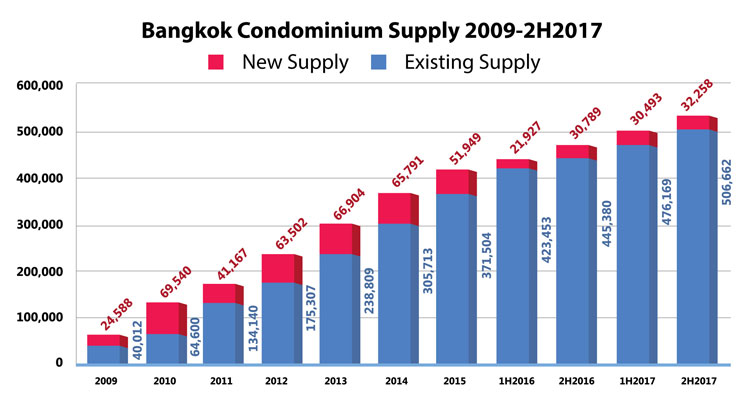
The condominium market in Bangkok at the end of 2017 showed positive results. The overall occupancy rate in the second half of 2017 was 76.5%, and average sales prices increased in several areas. New development projects continue to emerge, especially in suburban areas close to the new public transport extensions, due to the limited availability of prime land and high land prices in the central business district. A total of 32,258 units were launched in the second half of 2017, marking the highest supply volume in the past eight quarters, resulting in a cumulative total of 538,920 condominiums in Bangkok, an increase of 6.4% half-year on half-year. Sales prices in the areas surrounding the central business district and suburban areas continued to rise, while prices in the central business district slightly decreased by 5.2% half-year on half-year, due to a shift in market share from the prime Sukhumvit area to other districts. The average sales price of new supply across Bangkok decreased to 154,068 baht/square meter, a drop of 1.1% compared to the first half of 2017.
In 2017, several major developers in Thailand collaborated with foreign investors from Japan, China, and Hong Kong to accommodate the increasing demand from foreign buyers and advancements in construction technology. Locations along the new public transport routes are expected to attract significant interest due to the scarcity of land in the city center and high land prices. Consequently, many developers are increasingly focusing on areas such as Ramkhamhaeng, Ramindra, and Thonburi.
Supply Trends
The condominium market in Bangkok continues to show positive trends in 2017, with the number of new projects increasing by 19% year-on-year to 62,751 units. In the second half of 2017, new supply increased by 5% to 32,258 units compared to the second half of 2016, which had 30,789 units. The second half of 2017 demonstrated good growth due to more condominium projects being launched in the central business district, primarily in Sukhumvit, where approximately 6,500 units were launched, accounting for 51% of the total. Following that, 22% were on Witthayu-Chidlom Road, and 12% were in the Rama 4 area. Notably, 15 prime condominium projects launched a total of 4,777 units in the second half of 2017, marking a significant increase of 22.8% from the 1,091 units launched in the second half of 2016. New projects launched include Life One Wireless, The Lofts Silom, Vittorio Sukhumvit 39, Maru Ekkamai 2, and Ideo Rama 4.
Source: Knight Frank Thailand
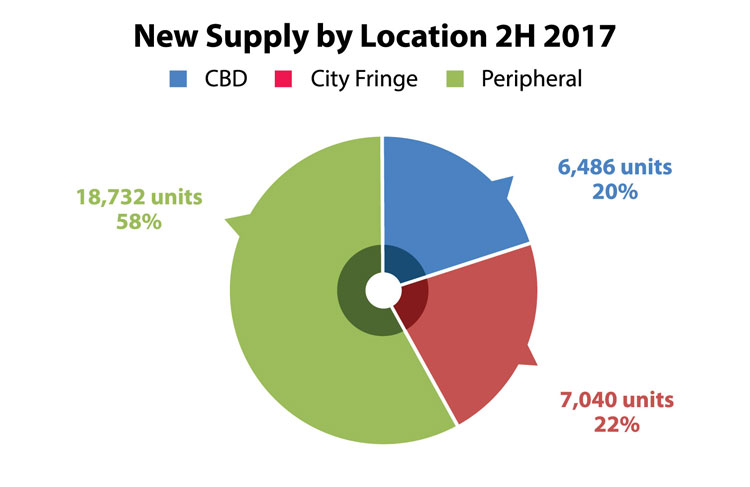
In the second half of 2017, the new supply in suburban areas totaled 18,732 units, accounting for approximately 58% of the total supply launched in that period. Recent condominium development projects in this area include Knightsbridge Prime Ratchayothin, Lumpini Park Phahol 32, The Nest Sukhumvit 64 and Supalai Park Taladplu Station. Meanwhile, new supply in areas outside the central business district accounted for 22% of all projects launched in Bangkok, with popular locations for new projects including Lat Phrao, Ratchadapisek, and Thonburi.
Source: Knight Frank Thailand
Demand Trends
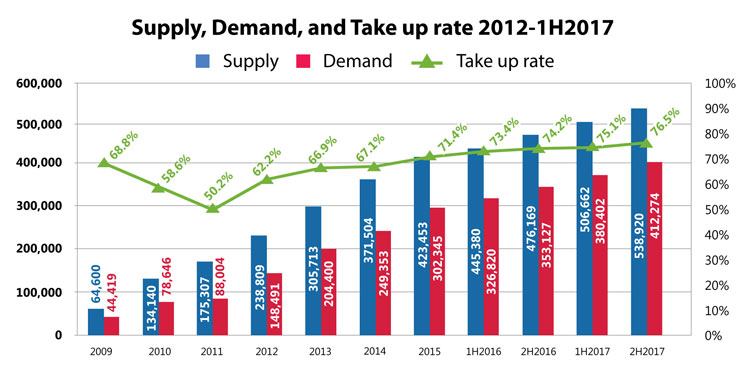
Sales in the condominium market in Bangkok have increased for several consecutive quarters, driven by promotional activities in the market. In 2017, the average occupancy rate throughout the year surged to 75.8%, an increase of approximately 2% year-on-year, reflecting growing confidence among buyers. In the second half of 2017, the market showed an average occupancy rate of 76.5%, up 1.4% half-year on half-year. New condominium projects in the central business district maintained a good stability, with an average occupancy rate of 77.4%. High-quality units in the central business district performed better in sales, with some developers achieving sales of up to 80% on the first day of launch. It is evident that the demand for high-quality condominium projects in prime locations is strong, as buyers of such properties often purchase them for personal use or long-term investment.
In the second half of 2017, there was an oversupply of residential demand in areas outside the central business district and suburban areas following confirmation of the extension of public transport routes. Buyers continued to show interest in projects in various areas, primarily in Ratchadapisek, Phaholyothin, Lat Phrao, and On Nut-Bearing. The occupancy rates for projects in the areas outside the central business district and suburban areas were 72.5% and 79.6%, respectively.
Source: Knight Frank Thailand
Price Trends
The average sales price of all types of condominiums launched in Bangkok in 2017 was 153,220 baht/square meter, an increase of 5.9% year-on-year. In the second half of 2017, the average sales price was 152,371 baht/square meter, reflecting a 16.8% increase half-year on half-year. The average sales price in the central business district was 241,585 baht/square meter, up 5.6% compared to the second half of 2016. However, the sales prices of new condominium projects in the central business district slightly decreased compared to the first half of 2017, with an average sales price drop of 5.24% due to a shift in market share from the prime Sukhumvit area to other districts such as Witthayu, Silom, Sathorn, and Rama 4.
The average sales price in areas outside the central business district in the second half of 2017 was 131,906 baht/square meter, approximately 0.6% higher than in the first half of 2017. Meanwhile, the average sales price of condominiums in suburban areas increased to 83,623 baht/square meter, up from 74,591 baht/square meter in the second half of 2016. Sales prices in both areas outside the central business district and suburban areas have continued to rise due to increasing land prices driven by the expansion of public transport routes in the city.
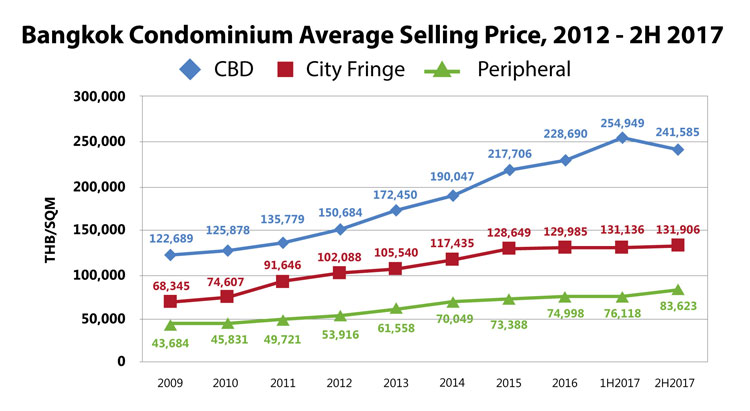
Source: Knight Frank Thailand
Thank you for the information from http://www.knightfrank.co.th/th