Timeline: The Journey of Thai Magazines from 'The Past' to 'Transition' in the Digital Age
The mention of the word "magazine" likely brings to mind a familiar image for many as a primary medium that has long been a companion to Thai bookstores. It serves as a close friend, providing knowledge, information, and entertainment to readers across generations. Moreover, when looked at more deeply, magazines do not merely act as a "medium" that transmits "messages" to recipients; they also serve as a tool for documenting the stories of society throughout various eras, holding significant historical importance.
The life of magazines is filled with interesting stories and histories, just as compelling as the content recorded within them. This article will take readers on a journey to explore the path of Thai magazines from the past to the present.
Thai Magazines in Their 'Early Days'
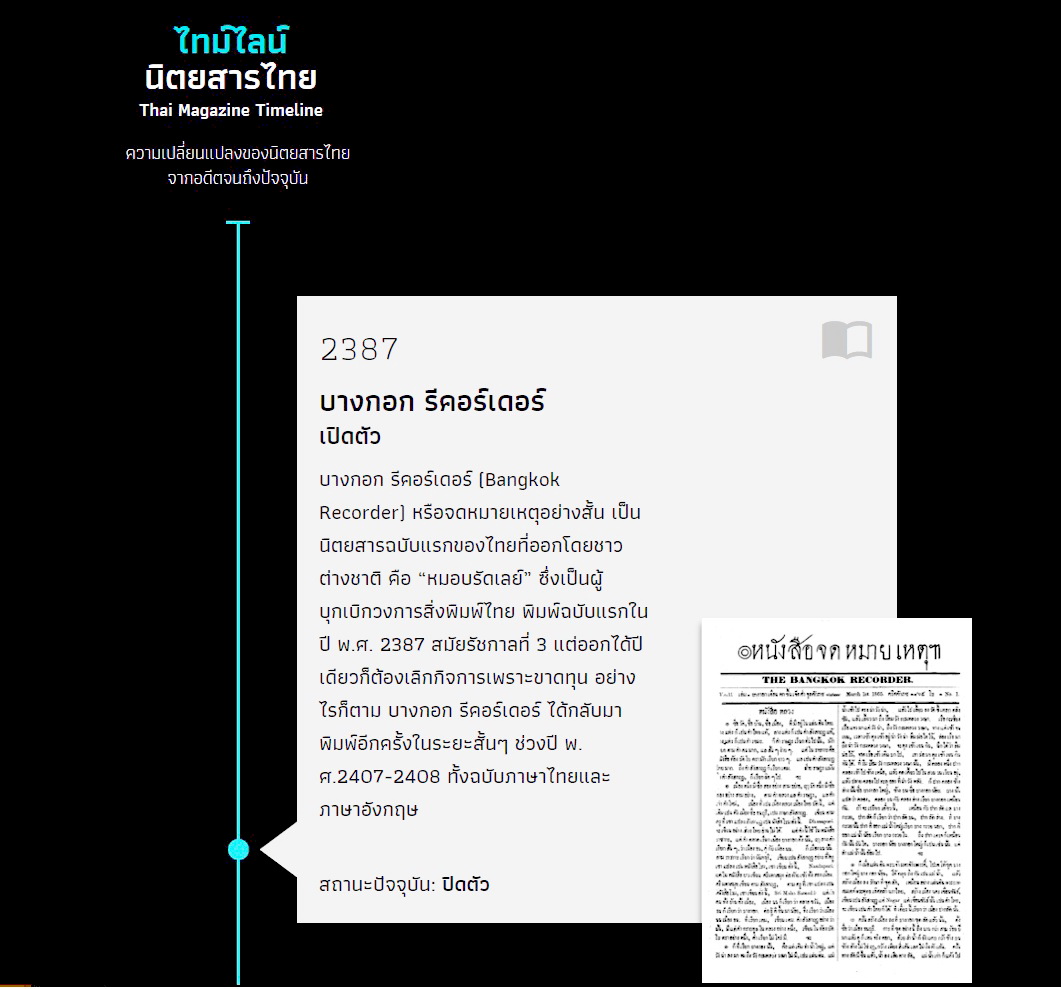
To capture the essence of the early days of Thai magazines, we may need to look back to the reign of King Rama III. The first magazines focused on disseminating information, reporting news, translating various sciences from abroad, and publishing literary works or poetry. They also served as a platform for political opinions. Each magazine from this era had a relatively short lifespan, often lasting only a few years or even just one year before shutting down, primarily due to the limited number of literate readers at the time.
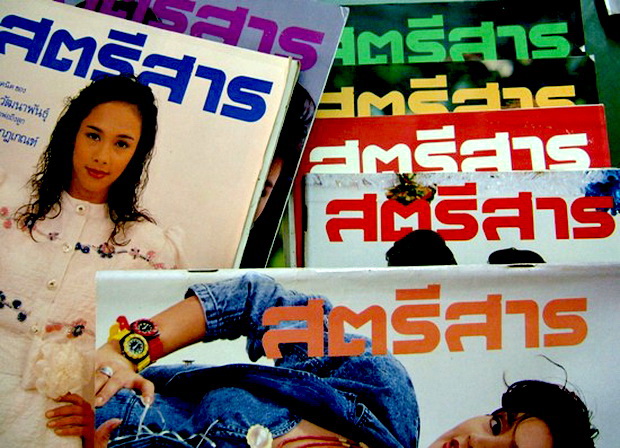
From being a medium for news and political opinions, magazines began to clearly separate their roles from newspapers after the political change in 1932. The direction of content started to shift towards entertainment, featuring advertisements for products and services, and emphasizing serialized novels for readers to follow in each issue. This was accompanied by the division of content and columns, which became a template for magazines in the following era, such as astrology columns, Q&A columns, and satire columns. This change led to a growing popularity of magazines, especially in the women's magazine category, such as "Srisang", "Sakul Thai", and "Kwan Ruan".
'The Golden Age': The Blooming Season of Thai Magazines
As printing technology advanced relentlessly, the Thai magazine industry entered a fruitful season. From the early days focused on entertainment, there began to be an increase in the production of specialized knowledge magazines, such as "The Guitar", "Home and Garden", and "Matichon Weekly". Additionally, there was a trend of purchasing magazine licenses from abroad to produce Thai editions, such as "ELLE", "CLEO", "C-Kids", and "Cosmopolitan".
The Thai magazine industry continued to grow until it reached its peak, with reports suggesting that there were over 400 Thai magazines. However, the popularity of physical magazines was not sustainable. As the media consumption behavior of Thais changed with evolving technology, the encroachment of online media that catered to new reader habits caused magazine producers to become increasingly anxious.
The Last Breath of Magazines in 'The Declining Days'
From the era of black-and-white proof paper to the era of four-color art paper, today marks another transformation. In the digital age, where information is easily and quickly accessible, many have turned to online media and social media for news and information.
This phenomenon is occurring globally, as we see people increasingly consuming news and content through websites or social media platforms like Facebook, Twitter, or YouTube, while reading physical magazines has decreased. The decline in readership has significantly tightened the flow of advertising revenue, which is a major lifeline for the magazine industry.
Advertising budget figures compiled by Nielsen Thailand reveal that magazine advertising revenue dropped from 4.268 billion baht in 2015 to just 2.929 billion baht in 2016, a decrease of over 31.37%. In contrast, online media advertising budgets grew from 1.058 billion baht in 2015 to 1.731 billion baht in 2016, an increase of over 63.61%, marking the highest growth compared to other media.
Since 2014, it has become evident that online media is experiencing exponential growth, with numerous online magazine websites emerging, such as Dooddot, Soimilk, Mango Zero, and The Cloud. Additionally, new online news outlets have also emerged, such as The Matter, The Momentum, and The Standard.
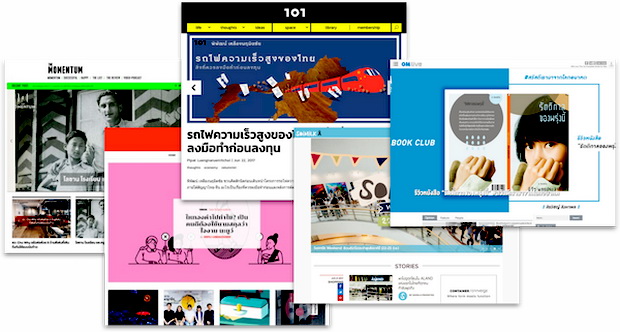
It is said that this is the golden age of online media, but conversely, it is a dark age for print media. The phrase "magazines are dying" has become a familiar refrain over the past 2-3 years, as the print media crisis continues to decline, leading many magazines to sadly shut down, leaving only memories on paper.
Looking back to 2015, the magazine industry faced a serious crisis when magazines like "Piyaw", "OHO", "Oops!", and "Scoop" announced the cessation of production. In 2016, it was the turn of "Sakul Thai", "Ploy Kaem Phet", "IMAGE", "VOLUME", "Seventeen", "I LIKE", and "Cosmopolitan" to gradually close down, which was disheartening. Most recently, in 2017, "Nation Weekend", "Marie Claire", "Men's Health", "Giraffe Magazine", and "Kitchen" all bid farewell to their readers at the beginning of the year.
The changing landscape of the industry has forced many magazines to adapt to the shifting trends. Some reduced their page counts, some adjusted their sizes, while others changed their publication frequency to bi-monthly or quarterly, or even transitioned to free magazines to cut costs. This led to a significant rise in the popularity of free copies, as seen with the launch of "Billboard Thailand" and "The Hollywood Reporter Thailand".
Many magazines are trying to implement innovative strategies to combat the current situation. Some are focusing on developing in-depth content for readers, while others are creating beautifully crafted editions worthy of collection. Meanwhile, many have expanded to create content on online platforms alongside their print magazines, such as "CLEO Thailand", "Way Magazine", and "GM live". Additionally, some have chosen to build a "brand" in the real world, such as "ELLE Magazine" organizing "ELLE Fashion Week" or "Happening", which includes both "Happening Shop" and fun events to follow.
Magazines have long been a part of Thai society, so it is not surprising that they require some dusting off. Although today the magazine stands may seem eerily quiet, the closure of magazines may not be seen as a defeat but rather a challenge that brings opportunities, as well as a good time for readers like us to see diverse content presented in new formats.
In the end, let’s not hastily judge the fate of Thai magazines, for in this uncertain age, parting does not mean we will not meet again...
See Data Storytelling here: https://data.boonmeelab.com/thaimagazine/
Note: Some images accompanying the article may not be related to the content.