Prime Minister Opens GASeP Meeting, Reinforcing Thailand's Readiness to Become a Regional Aviation Hub - 'Akom' Expects Thailand to Return to CAT1 by March 2019

General Prayuth Chan-o-cha, Prime Minister and Head of the National Council for Peace and Order (NCPO), presided over the opening of the regional meeting on global civil aviation security, the "Global Aviation Security Plan (GASeP)". Source: www.thaigov.go.th
On December 20, 2017, at the Royal Orchid Sheraton Hotel, General Prayuth Chan-o-cha, Prime Minister and Head of the NCPO, opened the regional meeting on global civil aviation security, the "Global Aviation Security Plan (GASeP)". Attendees included Dr. Fang Liu, Secretary General of the International Civil Aviation Organization (ICAO), Mr. Arun Mishra, Director of the Asia-Pacific Region of ICAO, Mr. Akom Termpittayapaisith, Minister of Transport, Mr. Chula Sukmanop, Director of the Civil Aviation Authority of Thailand (CAAT), along with executives from relevant Thai agencies and civil aviation security experts from 26 countries in the Asia-Pacific region, totaling approximately 150 participants.
The GASeP seminar was organized following the 39th ICAO Assembly held in September 2016 at ICAO's headquarters in Montreal, Canada. Attendees at that assembly recommended accelerating the development of the Global Aviation Security Plan (GASeP) to serve as a new framework for aviation security policies and plans, replacing the previous ICAO Comprehensive Aviation Security Strategy (ICASS). After GASeP was approved, ICAO conducted regional seminars to disseminate the plan, allowing each country to adapt it to their own context. Thailand was selected as the host for the Asia-Pacific region.
ICAO Secretary General Urges Thailand to Develop Sustainable Aviation Personnel
Dr. Fang Liu stated that the GASeP seminar is based on ICAO's "No Country Left Behind" concept. The new plan presented at this meeting will serve as a foundation for governments, stakeholders in the aviation industry, and ICAO to work together to enhance global aviation security. A roadmap outlining the roles and responsibilities of stakeholders will also be presented. The new plan and roadmap aim to achieve five key outcomes:
- Enhance awareness and response to security risks.
- Promote a culture of security and human awareness.
- Improve technological resources and innovations.
- Enhance oversight and quality assurance.
- Increase coordination and support.
GASeP will need to be reviewed and amended according to emerging aviation security threats and must be implemented at all levels—national, regional, and global—requiring cooperation from the aviation industry and various stakeholders. It is anticipated that the first five key outcomes will be realized before the 40th ICAO Assembly in 2019.
Additionally, the ICAO Secretary General advised Thailand, after lifting the red flag, that training and professional development for civil aviation personnel is crucial and should proceed alongside infrastructure development and the establishment of a master plan for infrastructure development. It is recognized that Thailand can develop skills and train civil aviation personnel to become key players in the civil aviation industry of Thailand and the region, which is one of the fastest-growing aviation and air transport markets.
Prime Minister Emphasizes Thailand's Commitment to Elevate Aviation Standards - 'Chula' Reveals Thailand's Safety Standards Have Surpassed Expectations
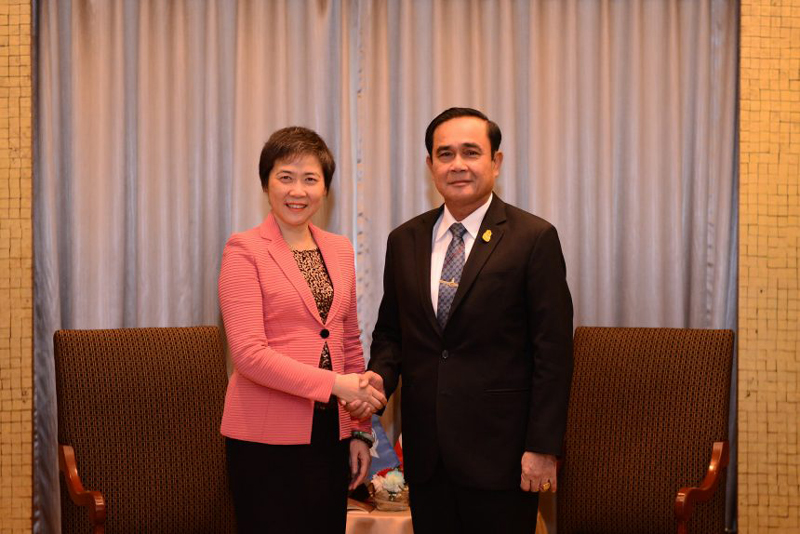
Dr. Fang Liu, Secretary General of ICAO, and General Prayuth Chan-o-cha, Prime Minister and Head of the NCPO
Source: www.thaigov.go.th
General Prayuth stated that as a member of ICAO and part of the international civil aviation community, Thailand is committed to maintaining this success and adhering to international obligations to uphold aviation safety standards and elevate Thai civil aviation to meet international standards. The successful resolution of significant safety concerns (SSC) has led to Thailand being removed from the list of countries with aviation safety risks (lifting the red flag) since October 6, 2017, confirming this commitment.
Thailand places great importance on civil aviation security, especially in light of current global threats, necessitating the development of a global aviation security plan. In the Asia-Pacific region, this plan must be implemented effectively and yield tangible results. The modern world is borderless, and while time is of the essence, safety must be guaranteed 100%.
“Threats can arise at any time, but that doesn’t mean we should panic. If we are fully prepared and everyone cooperates, it will be the best approach, better than focusing solely on laws and regulations. Creating awareness of various threats will allow everything to proceed without compromising legal standards. Therefore, we must establish a global aviation security plan, with countries cooperating under agreed rules for implementation,” the Prime Minister stated.
General Prayuth further noted that the global aviation security plan is a strategy to help member countries of ICAO build cooperation and networks for civil aviation security among member states and between member states and agencies or organizations involved in aviation security. It will also promote a culture of security and enhance operational capabilities by focusing on the use of modern technology and innovations, as well as improving the regulatory and quality assurance frameworks.
Hosting the GASeP meeting today reflects Thailand's significant role in being part of the international civil aviation community, providing a regional platform to achieve goals and enhance global aviation security. Representatives from member countries in the Asia-Pacific region have the opportunity to meet and share experiences in global aviation security.
Additionally, the Prime Minister expressed gratitude to ICAO for its close collaboration with Thailand in addressing aviation issues. The government will ensure that both full-service and low-cost airlines can access technology and comply with safety regulations rigorously.
Mr. Chula added that in terms of security, Thailand has been operating according to standards, and in some cases, even exceeding ICAO recommendations. Currently, Thailand operates above standards, as multiple sectors are involved in security, eliminating personnel issues.
“In terms of safety, we are exceeding standards because we have many personnel involved. Therefore, anything that should be done is implemented. While this may affect convenience somewhat, we believe we need to instill confidence in those entering Thailand that our security system is sufficient. Security is a complex issue, and those wishing to cause harm are constantly evolving. This trend suggests that those working in aviation security in Thailand will likely receive higher compensation as the work becomes more complex and demanding. More training and knowledge will lead to higher salaries,” Mr. Chula stated.
Reinforcing Thailand's Readiness to Become a Regional Aviation Hub
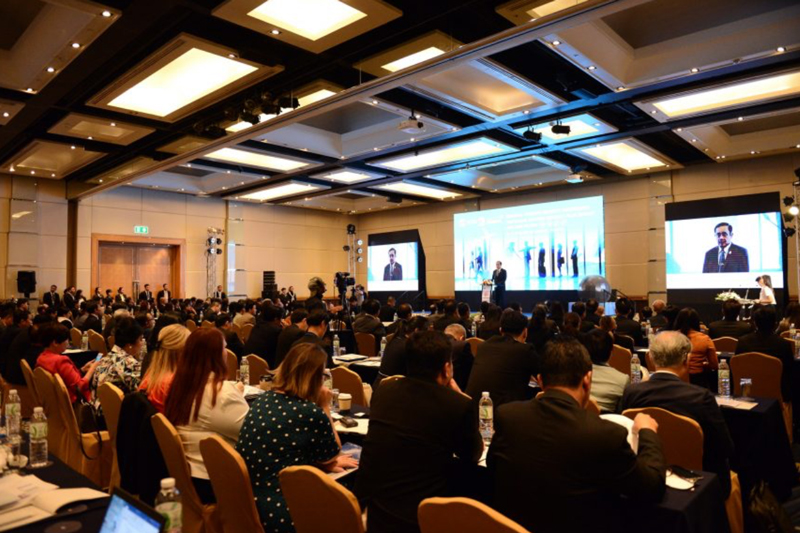
General Prayuth Chan-o-cha, Prime Minister and Head of the NCPO, presided over the opening of the regional meeting on global civil aviation security, the "Global Aviation Security Plan (GASeP)". Source: www.thaigov.go.th
Furthermore, General Prayuth discussed the country's economic development plan, which includes pushing Thailand to become an aviation hub (Aeropolis) and a maintenance, repair, and overhaul (MRO) center for the region. These industries are categorized as part of the future industries (New S-curve). The plan involves connecting key airports, including Suvarnabhumi International Airport, Don Mueang Airport, and U-Tapao Airport. In the future, the government plans for U-Tapao Airport to become another key transportation hub in the region.
This development is crucial for infrastructure, enhancing connectivity, facilitating tourists wishing to travel directly to the eastern region, supporting travel, trade, investment, and tourism in the area, and creating jobs for local communities, while also driving economic growth and helping the country escape the middle-income trap.
“Regarding the MRO center, on December 15, 2017, a memorandum of understanding was signed to study the feasibility of developing the TG MRO Complex at U-Tapao Airport, aiming to establish a modern, standard, and environmentally friendly aircraft maintenance center for the Asia-Pacific region, between Thai Airways International Public Company Limited and Airbus. This is part of the Eastern Economic Corridor development plan,” the Prime Minister stated.
The Prime Minister continued that the efforts to develop Thailand's aviation industry align with the recommendations of the ICAO Secretary General. Recently, the government approved additional funding for the construction of training facilities for aviation personnel, developing Thai youth to possess the skills and knowledge necessary to meet market demands and the needs of investors in the country, and to be prepared to handle new opportunities and threats.
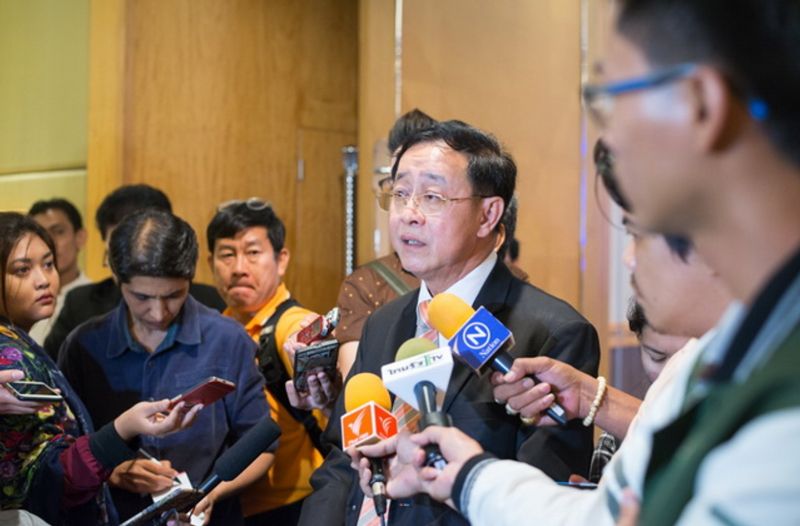
Mr. Akom Termpittayapaisith, Minister of Transport
Mr. Akom further stated that regarding expanding Thailand's aviation potential, it is observed that after lifting the red flag, international aviation growth from Thailand has increased, with requests for additional flights from Thailand to various countries. For instance, Thai Airways can expand flights to Europe, Japan, and China, but this must still comply with air services agreements, ensuring that each airport has sufficient capacity to accommodate the increased flights.
“Lifting the red flag is an important first step; we had to remove the red flag first. Now that we have done so, it signifies that our international aviation operations and airlines operating from Thailand are safe, assuring international passengers of our airline's safety,” Mr. Akom stated.
With the growth in aviation, the next priority is personnel. The shortage of pilots primarily concerns experienced pilots (captains). Mr. Akom confirmed that each year, the Civil Aviation Training Institute (CATI) produces sufficient pilots and aircraft maintenance technicians.
“Airlines naturally require experienced personnel. Some are still co-pilots, which takes time to upgrade to pilots. In simple terms, after lifting the red flag, we still have issues to address, but they are not significant. They involve legal amendments currently in process. Additionally, CAAT is collaborating with the Ministry of Transport to develop personnel, especially inspectors, and is gradually bringing in new talent alongside experienced workers,” Mr. Akom stated.
Mr. Akom continued that an important issue beyond personnel development is how to retain personnel. Today, the restructuring of CAAT into a supervisory agency with its own salary structure means that those working in CAAT, as aviation regulators, do not need to seek additional jobs.
“In the past, government salaries were insufficient. Some pilots had to fly for airlines to supplement their income. Now, we have eliminated that need. While personnel still need to fly to gain experience and familiarize themselves with new aircraft for inspection purposes, it is not for income generation, as CAAT receives sufficient budget support from the government and has its own fund to manage its operations,” Mr. Akom stated.
Expecting to Return to CAT1 by March 2019
In addition to lifting the red flag, Thailand still has another important mission: to upgrade the status of the National Aviation Administration of the United States (FAA) from Category 2 back to Category 1. Thailand aims to achieve this by March 2019.
Mr. Akom stated, “In the FAA, the key factor is the qualifications of pilots. They raised questions because our old system lacked sufficient personnel to inspect pilots. Today, we have established a new system where airlines will self-inspect pilots. This means that captains can inspect their junior colleagues before applying for a license from CAAT. ICAO agrees with this, and the European Aviation Safety Agency (EASA) also supports it. We need to discuss with the FAA that this system should be sufficient while we are building additional personnel.”
Regarding the progress of issuing new Air Operator Certificates (Re-AOC) to international airlines, one more airline, Asia Atlantic Airlines, is expected to receive the new certificate within 2017.
Thai Airways and Airbus Collaborate to Establish Thailand as an Aircraft Maintenance Hub
According to an assessment by the Airbus working group, Thailand is well-positioned geographically, with skilled labor and market potential that will bring significant benefits in the future. It is projected that the fleet serving Asia and the Pacific will double in the next 20 years, from approximately 6,100 aircraft to over 17,000. The estimated value of the aircraft maintenance, repair, and overhaul (MRO) sector in this region is expected to reach $664 billion in the next 10 years.
U-Tapao Airport can accommodate aircraft of all sizes and already has a comprehensive maintenance facility operated by Thai Airways. Additionally, skilled labor is available, and next year, Thai Airways will begin maintaining Airbus A380 aircraft under the supervision of Airbus. In the next 10 years, a new hangar will be constructed at U-Tapao Airport, as it is expected to grow into a dual-runway airport with the potential to serve as a maintenance hub for wide-body aircraft. An engineering institute will be established in collaboration with Thai Airways, Airbus, and CAAT, with Airbus planning to set up a composite materials repair center, which will benefit the development of Thailand's aviation and aerospace sectors.
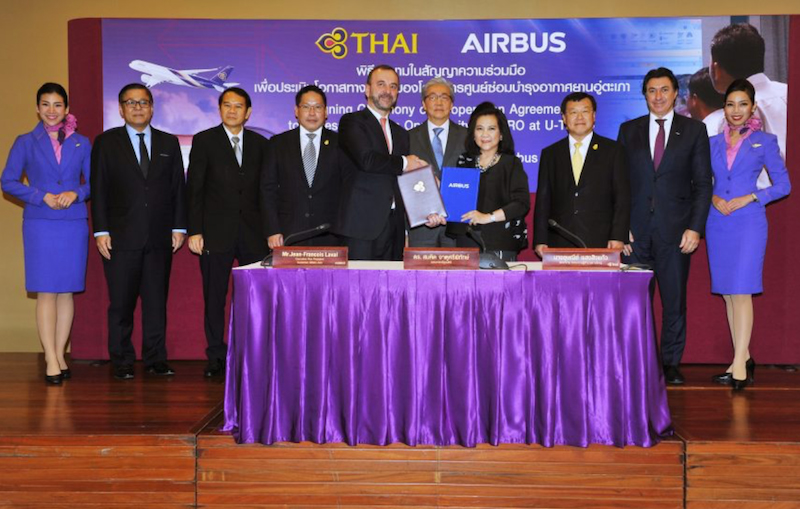
Mr. Sihasak Phuangketkeaw, Thai Ambassador to Paris, Mr. Kanit Sangsuphan, Secretary of the Eastern Economic Corridor Policy Committee, Mr. Uttama Savanayana, Minister of Industry, Mr. Jean-François Laval, Deputy Managing Director for Customer Affairs in the Asia Region at Airbus, Mr. Somkid Jatusripitak, Deputy Prime Minister, Ms. Usanee Sangsingkeo, Acting President of Thai Airways International Public Company Limited, Mr. Phairin Chuchotitham, Deputy Minister of Transport, and Mr. Peter Pruegel, Ambassador of the Federal Republic of Germany to Thailand (left-right)
Source: Thai Airways
On December 15, 2017, Ms. Usanee Sangsingkeo, Acting President of Thai Airways, and Mr. Jean-François Laval, Deputy Managing Director for Customer Affairs in the Asia Region at Airbus, signed a cooperation agreement to assess business opportunities for the U-Tapao Aircraft Maintenance Center, aiming to establish a global aircraft maintenance hub between Thai Airways International Public Company Limited and Airbus.
Ms. Usanee revealed that the U-Tapao Aircraft Maintenance Center project is one of the key projects in the Eastern Economic Corridor development plan (EEC Project) and is of great importance to Thailand. This signing ceremony clearly demonstrates the strong collaboration between Thai Airways and Airbus, marking further progress after the signing of a memorandum of understanding (MOU) to assess the feasibility of developing the U-Tapao Aircraft Maintenance Center on March 8, 2017. The results of the feasibility study and project analysis have been submitted to relevant government agencies for consideration, and will subsequently be presented to the Eastern Economic Corridor Development Policy Committee, chaired by the Prime Minister, for approval.
The cooperation agreement signed today between Thai Airways and Airbus aims to establish a framework for collaboration in assessing business opportunities for developing the U-Tapao Aircraft Maintenance Center, leading to future business contracts. The key points of the cooperation agreement are summarized as follows:
1. Define the scope for discussion and analysis to assess business opportunities, initially identifying seven business activities:
- Establishing an aircraft maintenance business at U-Tapao International Airport, covering major aircraft repairs, ramp-level maintenance, and aircraft painting.
- Establishing a training center for aircraft maintenance technicians at U-Tapao, in collaboration with the Civil Aviation Training Institute of Thailand, supported by relevant government agencies.
- Establishing an aircraft composite repair shop.
- Utilizing technology and innovations in aircraft maintenance to create a smart hangar.
- Establishing a spare parts warehouse and logistics center to support aircraft maintenance.
- Designing and constructing appropriate buildings and maintenance centers.
- Establishing a maintenance shop to support ramp-level aircraft maintenance.
2. Establishing a joint committee between Thai Airways and Airbus to negotiate, study, analyze, assess, and decide on joint business ventures.
3. This agreement is not legally binding on either party to undertake any business opportunities or enter into any business contracts. It primarily establishes a framework for cooperation in analyzing and assessing business opportunities between the parties.
However, if the assessment of business opportunities in any of the aforementioned activities is successful, it can lead to joint venture agreements for each activity, with the first target being the establishment of the aircraft maintenance business, expected to commence in 2019.
Thanks for the information and images from: www.thaipublica.org