"The Chinese Dream": Deng Xiaoping and the Ideology of Chinese Socialism
For those researching the history of literary discourse, it is clear that the "Chinese Dream" (中国梦) is not a mere imitation of the American Dream. Instead, it has a long-standing history in both literature and intellectual history in China, tracing back to the Song Dynasty. It is referenced in the ancient anthology of poetry known as the Shijing (詩 經), specifically in the poem titled "The Flowing Spring" (下泉), which describes a poet awakening to a harsh reality after dreaming of the glory of the Western Zhou Dynasty (1046 BC–771 BC).
During the tumultuous times of the Southern Song Dynasty, the poet Zheng Shixiao also wrote poetry proclaiming the "heart filled with the Chinese Dream (中国梦)."
This concept of the Chinese Dream relates to a shared hope for the rejuvenation of China, which, although it did not collapse like other civilizations, did fade from prominence in history for a time. The phrase "Chinese Dream" has continued to be referenced up to the era of Deng Xiaoping.
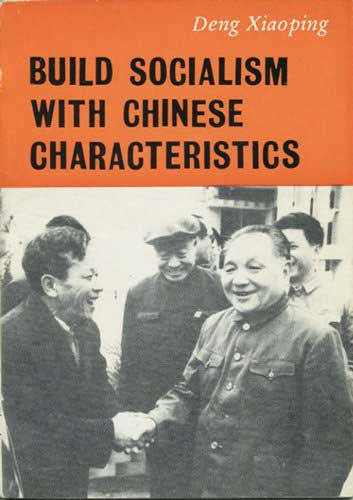
The Ideology of Chinese Socialism by Deng Xiaoping, 1982
Deng Xiaoping was one of the first to recognize the grave mistakes of the Maoist socialist system, which adopted the development model of the former Soviet Union and attempted to adapt it to China. However, it stumbled during the Great Cultural Revolution.
Deng had the courage to summarize the lessons learned, rectify those mistakes, and reform with careful boldness to create a new definition of Chinese socialism. He announced a path for modernizing the country, developing a nation-building model that aligns with the context of the contemporary global society and the realities of China. It is often said that the concept of modern nation-building in China, or "Socialism with Chinese Characteristics" (中国特色社会主义), began in the Mao era and was realized in the Deng Xiaoping era.
Deng proposed the idea of "Socialism with Chinese Characteristics," summarizing it into guiding theories known as the "Deng Xiaoping Theory" in 1982. He reformed the economic system, which had four special characteristics, such as rejecting the exclusive use of collective ownership while allowing for other forms of ownership. Additionally, he transformed the central economy into a market economy, distributing income based on the quantity and efficiency of labor.
Importantly, he opened the country to encourage foreign investment in China to learn and utilize foreign technology and management experiences. At the same time, laws were enacted to protect the interests of foreign investors, alongside strategies to expand international trade and enhance economic cooperation, encouraging local enterprises to venture into the global market.
Subsequent Chinese party leaders, including Jiang Zemin and Hu Jintao, have built upon this theory to develop new theories that branch out according to circumstances, achieving success in various aspects.
Recently, at the 19th National Congress of the Communist Party of China (CPC) on the morning of October 18, President Xi Jinping, who serves as the General Secretary of the Party, emphasized the two-step plan towards a "modern socialist country" during the opening ceremony at the Great Hall of the People in Beijing, reiterating the concept of "Socialism with Chinese Characteristics."
Xi Jinping announced that China is entering a new era of development under "Socialism with Chinese Characteristics," and the push for development from now until 2020 will determine the achievement of building a moderately prosperous society for all.
Xi Jinping revealed the Party's two-step plan to build a "modern socialist country" by the mid-21st century. According to this new plan, the Party will achieve the foundation of modernization for socialism in the first phase from 2020 to 2035. After that, it will promote development to create a "modern socialist country" that is "prosperous, strong, democratic, culturally advanced, harmonious, and beautiful" over the next 15 years.
Nearly 40 years have passed since the announcement and governance of the country based on Deng Xiaoping's ideology of Socialism with Chinese Characteristics in 1982. Although it is still too early to judge the success of the people's well-being across the nation, subsequent Chinese leaders have proven that "Socialism with Chinese Characteristics" has the power to realize the Chinese Dream in a manner that is most suitable for China's identity.
"Refreshing, the flowing spring, the forest
Ah! Suddenly I awaken, sighing
Thinking of the glory, the capital of Zhou"
- Part of the ancient poem from the Shijing (詩 經) titled "The Flowing Spring" (下泉)
(The column "Chinese Dream" will continue to convey stories of social literature, national rejuvenation, socialism with Chinese characteristics, well-being, and individual dreams in subsequent installments.)