Following the President of the Thai Railway Engineering Association to Visit Hitachi's Train Assembly Plant in Newton Durham

Article by Mr. Disapol Padungkul
President of the Thai Railway Engineering Association (TREA)
The SMART GROWTH THAILAND team would like to express our gratitude here.
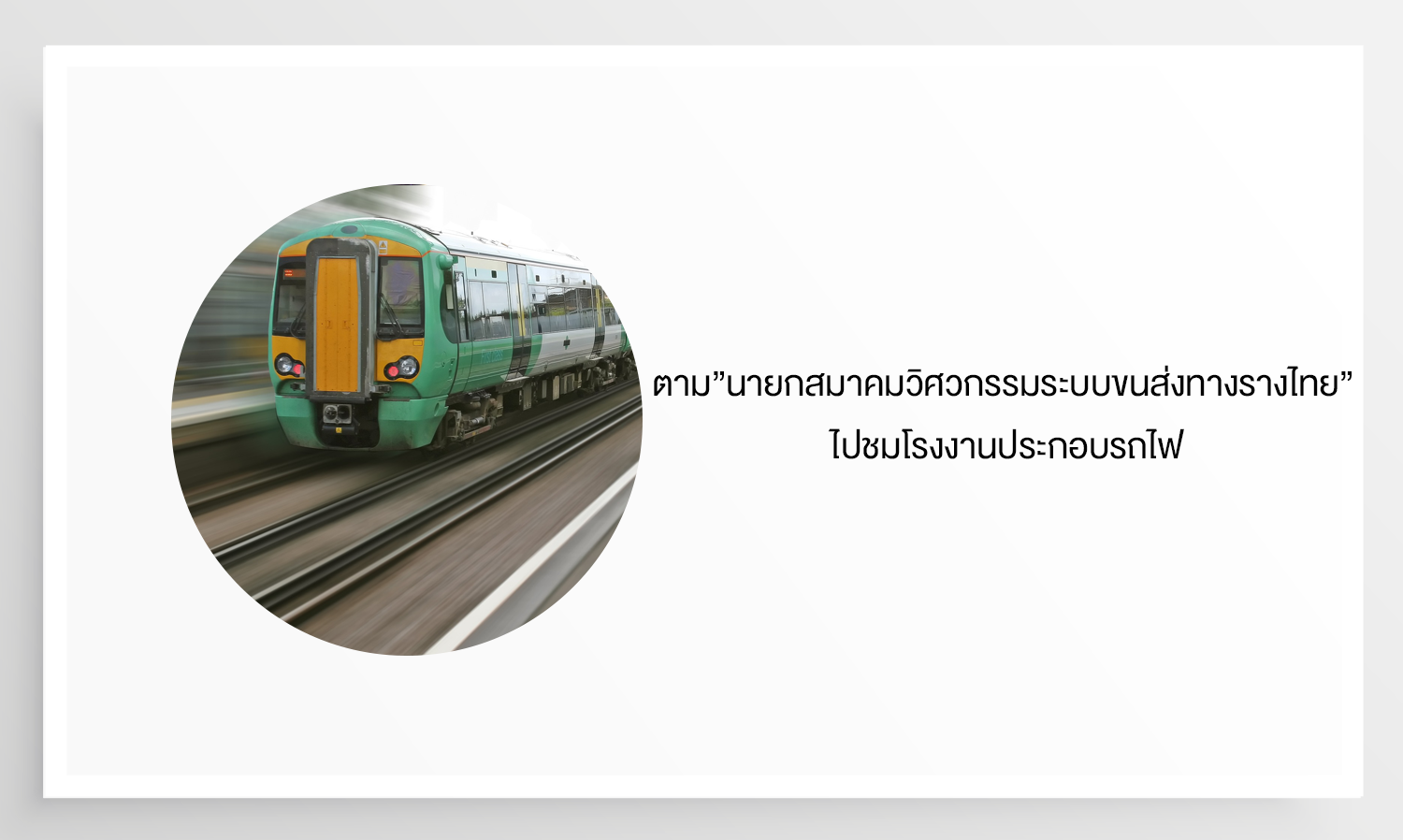
After I, (Mr. Disapol Padungkul), received news that Prof. Wareesara Veerawat from the Industrial and Logistics Department at Mahidol University is interested in train operation management and transit-oriented development (TOD), particularly around the Red Line train station in Salaya, which has potential for development due to its proximity to a large university and as a residential area for people working in Bangkok. Currently, many commuters travel by private car, leading to significant traffic congestion during rush hours before crossing the Chao Phraya River at both the Rama VIII and Phra Pin Klao bridges. As a model for developing our modern city, we hope to collaborate with Newcastle University to explore new research opportunities or other activities with the New Rail research development team, which includes a visit to the Hitachi train assembly plant in Newton Durham, located about an hour south of Newcastle. Our group consists of railway system researchers from China, labor experts from Australia, and students from New Rail, arriving at the plant around 1 PM. Before entering the factory or construction area, which is under the control of Japanese companies, safety is prioritized. We had to inform them of our shoe sizes in advance so that safety shoes could be prepared for us. Other personal protective equipment, such as reflective vests, helmets, and safety glasses, were also provided for the safety of visitors. We began our tour of the train assembly line from the reception area, moving to the assembly sections inside the train. As usual, photography was not permitted in the working areas, but we managed to take a group photo as a keepsake. I had to gather information from the website http://hitachirail-eu.com/ and found that this factory was built and officially opened two years before our visit (October 2015) with an investment of over 3.69 billion baht on approximately 80 rai of land, with a factory building area of over 44,000 square meters, including a test track with a 25 KVA electrical system, 1,100 meters long. It has created over 730 skilled and semi-skilled jobs in the northeast of England and can assemble all types of trains, including high-speed trains, intercity trains, and urban trains. More details can be found on the website. During our visit, the factory was assembling trains for two projects: the intercity train project with 866 carriages or 122 sets, using the Hitachi Class 800/801 train design, which can reach speeds of up to 200 km/h. Of the 122 sets, 42 are electric trains and 80 are diesel-electric trains. Twelve sets were imported fully from the Kasado factory in Japan, while 110 sets were assembled at this plant. The factory does not start from scratch; it does not create the body shell or bogies but imports them from Japan and Italy. Hitachi acquired the Italian company Ansaldo, which produces trains and signaling systems, two years ago, facilitating the establishment of the assembly plant in England. The other project involves the intercity trains between Edinburgh-Glasgow and Stirling-Alloa-Dunblane, which are EMU Class 385 trains capable of speeds between 160-200 km/h, consisting of 70 sets, with 46 sets having three-car configurations and 24 sets with four-car configurations. Fourteen sets were imported from Japan, including ten fully completed sets and four partially completed sets, to develop assembly skills while utilizing local content in England and Europe, as shown in the accompanying images.
Having had the opportunity to visit train assembly plants in several countries, including China, Japan, South Korea, Malaysia, and England, it is evident that the development of the transport system industry, particularly the train assembly industry, positively impacts the economy more than merely undertaking rail infrastructure projects focused solely on importing rail products from abroad. The industrial development model aligns with the studies conducted by NSTDA and TREA, which outline the following:
Step 1: Import complete carriages.
Step 2: Import some components to develop labor skills and supporting industries.
Step 3: Manufacture complete carriages, depending on the economics of the factory business. This is the correct approach.
This model can be applied to the Thai-Chinese and Thai-Japanese high-speed rail projects. We should not let our money flow out of the country for just train carriages. Let's use these baht to develop the industry, creating jobs and distributing income to the manufacturing sector for components.
Thanks for the information and images from http://hitachirail-eu.com/


Thanks for the information from www.smartgrowththailand.org