
Chinese Tourists Visiting Thailand in Q4 2017 Show Continued Positive Trends ... Expected to Exceed 9.70 Million for the Year
The China National Tourism Administration (CNTA) reported that in the first half of 2017, approximately 62.03 million Chinese tourists traveled abroad, marking a 5.1% increase compared to the same period last year. Thailand remains one of the top travel destinations for Chinese tourists. Although the Chinese tourist market in Thailand faced challenges in the first four months of 2017 due to the aftermath of regulations on zero-dollar tours, it showed signs of recovery towards the end of the first half of the year. The Kasikorn Research Center summarized the situation of the Chinese tourist market and its outlook for the remainder of 2017 as follows:
- The Chinese tourist market in Thailand has returned to normal conditions, with a growth rate of 10.3% in August 2017 compared to the same month last year.
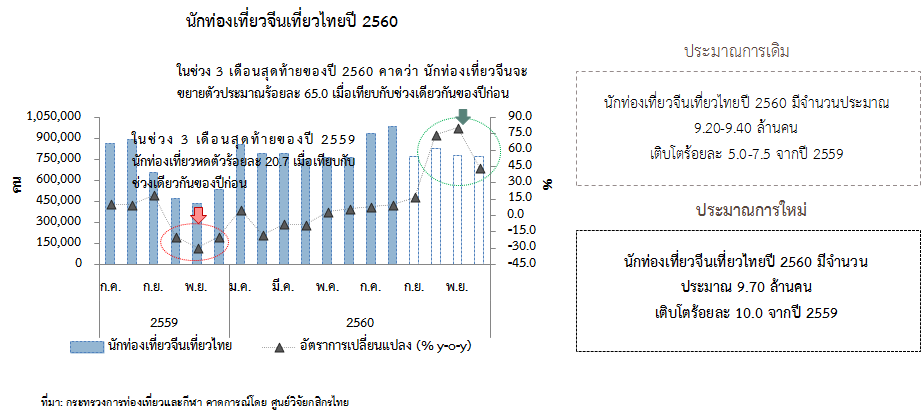
Despite a slight slowdown in growth at the beginning of the year, the Chinese tourist market in Thailand resumed its growth from May 2017. Reports from the Ministry of Tourism and Sports indicated that in August 2017, the number of Chinese tourists visiting Thailand grew for the fourth consecutive month, achieving double-digit growth for the first time in ten months, expanding by 10.3% compared to the same month last year, totaling over 983,000 visitors. Consequently, the total number of Chinese tourists visiting Thailand from January to August 2017 reached 6.63 million, a slight decline of 0.4% compared to the same period last year. This growth can be attributed to several factors, including the reduction of visa fees for foreign tourists and the impact of international political situations between China and South Korea, which led to a slowdown in Chinese tourists traveling to South Korea. Reports from the Korea Travel Organization (KTO) indicated that in the first eight months of 2017, the number of Chinese tourists visiting South Korea decreased by 48.8% compared to the same period last year.
- Chinese tourists visiting Thailand for the remainder of 2017: show a positive trend... reflected through data from Chinese travel websites where Thailand remains a top travel destination.
The atmosphere of the Chinese tourist market in Thailand for the remainder of 2017 is expected to maintain continuous growth. The Kasikorn Research Center anticipates that the Chinese tourist market will receive special support from the long National Day holiday in the first week of October 2017 (from October 1-8, 2017), during which a significant number of Chinese tourists are expected to travel to Thailand. Data from Ctrip (a major Chinese travel service website) indicates that during this year's National Day holiday, approximately 6.0 million Chinese tourists plan to travel abroad, with Thailand being the most booked destination, followed by Japan and the United States. The Kasikorn Research Center estimates that during the National Day holiday, the number of Chinese tourists visiting Thailand could reach approximately 330,000, accounting for about 5.5% of Chinese tourists traveling abroad during this holiday. The number of tourists traveling to Thailand during this year's National Day holiday is expected to increase by about 57.1% compared to the same period last year. This acceleration in the growth of Chinese tourists visiting Thailand is partly due to the international situation between China and South Korea and the comparison to the low base in 2016, which was the beginning of the zero-dollar tour regulations.
Given this trend, along with the ongoing international situation between China and South Korea, which significantly affects Chinese tourists' travel patterns, it is likely that Chinese tourism operators will continue to seek alternative destinations in the region to compensate for the South Korean market. Additionally, the Chinese tourist market in Thailand remains large and significant, prompting Thai businesses to focus on targeting Chinese tourists continuously. Financial institutions and retail businesses have also introduced payment solutions like Alipay and WeChat Pay to facilitate spending for Chinese tourists. The Kasikorn Research Center has revised its estimate for Chinese tourists visiting Thailand in 2017 to 9.70 million (up from the previous estimate of 9.20-9.40 million), with a growth rate of 10.0%, continuing from a 10.5% growth in 2016. It is also expected that revenue from Chinese tourists will reach approximately 510 billion baht, an increase of 12.9% from a 15.2% growth in 2016.
However, even though the number of Chinese tourists visiting Thailand is expected to increase, there are issues that tourism operators targeting Chinese tourists may need to monitor. Marketing to Chinese tourists is no longer as straightforward as before. Operators focusing on Chinese tour groups or marketing to Chinese tourists will need to have strategies in place to compete with other countries for this market segment. Additionally, there is a noticeable shift in the behavior of Chinese tourists, moving from large tour groups to smaller groups or independent travel, especially among working-age individuals and students. This change is facilitated by reduced language barriers and the ease of accessing information online for price comparisons and discovering new attractions.
Considering Thailand's tourism market position targeting Chinese tourists based on tour package pricing, Thai operators face intense competition, particularly as the prices of travel packages to Thailand have risen due to increased domestic business costs. The prices of packages to Thailand are now comparable to those for Japan (the lowest average price), leading to price comparisons. At the same time, price-sensitive Chinese tourists may consider traveling to countries with cheaper packages, such as Vietnam or Cambodia, which have seen a significant increase in Chinese tourists since the beginning of 2017. Therefore, Thai operators may need to consider adjusting their tourism product offerings to align with the trends of Chinese tourists and competitive pricing to remain viable.
Additionally, there are other factors that operators need to monitor, such as the policies of the Chinese government, which plans to stimulate domestic tourism growth from 2016 to 2020. Data from the CNTA indicates that domestic travel among Chinese tourists has been accelerating, with a growth rate of over 13.5% in the first half of 2017 compared to the same period last year (totaling 2.54 billion trips). This plan to stimulate domestic tourism may lead Chinese tourism businesses, including travel agencies and airlines, to expand their domestic routes, posing a challenge to maintaining growth in the Chinese tourist market in the future.
Thank you for the information from www.kasikornresearch.com