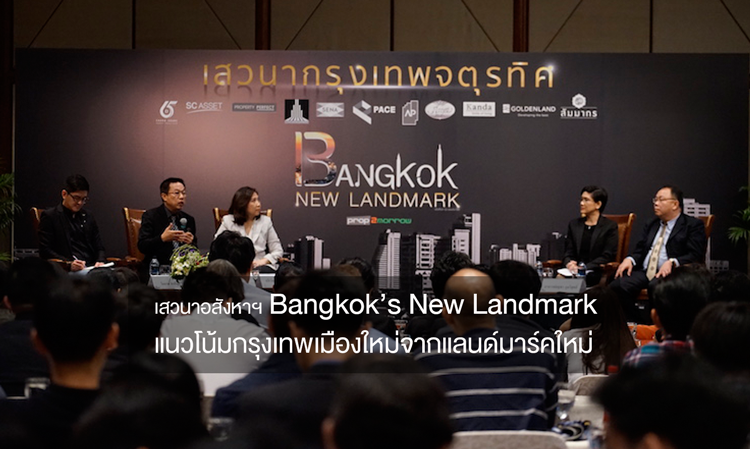
Real Estate Forum: "Bangkok’s New Landmark - Trends of a New Bangkok from New Landmarks"
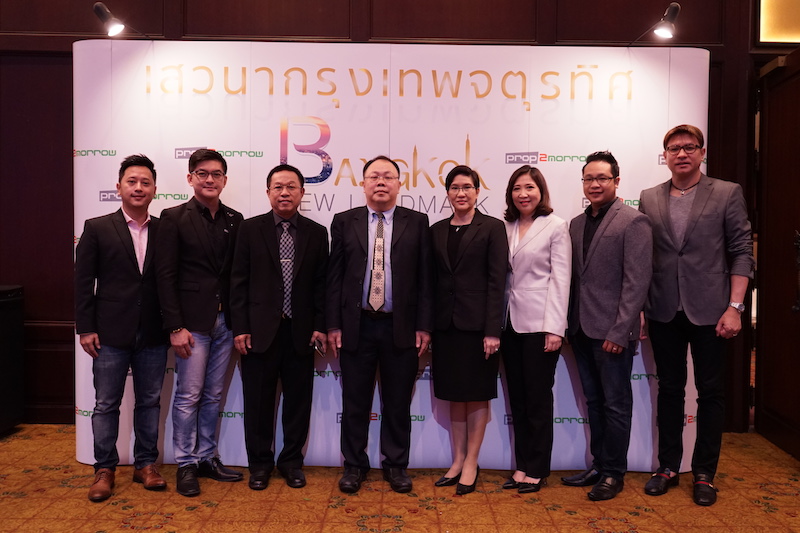
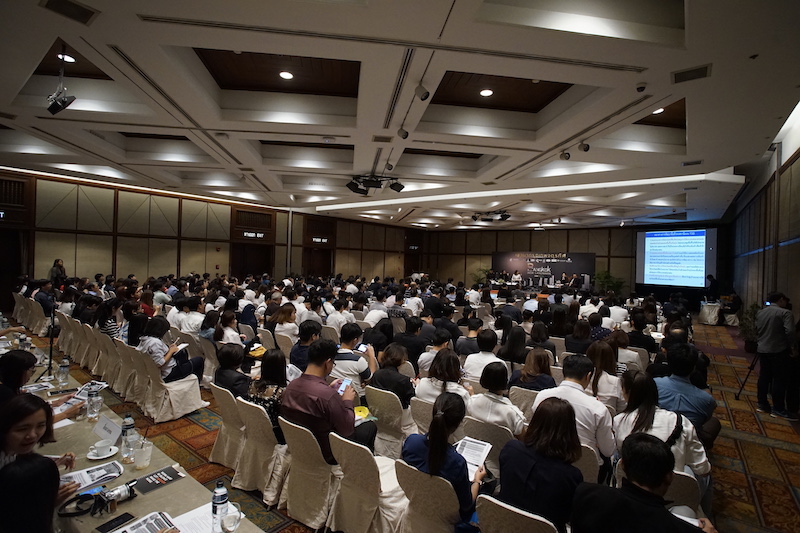
Prop2morrow organized a forum titled “Bangkok’s New Landmark - Trends of a New Bangkok from New Landmarks” featuring speakers from both the public and private sectors, including Mr. Kongkanok Menaruchi, a policy analyst and head of the rail transport strategy and planning group at the Office of Transport and Traffic Policy and Planning or OTP.
Since the first rail system was established in 1994, with the light green line (Sukhumvit) and the dark green line (Silom), there are currently plans for a total of 12 routes, divided into major systems like BTS and MRT, and secondary systems like monorails, the orange line, and the pink line, depending on passenger numbers in those areas over a long-term period of 30 years, to create a master plan known as M-Map.
The Master Plan for Rail Mass Transit in Bangkok and Surrounding Areas (M-MAP)
The network is expected to be completed by 2029 with 12 lines, including 10 main lines under an expedited plan approved by the cabinet, covering a distance of 464 kilometers with 312 stations, serving an area of 680 square kilometers and accommodating 5.13 million people. The remaining 2 secondary lines, the blue and gray lines, will be managed by the Bangkok Metropolitan Administration. Additionally, a unified ticketing system will be implemented to reduce the initial fare to one time, with actual charges based on distance traveled.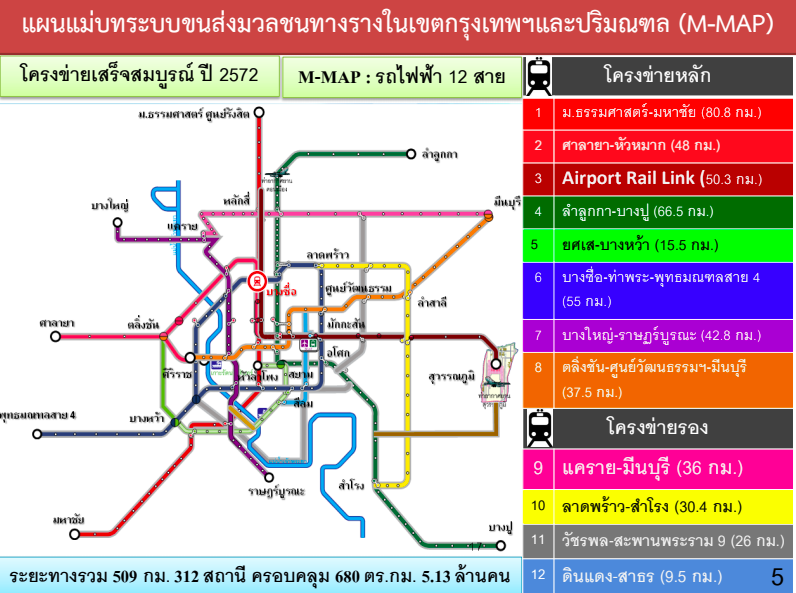
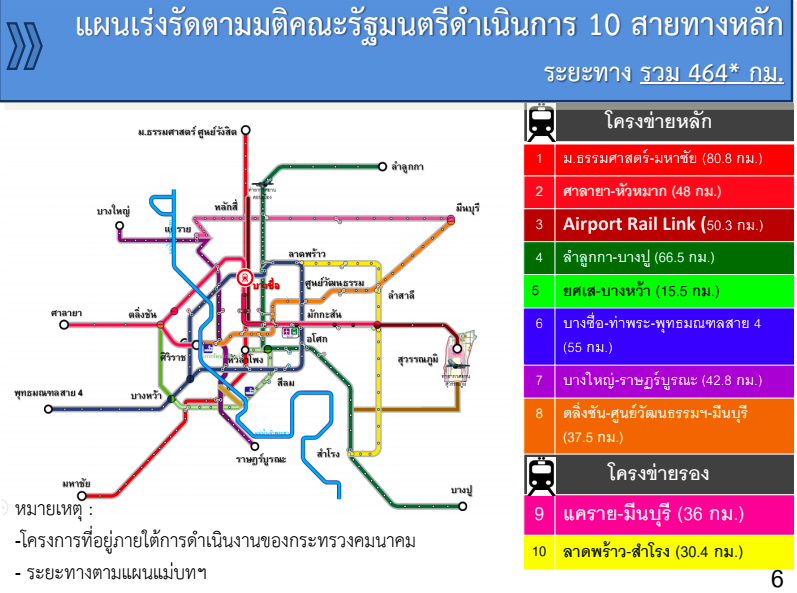
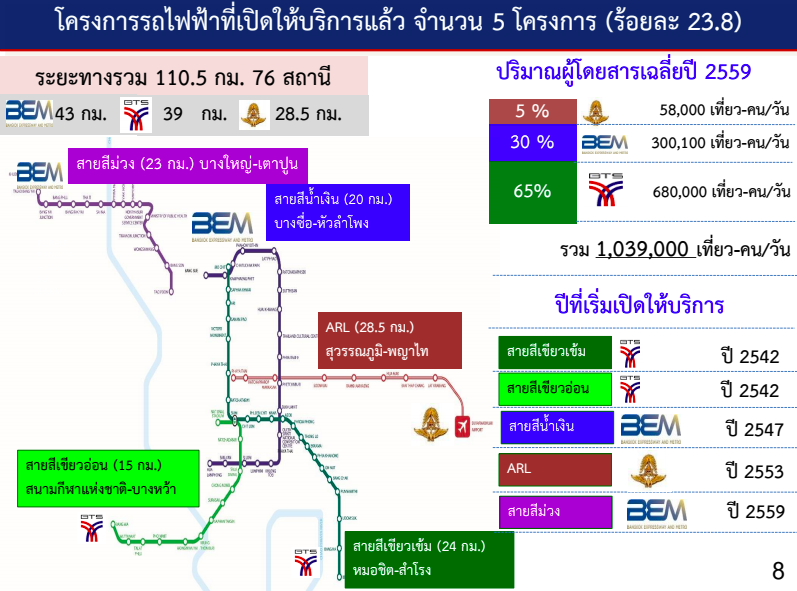
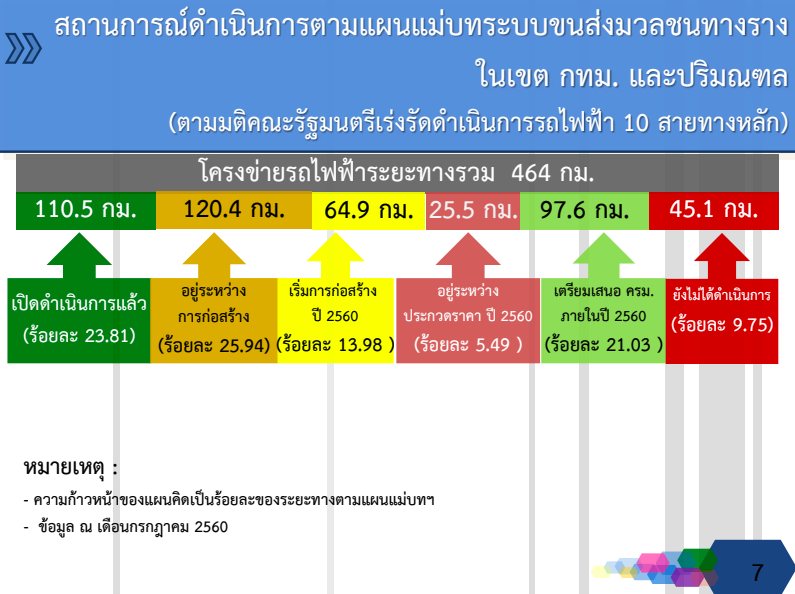
The network consists of 8 main routes and 2 secondary routes. Currently, 5 projects covering 110.5 kilometers (23.81%) are operational, while 6 projects covering 120.4 kilometers (25.94%) are under construction. Additionally, 6 projects covering 64.9 kilometers (19.98%) have completed bidding and are set to begin construction this year (as approved by the cabinet on May 30).
There are 7 projects awaiting cabinet approval this year, totaling 97.6 kilometers (21.03%), including the dark red line from Rangsit to Thammasat University (10 kilometers), the light red line from Taling Chan to Salaya (14 kilometers), the blue line from Bangkae to Phutthamonthon Sai 4 (8 kilometers), the dark green line from Kukot to Lam Luk Ka (6.8 kilometers), the new ARL line from Phaya Thai to Bang Sue (21.8 kilometers), the orange line from the Cultural Center to Bang Khun Non (13.4 kilometers), and the purple line from Tao Poon to Rat Burana (23.6 kilometers), with 9.75% still not initiated. By 2019, a total of 140.2 kilometers will be operational, followed by 326.4 kilometers in 2021, and 418.9 kilometers by 2029.
Furthermore, the cabinet has assigned the OTP to study and consider including 3 secondary mass transit projects in Bangkok in M-Map 2: the gray line from Watcharapol to Rama 9 Bridge (26 kilometers), the Bangna-Suvarnabhumi light transit system, and the gold line from Krung Thonburi BTS station to Klong San district and Prachathipok Road (2.7 kilometers).
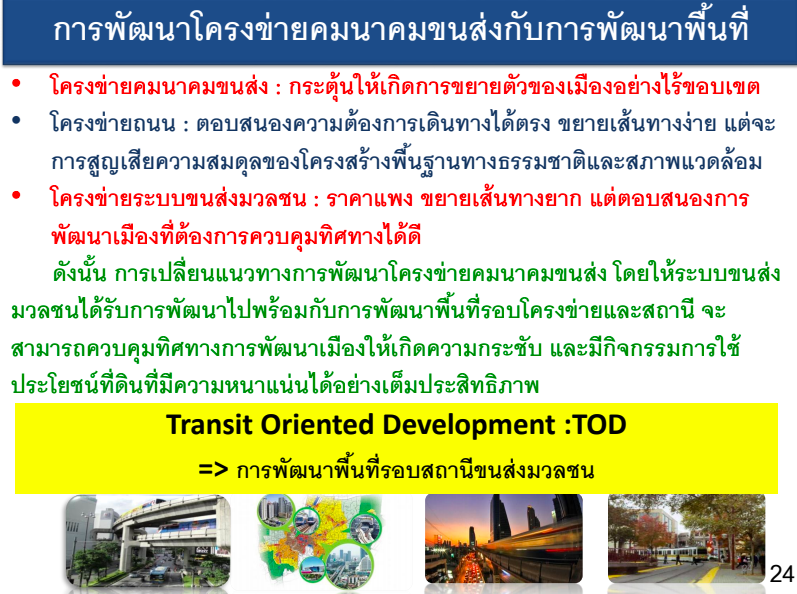
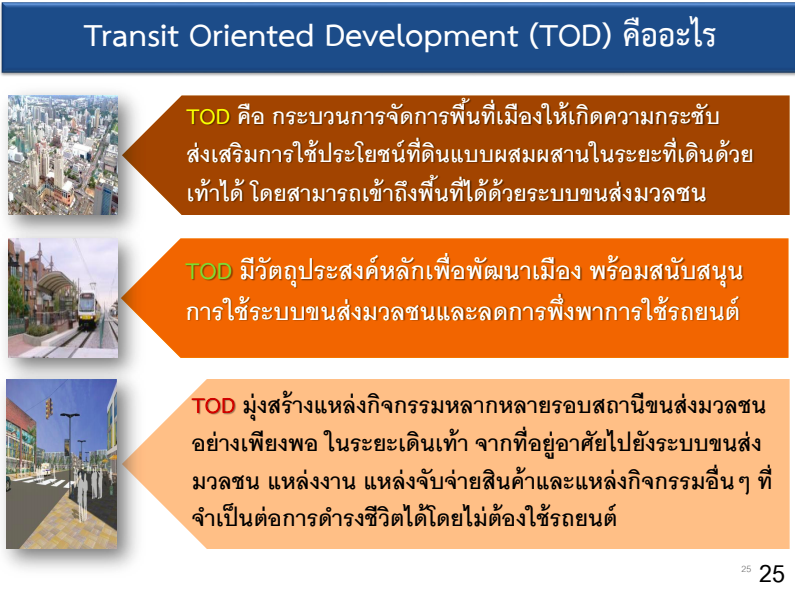
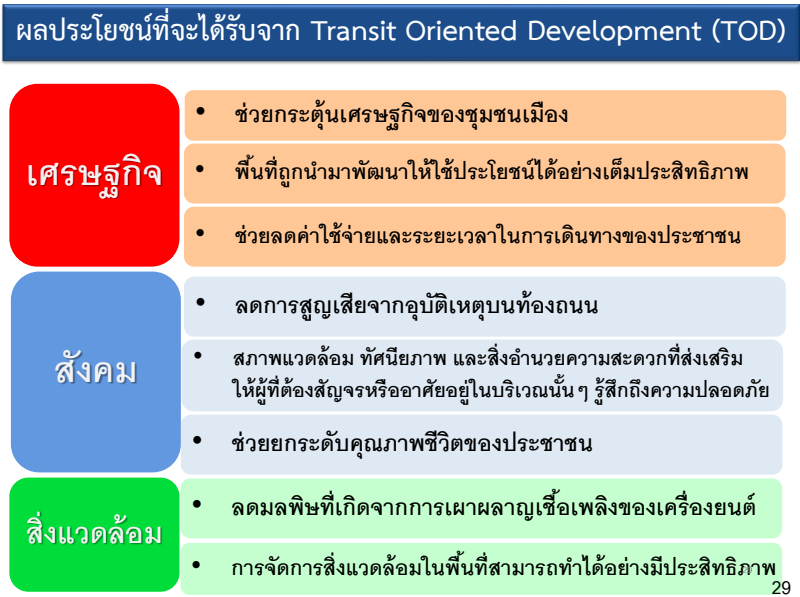
With the announcement of the new city plan in 2018, it supports the development of the mass transit system, promoting dense residential areas within a 500-meter radius around 400 BTS stations. The principles of Transit-Oriented Development (TOD) are applied to manage urban areas to be compact, encouraging mixed-use land development within walking distance from residences to mass transit systems, workplaces, shopping areas, and other activities without the need for cars. Investors developing suitable TOD projects will receive bonuses, such as an increase in development potential if green spaces are included.
Additionally, the Ministry of Interior has been tasked with drafting a metropolitan city plan, which combines the Bangkok plan with neighboring provinces to guide urban development in a unified direction, preventing disparities in development and establishing a consistent Floor Area Ratio (FAR).
Ms. Aliwasa Patthanathabutr, Managing Director of CBRE (Thailand) Co., Ltd. stated that various factors have caused demand and supply to misalign, resulting in some projects being successfully sold while others struggle. Tourists visiting Thailand have become small investors purchasing condominiums, particularly Chinese tourists, who continue to expand their investments over the next 10 years. However, the Chinese government has set limits on the amount of money that can be transferred abroad, which may lead to issues with transferring ownership, resulting in increased stock in the market.
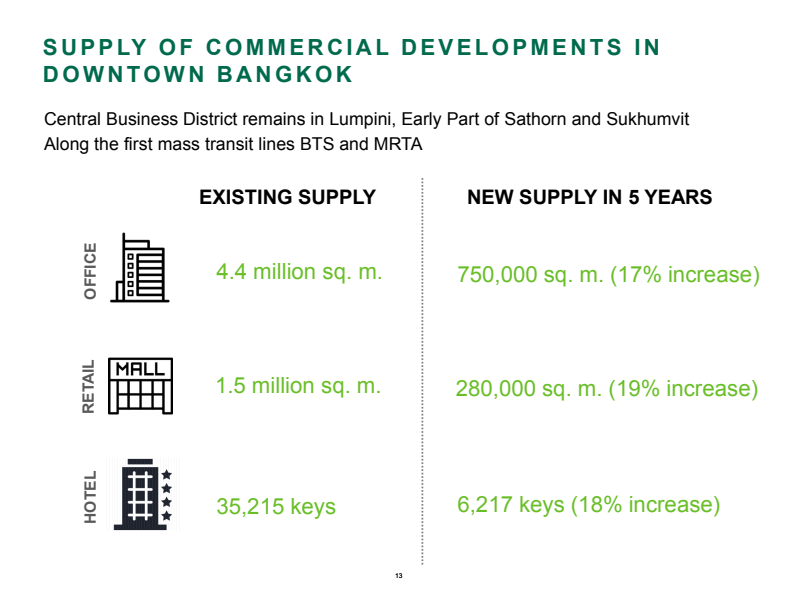
The real estate trend in the next 5 years is expected to slow down in terms of unit numbers and new project launches, but developments will be of higher quality. Consumers will increasingly demand public spaces, such as green areas; if developers do not adapt, they will struggle to sell.
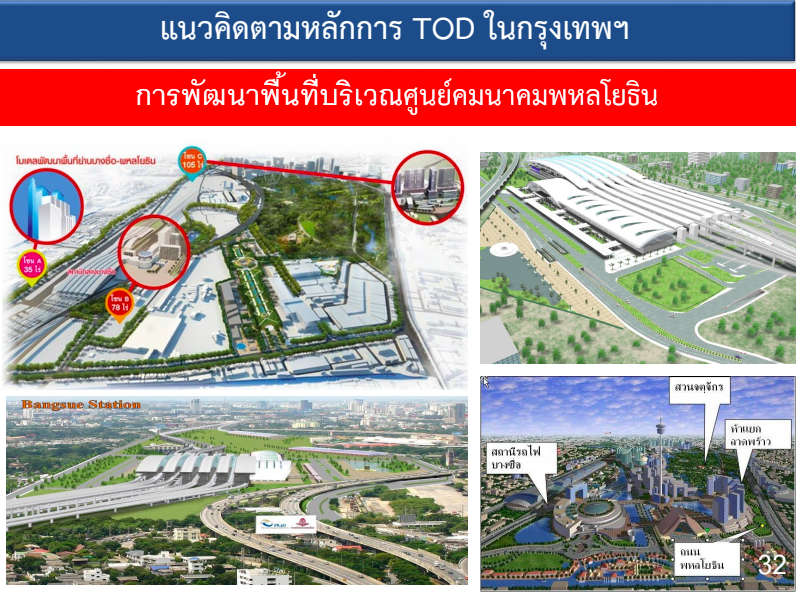
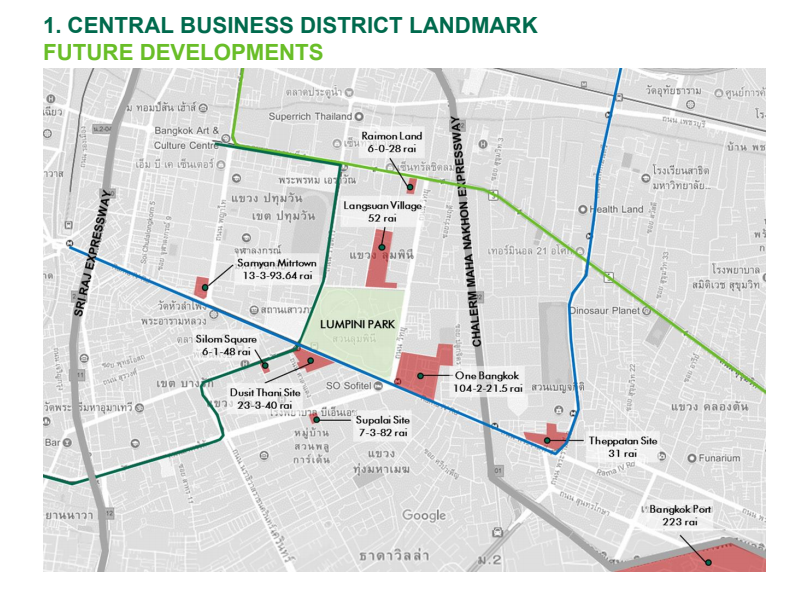
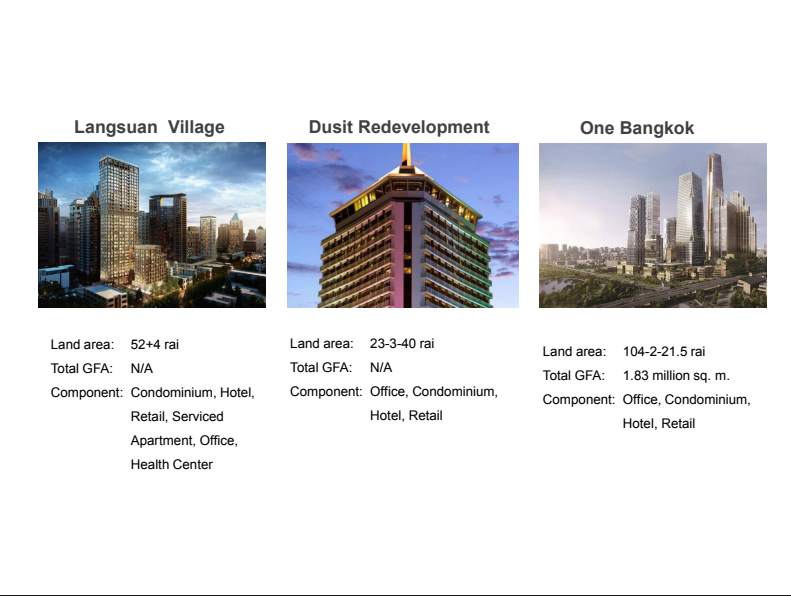
Moreover, in the next 5 years, new landmarks will emerge from the integration of 3 major projects: One Bangkok (104 rai), the land development project around Dusit Hotel (23 rai), and the Lang Suan Village project (52 rai). However, all 3 projects are leasehold areas, so when they are sold, they cannot be sold outright but must be leased long-term, necessitating a comparison of sale prices between leasehold and freehold.
The expansion of Bangkok looks towards Pattaya, focusing on Bang Sare, which is not far from Bangkok, easily accessible, and has development potential to support the AEC, as well as being an important tourist destination, leading to related businesses such as restaurants, hotels, and residential accommodations. Therefore, new mixed-use projects are emerging on large land parcels to meet market demand.
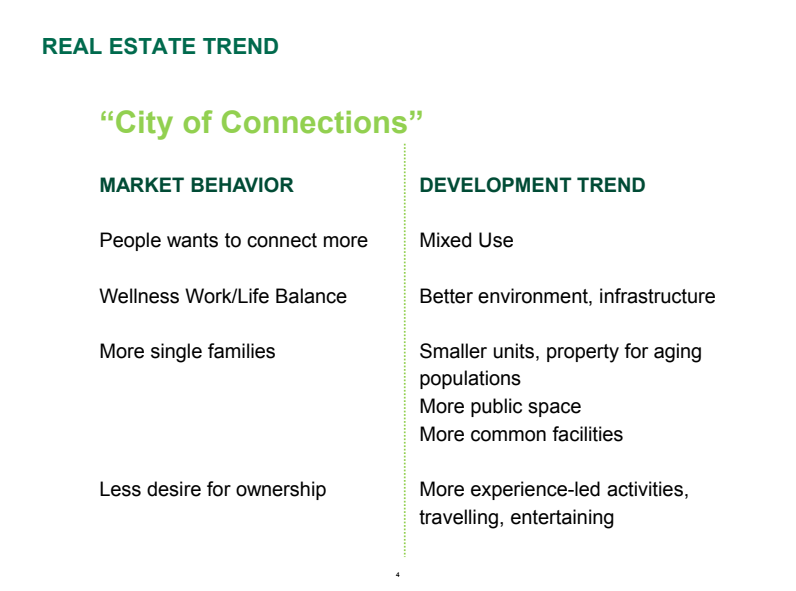
Mr. Isara Boonyang, Honorary President of the Housing Business Association mentioned that the rail system project model is a crucial factor for Bangkok's growth. The expansion of the rail system to the regions will lead to the development of cities along the routes, creating central cities distributed across the regions, such as Laem Chabang Port taking over the role of Klong Toey Port, and the expansion of U-Tapao Airport to support the Eastern Economic Corridor (EEC) plan, which will establish central cities instead of regional ones.
The expansion of the electric train routes will lead to more development outside the city, but the amount of land available for development remains the same. If the Floor Area Ratio (FAR) does not change, the land available for new development will decrease. Although development may extend further out to provide affordable housing, the FAR in the outer areas will decrease, thus not helping to lower prices.
Overall, the real estate market this year is expected to grow by 5-10%. However, the transfer of ownership for loans from January to July has decreased by 25%, with horizontal properties down by 17% and high-rise properties down by 33%. A survey on housing demand shows that 73% of people are looking for properties priced between 1-4 million baht, while the demand for high-end homes is around 3,000 units per year, leading most developers to focus on the market priced below 5 million baht, which is a larger market.
Mr. Anucha Kulvisut, a real estate investment expert noted that the return on investment in condominiums over the past 2-3 years has been declining from 6-8% to only 4-6%. Data from the housing price index from bank loan data shows that since the beginning of this year until July 2017, single-family homes and townhomes have started to improve after declining from 2015-2016, with a growth rate of 3.9%, while condominiums have begun to decline by 2.9%, despite having good growth over the past 4 years.
Next year, the real estate market is expected to perform well, as indicated by the improving SET index. Typically, when the stock market is doing well, stock traders will invest their profits into real estate.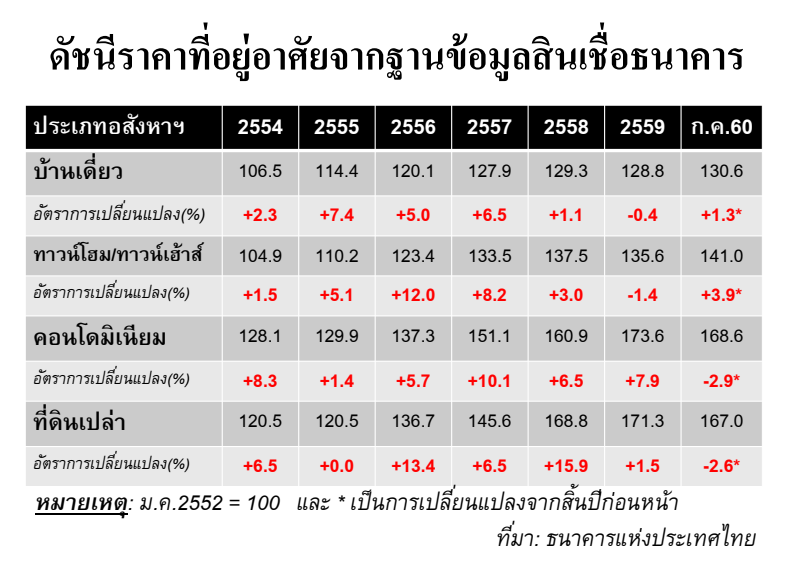
When choosing to invest in condominiums, it is essential to consider that new condominiums for sale along unconstructed electric train routes are often priced as if the train is already operational. Therefore, it is advisable to select projects located along completed train lines, preferably those adjacent to stations or no more than 400 meters away, focusing on stations that are junctions or have skywalks, ensuring that the walking distance from the residence to the train station and other amenities does not exceed 15 minutes, and checking for parking availability in the project, which typically accommodates 30-60% of the number of units. Choosing condominiums in red zones will maintain their value, and opting for newly completed condominiums will allow for immediate sales at good prices.
Thank you for the information from: www.prop2morrow.com