Prime Real Estate Markets in Leading ASEAN Cities: Bangkok, Singapore, Kuala Lumpur, Jakarta
For real estate investors, which country in ASEAN should we choose to invest in? You should pay attention to the four major countries in the region, namely Singapore, Malaysia, Thailand, and Indonesia, as the capitals of these four countries have investment potential in the prime residential market, attracting investors from various groups, as stated by Mr. Nicholas Holt Head of Research Knight Frank Asia Pacific.
According to Knight Frank's research, the five-year investment return in the prime residential sector during the first quarter of 2017 (1Q2017) in Kuala Lumpur was 2.1%, while Jakarta (Q4 2016) and Bangkok showed significant growth at 123.3% and 51.3% respectively, whereas Singapore saw a decline to 1.3%.
Bangkok: Watch the Condo Market
Prime residential real estate located in Bangkok's central business district has shown positive trends in recent years, with various outstanding projects in terms of quality, amenities, and selling prices per square meter, according to Ms. Ritsini Sarikabutra, Director, Head of Research and Consulting Knight Frank Thailand. The five-year investment return in the luxury residential market in Bangkok from the first quarter of 2012 to the first quarter of 2017 was approximately 51.3%.
"Thailand remains a good long-term investment option as the buyer demographics continue to expand, providing investors with opportunities for higher returns," she stated.
The supply of prime real estate in Bangkok is expected to see limited growth due to the shortage of suitable land at reasonable prices. Therefore, property prices in this sector are anticipated to rise further as no new supply is expected while demand remains high,” she said.
Notably, there is increasing demand in the prime condo market in Bangkok. “Condos have become a significant highlight in Bangkok's real estate sector. The rising cost of commuting and the rapidly changing lifestyle of Thais are driving this increase, especially in the downtown condo market which attracts working professionals and retirees,” Ms. Ritsini remarked.
Singapore: A Safe Investment Paradise
Singapore is renowned as a safe investment destination, attracting ultra-high-net-worth investors from around the world, Mr. Holt stated. Singapore ranks as the second most popular country for ultra-high-net-worth individuals globally who own overseas real estate, according to Knight Frank's 2017 Wealth Report.
Alice Tan Director and Head of Research and Consultancy Knight Frank Singapore noted that investors and homeowners view Singapore as a safe investment location and choose to invest in private residential properties as a short to medium-term investment option. "We have observed an increase in transactions for prime private residential properties located in Singapore's central region.
In the first quarter of 2017, 729 units of residential properties were sold in Singapore's central region, accounting for 14% of the total transaction volume in the city during the same period, which is higher than the quarterly average of 691 units sold in 2016," she added. She also mentioned that there continues to be price growth in the luxury condo market, at 4% year-on-year in the first quarter of 2017.
"The adjustment of the seller's stamp duty period from 4 years to 3 years may help offset costs for potential homebuyers looking to invest in Singapore's private residential market,” she said.
"However, there remains a significant number of unsold properties, totaling 5,555 units in central Singapore. The additional tax burden affecting developers and the lack of broad economic recovery indicators pose negative risks to demand and prices in the prime private residential market,” she stated. Given the various circumstances and unpredictable situations, she believes that prices for prime residential properties without land in Singapore may decrease by 1-2% year-on-year in the fourth quarter of 2017.
Kuala Lumpur: Quality Homes at Lower Starting Prices
Mr. Holt stated that Kuala Lumpur offers high-quality residential properties at lower starting prices compared to other regional markets.
According to data from consulting firms, the price of residential properties in Kuala Lumpur was $4,608.30 per square meter at the end of 2016, which is higher than Jakarta's price of $4,366.81 per square meter but still lower than Bangkok's price of $9,708.74 per square meter and Singapore's $23,255.81 per square meter. In other words, investors can purchase a luxury home with a usable area of 217 square meters in Kuala Lumpur for $1 million compared to 229 square meters in Jakarta, 103 square meters in Bangkok, and 43 square meters in Singapore.
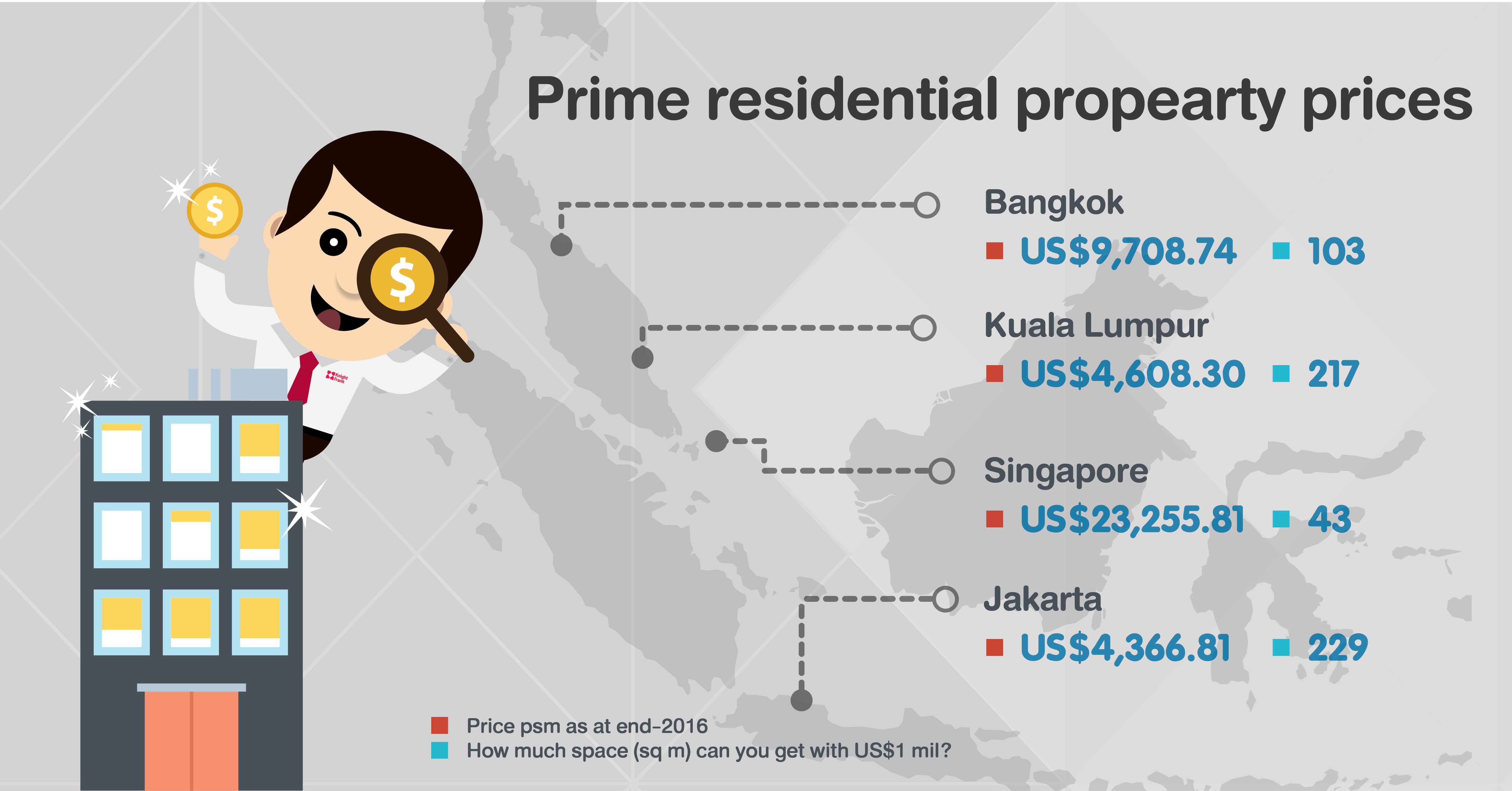
Source: Knight Frank and TheEdgeproperty.com
"In terms of pricing, Kuala Lumpur is very attractive, and with no restrictions on property ownership, foreigners can purchase real estate and hold ownership under varying price thresholds in each city," Judy Ong Director of Research and Consultancy Knight Frank Malaysia stated.
Additionally, Kuala Lumpur offers a lower cost of living compared to other cities and has a better transportation network with ongoing and upcoming infrastructure projects such as the MRT (Mass Rapid Transit) project, light rail expansion, and the proposed high-speed rail project between Kuala Lumpur and Singapore (HSR).
Although the cooling measures implemented since 2012 have impacted the prime residential property market in Kuala Lumpur, causing a decrease of 1.9% in the first quarter of 2017 compared to the previous year, Sarukunaan Subramaniam Managing Director Knight Frank Malaysia stated that the good GDP performance in the first quarter of 2017, coupled with the upcoming major elections, may help boost market confidence.
"With the first MRT line in the Greater Klang Valley completed and set to launch fully in July, along with the proposed high-speed rail (HSR) project, both projects will have a positive impact. Kuala Lumpur remains one of the most livable cities in Southeast Asia and even globally," he said.
To enhance the appeal of prime residential properties in Kuala Lumpur, Ong suggested that the government should review issues related to stamp duty and other transaction costs, including property income tax.
Furthermore, the Malaysia My Second Home program needs to be improved and promoted further, with additional promotions to position the city as a gateway for multinational companies and international financial institutions.
Jakarta: Overall Positive Investment
In the fourth quarter of 2016, the price of prime residential properties in Jakarta showed a slowdown, with an increase of only 0.3% year-on-year, Hazaan Pamudji Senior Assistant Director of Consulting and Property Valuation Knight Frank Indonesia stated.
"The overall outlook for 2017 still presents both opportunities and challenges positively. Despite the successful local elections and tax amnesty program early in 2017, prime real estate buyers and investors remain cautious, choosing to wait and see due to political uncertainties and transparency issues in banking regarding taxes," he said.
This has led some major prime real estate developers to shift towards developing affordable projects in suburban areas, targeting first-time homebuyers while waiting for the main market to improve.
Pamudji believes that the cautious wait-and-see attitude will persist until the presidential elections in 2019, which will depend on peaceful outcomes and improved economic conditions.
Thank you for the information from www.knightfrank.com