End-of-Year Economic Stimulus and Challenges for Resorts, Hotels, and Carbon Footprint
At the end of each year, the tourism sector often serves as a crucial driver that helps revitalize the economy, thanks to both Thai and international tourists who travel for leisure, spend money, and utilize various business services, all of which contribute to generating income and circulating funds within the system continuously.
However, Thailand's tourism industry has faced a crisis due to negative factors affecting confidence, such as safety concerns along the Thai-Myanmar border, the impact of natural disasters, and a slowing economy.
The latest report from the Ministry of Tourism and Sports indicates that from January 1 to September 21, 2025, a total of 23,450,122 international tourists visited Thailand, a decrease of 7.44% compared to the same period last year.
To stimulate the economy, the government has introduced the “Good Travel, Good Return 2025” initiative, offering tax deductions of up to 30,000 baht per person to encourage more Thai citizens to travel domestically during the end of the year to the beginning of the next year. This is expected to generate significant financial circulation in the economy, increase income for local businesses and communities nationwide, and distribute economic opportunities to small and medium-sized enterprises in the tourism sector.
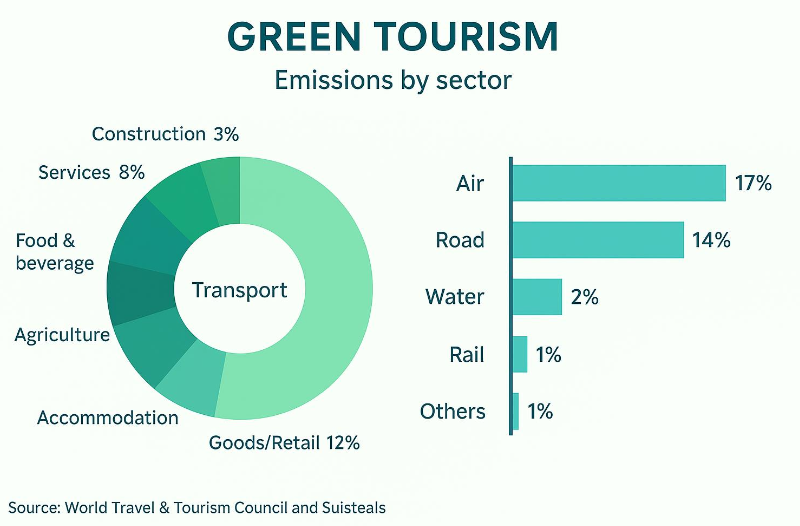
Nonetheless, the recovery of the tourism industry is not only an economic driver but also one of the major sources of greenhouse gas emissions globally.
A report from Krungsri Research (2024) states that global tourism activities emit approximately 3.9 to 5.4 billion tons of carbon dioxide equivalent, accounting for 8 to 11% of global emissions, with the hotel sector contributing about 6% of the total.
Meanwhile, EY Parthenon and Booking.com report that accommodation providers worldwide emit over 264 million tons of carbon dioxide annually, representing about 10% of the carbon footprint in the entire tourism industry.
These figures reflect that the hotel business is one of the sectors that must adapt the most. Hotels around the world are beginning to prioritize reducing their environmental impact through efficient energy use, water resource management, and waste reduction at every stage of operation.
A key approach that is gaining popularity is Green Building Certification such as LEED, TREES, EDGE, and Green Hotel Plus, which not only confirms the organization's environmental commitment but also produces measurable practical results, such as:
-
Reducing electricity consumption by an average of 20-40%
-
Reducing water usage by 20-30%
-
Reducing landfill waste by over 50%
In Thailand, for example, InterContinental Chiang Mai Mae Ping and TRIBE Living Bangkok Sukhumvit 39 have received international green building certification, achieving over 25% annual energy savings and reducing carbon dioxide emissions by more than 1,000 tons per year, exemplifying a business that harmoniously integrates “economic profit” with “environmental responsibility.”

Modern travelers' behaviors are also clearly changing. Research from Booking.com (2024) found that:
-
81% of global travelers and
-
98% of Thai travelers
prefer to stay in accommodations that operate sustainably.
At the same time, 83% of Thai travelers are willing to pay more to support hotels with clear environmental policies, reflecting that “sustainability” is no longer just an image but has become “a key factor in consumer decision-making.”
The government is also pushing the Value over Volume policy to shift from relying on the number of tourists to creating sustainable “value” in the economy by enhancing the quality of tourist attractions, preserving culture, and reducing environmental impacts, which aligns with the concept of Circular Economy that encourages tourism businesses to use resources wisely and recycle them.
Overall, the end-of-year economic stimulus represents a significant opportunity to drive Thailand's economy to grow. However, it is also a turning point where all sectors should look beyond just the number of tourists, as the sustainability of this industry can only be achieved when “economy, environment, and society” grow together in balance.
“Economic growth will be more meaningful if it is growth that does not leave the environment behind.”
Thus, hotels and resorts not only generate income but also play a crucial role in steering Thailand towards a Low-Carbon Economy and a future of sustainable tourism where people, businesses, and nature can coexist in harmony.
For more information, visit www.lws.co.th
By Prabhan Sak Raksaiwan
Managing Director, LWS Wisdom and Solutions Co., Ltd.