
Minimum Wage Starting in 2025 Increased by an Average of 2.9% - Koh Samui and Chachoengsao See the Highest Increase of 14-15%
- The Kasikorn Research Center predicts that the adjustment of the minimum wage starting from January 1, 2025 will average 355 baht/day, which will lead to an increase in labor costs for businesses by at least 2%.
- Businesses that rely heavily on low-skilled labor are expected to be more affected than others, particularly in the sectors of agriculture, construction, hotels and restaurants, retail-wholesale, and manufacturing. The impact may vary by region.
- Looking ahead, there is a tendency for the minimum wage to be further increased. Therefore, enhancing labor productivity and restructuring production towards targeted industries is crucial for businesses.
On December 24, 2024, the Cabinet approved the conclusions of the Tripartite Wage Committee to announce an unequal nationwide minimum wage increase, effective from January 1, 2025, resulting in an average nationwide minimum wage increase from 345 baht/day (the last nationwide adjustment was on January 1, 2024) to 355 baht/day, representing an average increase of 2.9%. The details are as follows:
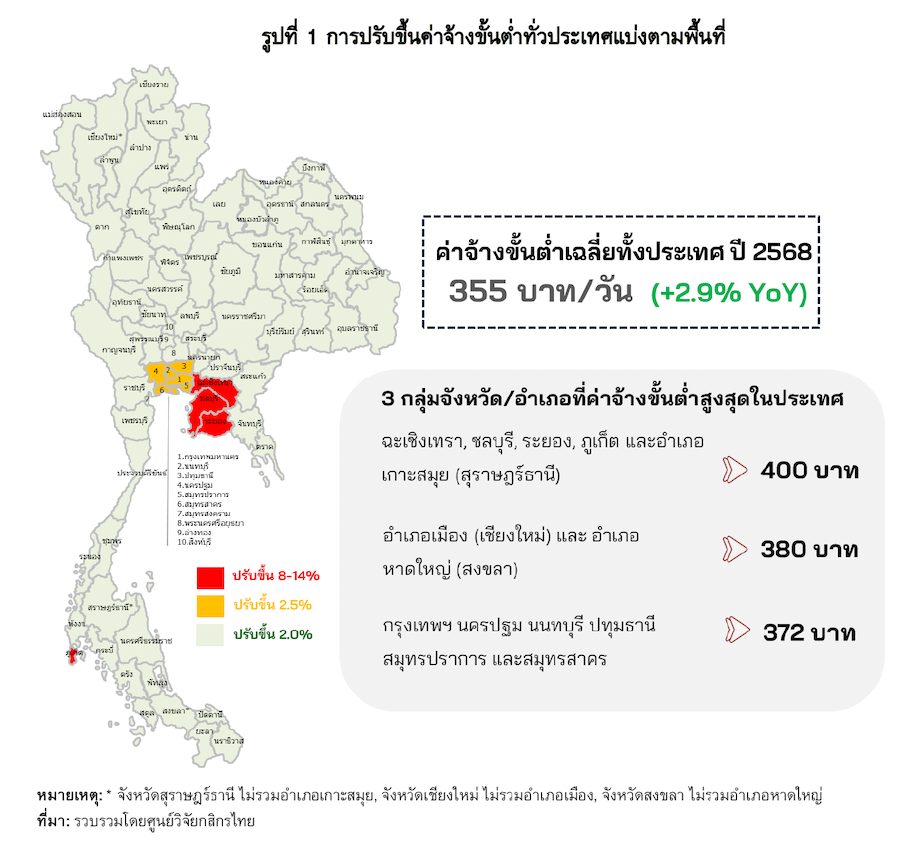
- The minimum wage will be increased to 400 baht/day in only 4 provinces and 1 district: Chachoengsao, Chonburi, Rayong, Phuket, and Koh Samui (Surat Thani).
- The minimum wage will be increased to 380 baht/day in 2 districts: Mueang (Chiang Mai) and Hat Yai (Songkhla).
- The minimum wage will be increased to 372 baht/day, representing a 2.5% increase from the previous rate for the Bangkok and surrounding areas, totaling 6 provinces.
- The minimum wage will be increased by another 2% from the previous rate for the remaining 67 provinces.
The Kasikorn Research Center estimates that this minimum wage adjustment will lead to an average increase in labor costs for businesses of at least 2% (assuming other factors remain constant)[1] and may reduce business margins amidst high economic uncertainty, including weak purchasing power and declining competitiveness of Thailand. However, the level of impact on businesses may vary as follows:
1) The minimum wage increase is expected to impact businesses that rely heavily on low-skilled labor, as these businesses often pay wages based on the minimum wage (less than 10,000 baht per month), particularly in agriculture (76% of total employment), hotels and restaurants (46%), construction (46%), manufacturing (36%), and retail-wholesale (35%).
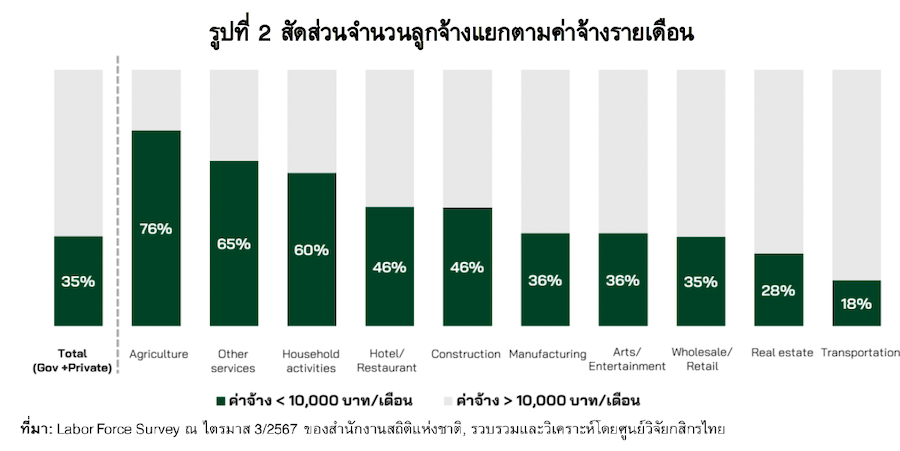
However, the net effect of the minimum wage increase, aside from the high proportion of labor relying on the minimum wage, will depend on the specific factors of each business, such as their ability to generate revenue and manage costs, adjust product and service prices, and adapt. For instance, larger enterprises are likely to be less affected than SMEs due to better risk diversification in costs, and manufacturing businesses may not be significantly impacted as they can more easily adopt labor-saving technologies compared to the service or agricultural sectors.
2) In terms of regional aspects, the wage increase this time, ranging from 7-55 baht, will result in varying labor cost increases across provinces. Businesses located in areas with significant minimum wage increases may face higher labor costs than similar businesses in other areas, particularly in tourist areas like Koh Samui (Surat Thani), where the minimum wage increased by as much as 15%, as well as Mueang (Chiang Mai) and Hat Yai (Songkhla), which saw increases of 9-10% from the previous rates.
In Chachoengsao, Chonburi, and Rayong, although the minimum wage has increased by 8-14% from the previous rate, the impact is expected to be limited in some areas, such as the EEC region, where businesses are often in targeted industries like electrical appliances and electronics, automotive and parts, which typically employ skilled labor at wages higher than the minimum wage, as reflected by the average wage for vocational and associate degree workers at 20,368 baht/month[2]. Additionally, the use of labor-saving technologies such as automation/robotics means that manufacturing businesses in these areas may not face severe impacts.
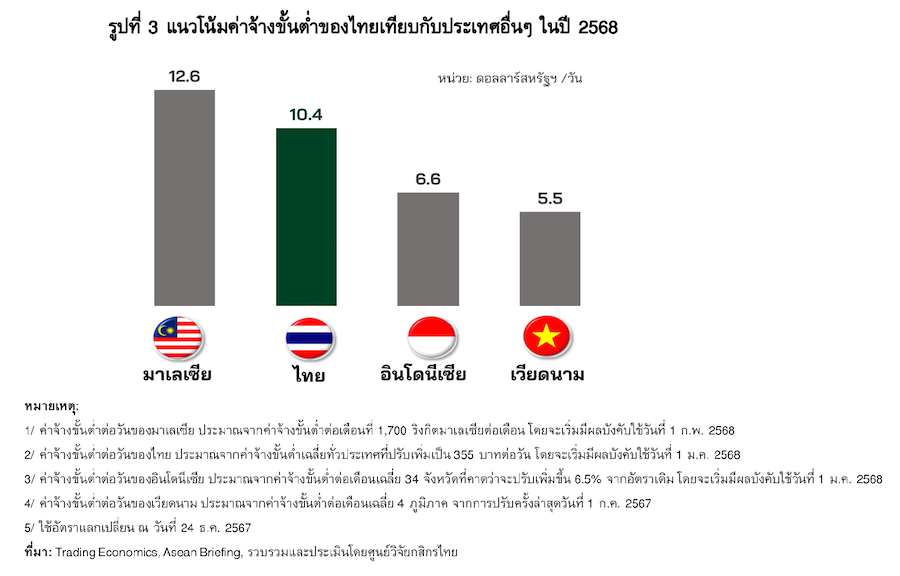
The minimum wage increase is one of many factors affecting the competitiveness of Thai businesses. Currently, Thailand's labor costs are higher than some competing countries such as Indonesia and Vietnam. Coupled with the rapid transition to a super-aged society compared to many ASEAN countries, and the potential for higher economic growth in these countries, attracting foreign investment in Thailand will increasingly rely on skilled labor and other fundamental factors.