Krungthai Bank Projects Thai Economy to Grow 3.2% This Year, Highlights Global Economic Challenges and Urges Businesses to Focus on Risk Management
Krungthai COMPASS Research Center estimates that the Thai economy will grow by 3.2% and 4.2% in 2022 and 2023, respectively, facing new challenges from a slowing external economy and uneven recovery domestically, referred to as "The New K-shaped Economy".
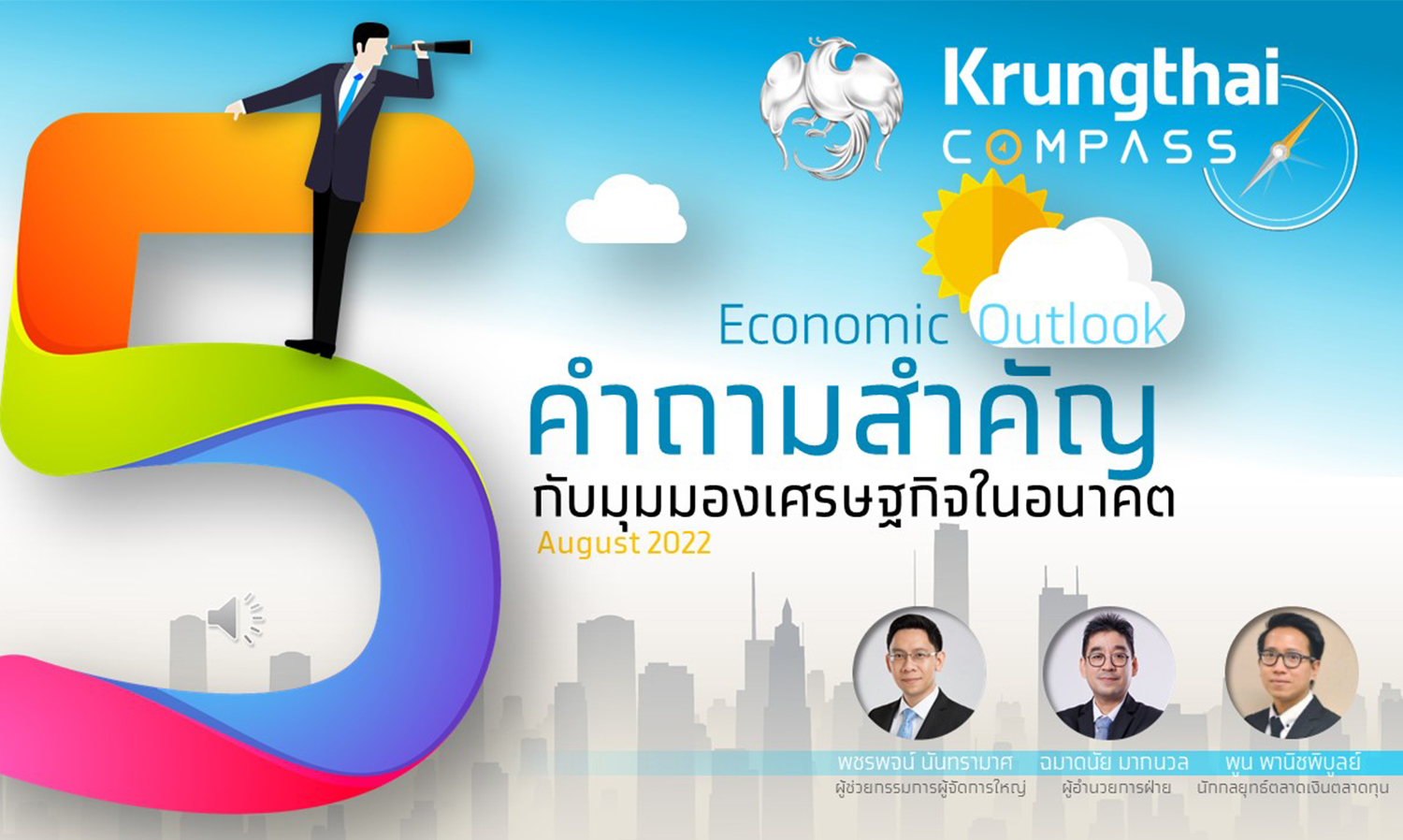
Dr. Pacharapoj Nantharamas, Assistant Managing Director and Chief Economist of Krungthai Bank, revealed that Krungthai COMPASS forecasts a slowdown in the global economy, with persistent global inflation leading the Federal Reserve to likely raise interest rates to 3.3% by the end of this year. It is expected that the Fed's monetary policy will lead to a soft landing. For the Thai economy, Krungthai COMPASS anticipates support from better-than-expected tourism recovery, projecting a 3.2% growth in 2022, up from the previous estimate of 3.0%, and a 4.2% growth in 2023. Inflation is expected to accelerate from 5.6% in the first half to 6.6% in the second half, with an average annual inflation rate of 6.1%, before slowing to 2.0% next year due to easing supply chain disruptions and a global economic slowdown that reduces pressure on commodity prices. As for interest rates, it is expected that the Bank of Thailand (BOT) will gradually raise the policy interest rate to 1.25% by the end of 2022 and 2.00% by the end of 2023.
Krungthai COMPASS views that the Thai economy is becoming "The New K-shaped Economy", where new risks from the global economic slowdown due to inflation and high costs are presenting greater challenges for businesses that thrived in the past, such as export businesses. Meanwhile, the gradual easing of COVID-19 restrictions is boosting domestic businesses, particularly in tourism. We estimate that the number of foreign tourists this year will recover to 8.1 million, higher than the previous estimate of 6.4 million, and will increase to 21.3 million in 2023, reaching halfway back to normal levels. However, many sectors are not benefiting significantly from the overall improvement, indicating a continued need for economic policies to provide support.
Dr. Chamadanai Maknual, Director of Business Risk and Macro Research at Krungthai Bank, assesses that the impact of the global economic slowdown will lead to a decline in exports in the near term compared to the first half, which saw a growth of 12.7%. Exports in 2022 are expected to grow by 7.5%, while in 2023, growth is projected at 2.5%. Moving forward, attention must be paid to the review of the U.S. tariff barriers against China, as the U.S. may reduce or eliminate tariffs on certain intermediate goods such as plastics, chemicals, rubber products, and consumer goods like furniture. These products together account for about one-fifth of the value of Thai exports to the U.S. Thai exporters of these goods may be affected and need to seek alternative markets. Another challenge is the crisis in emerging market countries facing severe public debt and current account deficits, particularly vulnerable countries in Asia, including Laos, Myanmar, Pakistan, and Sri Lanka, which are regionally connected to Thailand. The combined value of Thai exports to these four countries is approximately 3.79% of total exports, while imports account for about 2.39% of total Thai imports. Krungthai COMPASS views these risks as issues that need to be monitored if the aforementioned problems escalate into future economic crises.
Mr. Poon Panichpipool, Market Strategist at Krungthai Global Markets, estimates that in the remaining part of this year and into next year, the movement of the Thai baht will depend on three key factors: the direction of the U.S. dollar, the fundamentals of the Thai economy reflected through the current account balance, and the direction of capital flows from foreign investors. It is estimated that the baht may gradually strengthen towards the end of this year, reaching 34.25-34.50 baht per dollar. For next year, the recovery of the Thai economy, benefiting from the tourism sector and the gradual weakening of the dollar, is expected to lead to the baht strengthening to 33.50-33.75 baht per dollar in the first half of 2023, with an expected rate of 34 baht per dollar by the end of 2023.
From the overall perspective above, Krungthai COMPASS assesses that the years 2022-2023 will be a time when businesses must prioritize risk management from both short-term and long-term factors. In the short term, this involves managing costs due to high inflation and protecting against income and cost impacts from exchange rate volatility. In the long term, businesses must stay informed and adapt to the changing global trends, particularly as all sectors emphasize environmental factors and reducing greenhouse gas emissions to achieve Net Zero Emissions goals and reform the economy using digital technology, which can also create new business opportunities.