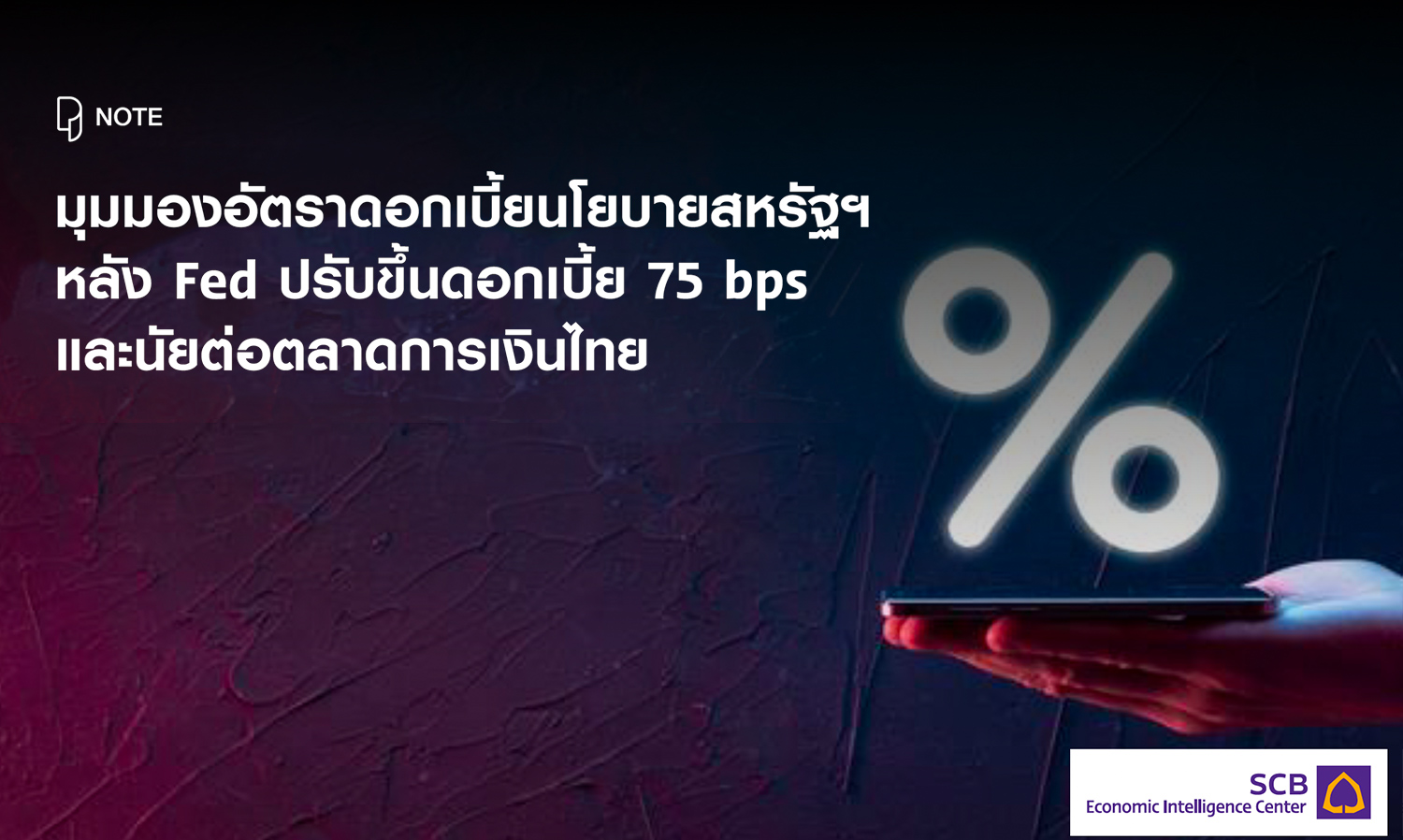
US Policy Interest Rate Outlook After Fed Raises Rates by 75 bps and Its Implications for the Thai Financial Market
The US Federal Reserve (Fed) raised its policy interest rate by 75 bps to a range of 1.5-1.75% during the meeting on June 15, 2022, marking the largest rate hike since 1994. This decision was prompted by the consumer price index (CPI) inflation rate, which continued to accelerate at 8.6% in May, with no signs of slowing down. Additionally, long-term inflation expectations from households, as reported by the University of Michigan, increased to 3.3% in June from 3% in February to May. This raised concerns for the Fed about their ability to control inflation expectations, potentially exacerbating the issue. Meanwhile, the labor market has been recovering steadily, with the unemployment rate returning to pre-COVID-19 levels. Furthermore, the Fed's median dot plot indicates an additional interest rate hike of 1.75% this year, projecting the US policy interest rate to rise to 3.4% by the end of this year and 3.8% by the end of next year, before decreasing to 3.4% in 2024. However, during the press conference following the meeting, the Fed Chair communicated that this 75 bps hike is considered larger than usual, leading the market to adjust its expectations for the next rate hike to below 100 bps. Regarding the Fed's outlook on a potential recession, estimates suggest that the Fed does not anticipate the US entering a recession this year or next, but they believe that this significant rate hike will only slow down the US economy (soft landing). The Fed acknowledged that the chances of achieving a soft landing are diminishing and becoming more challenging due to uncontrollable factors such as the Russia-Ukraine war, China's lockdowns, and rising oil and food prices.
After the meeting, the US dollar index weakened after having strengthened significantly prior to the meeting. US government bond yields decreased, and US stock markets fell due to recession concerns. The Thai baht also weakened following the Fed's expected rate hike, resulting in US stock markets, including Nasdaq and S&P 500, rising by 2.5% and 1.5% respectively by the end of the trading day. However, subsequent market concerns about a recession led to declines in the Nasdaq, S&P 500, and Dow Jones by approximately 4.5%, 2%, and 2% from the day before the meeting (latest data as of June 20, 2022). The US dollar weakened by 1% from the day before the meeting, while the yields on 2-year and 10-year US government bonds decreased by about 25 bps. The Thai baht weakened by about 0.8% to 35.3 baht per US dollar, and the yield on 10-year Thai government bonds slightly decreased from 3.0% to 2.93%.
The EIC expects the Fed to raise interest rates by another 75 bps in July to cool down the strong recovery in demand and bring inflation and inflation expectations closer to the target. Factors that will likely lead the Fed to continue raising policy interest rates at a high rate include:
- Persistent high inflation pressure. The EIC expects that in June, inflation will remain high, similar to May, necessitating further high rate hikes by the Fed. Looking back at previous hiking cycles in 2004 and 2015, inflation was around 3% and 0.5%, respectively, with the Fed raising rates by 25 bps at a time. However, current inflation stands at 8.6%, significantly above the Fed's target of 2%, indicating a need for much higher rate hikes than in the past. Additionally, consumer inflation expectations for the next five years are at 3.3%, and for the next year at 5.4%, reflecting consumer views that the Fed's current rate hikes are insufficient to bring inflation down to target levels, unlike previous hiking cycles where inflation expectations were below 3%.
- A tightening labor market. The unemployment rate in the US in May 2022 was 3.6%, matching pre-COVID-19 levels (December 2019) and below the non-accelerating inflation rate of unemployment (NAIRU) of 4.5%. This indicates a very tight labor market, with current unemployment rates lower than those during previous hiking cycles, which were around 5-5.6%. Additionally, job openings remain high, putting upward pressure on wages, which further drives inflation higher compared to past periods without wage pressures. Therefore, current US monetary policy is considered very accommodative relative to the recovering labor market.
- A strong recovery in the US economy. Consumption and manufacturing are currently expanding at rates higher than in previous hiking cycles, with private consumption (accounting for 68% of US GDP) growing over 10% recently, despite a slowdown in the latest month (May) due to tightening financial conditions. Similarly, new orders reflecting future demand grew at a high rate of 14% in April, indicating that the economy is stronger than during past hiking cycles and can better withstand rapid tightening of monetary policy.
Therefore, the EIC believes that the Fed will need to continue raising interest rates significantly in the third quarter of this year, with expectations of 75 and 50 bps hikes in July and September, respectively. However, in the fourth quarter, as inflation is expected to slow down, the Fed will likely raise rates by only 25 bps in November and December, resulting in the Fed funds rate being at 3.25-3.5% by the end of 2022, close to the Fed's projected policy rate at year-end.
The tightening US monetary policy will lead to tighter global financial conditions through three channels: higher financial costs, capital outflows from developing economies, and declining returns on global risk assets. Specifically:
- Higher financial costs in line with rising interest rates and government bond yields. Borrowing costs for businesses, consumers, and mortgage rates in the real estate market are expected to rise, leading to a slowdown in demand and economic activity.
- Increased volatility in capital flows, with a tendency to flow out of developing economies compared to 2021, likely flowing into the US or developed economies where real interest rates (adjusted for inflation) are rising and perceived as less risky than developing economies, resulting in the US dollar strengthening against most developing currencies.
- Declining returns on global risk assets due to reduced liquidity in the global financial system, which will impact the wealth effect for both businesses and households.
Moreover, the tightening monetary policy of major economies, particularly the US, is likely to affect the recovery of economies in developing countries differently. It has been found that Latin American economies are at the highest risk due to weak external and price stability. In Thailand, stability has weakened due to a current account deficit and rising inflation, but it is expected to improve by the end of this year with the recovery of the tourism sector.
The Fed's interest rate hikes will be a significant factor leading to a continuous increase in long-term Thai government bond yields. The EIC anticipates that in the near term, Thai government bond yields may rise slightly. Factors supporting the increase in 10-year Thai government bond yields include:
- The Fed's accelerated rate hikes and balance sheet reduction will likely lead to further increases in US government bond yields. The EIC expects that the 10-year US bond yield may rise slightly this year, even though the rate hikes have already been priced in.
- The direction of yields in global and Thai money markets is expected to rise in line with rate hikes by various central banks, especially in the US, with changes in 10-year Thai government bond yields correlating with changes in US yields by up to 80%.
- The expected recovery of the Thai economy in the second half of the year, which is anticipated to improve due to recovering domestic demand and an increase in foreign tourist numbers.
However, the EIC believes that Thai government bond yields will not rise rapidly, as US inflation is expected to decrease towards the end of the year, and the US economy is likely to slow down, preventing US government bond yields from increasing rapidly.
The Fed's accelerated rate hikes will strengthen the US dollar, putting downward pressure on the Thai baht in the short term, similar to other developing economies' currencies. However, the baht is expected to strengthen again by the end of the year, following the recovery of the Thai economy, which is likely to stimulate capital inflows and a return to a current account surplus. In the short term, the baht may still face depreciation pressures like other currencies in the region, with expectations that the baht will range between 34.5-35.5 baht per US dollar due to:
- The Fed's tightening monetary policy leading to a continuous increase in the interest rate differential between the US and other countries.
- Concerns about a recession and tensions from the Russia-Ukraine war causing investors to seek safer assets.
- The Thai current account deficit remaining high in the first half of 2022 due to high energy prices, resulting in increased import values. Additionally, rising inflation while the Thai economy has not yet recovered significantly is another factor pressuring the baht.
However, the Thai baht is expected to strengthen towards the end of the year within the range of 33.5-34.5 baht per US dollar due to:
- The Thai economy is expected to improve in the second half of the year, which will help stimulate portfolio flows from foreign investors.
- The current account is expected to return to surplus, driven by an increase in foreign tourist numbers, along with declining oil prices and shipping costs.
In summary, the Fed's interest rate hike this time aligns with market expectations, and the Fed is likely to continue raising policy interest rates. In the third quarter of this year, there is a high chance of further rate hikes of 75 and 50 bps, leading to a significant slowdown in the US economy this year, with reduced chances of a soft landing. This aligns with some market participants' concerns about a potential recession in the near future. Additionally, the tightening monetary policy will lead to tighter global financial conditions, including in Thailand, with 1) rising interest rates and government bond yields increasing financial costs, 2) increased volatility in capital flows likely moving from developing economies to major economies, strengthening the US dollar, and 3) reduced liquidity in the global financial system impacting global risk assets. Regarding the impact on the Thai financial market, long-term Thai government bond yields are expected to rise slightly in line with rising yields in global money markets, especially US government bond yields, while the baht will face short-term depreciation pressures from the Fed's rate hikes and war risks, expected to be in the range of 34.5-35.5 baht per US dollar. However, the baht is expected to strengthen again within the range of 33.5-34.5 baht per US dollar by the end of the year, driven by a recovering Thai economy and a return to a current account surplus.
Analysis by... https://www.scbeic.com/th/detail/product/Inflation-210622
Author: Wachirawat Banchuen ([email protected])
Senior Economist
Jongrak Kongkumchai ([email protected])
Analyst
Nichanan Logewitool ([email protected])
Analyst
Economic Intelligence Center
Siam Commercial Bank Public Company Limited
EIC Online: www.scbeic.com
Line: @scbeic