Kasikorn Bank Advises on Preparing for Cryptocurrency Tax Filing
Kasikorn Bank, through K WEALTH, provides guidance on filing taxes for cryptocurrency investors following the Revenue Department's announcement of practices exempting withholding tax and allowing the inclusion of profits and capital gains within the same tax year for income calculation. This involves maintaining detailed profit/loss accounts for trading, staking coins, and recording mining costs clearly to combine with other income for annual tax filing.

Mr. Weerapon Bodeerat, Senior Director of Customer Consulting Development and K WEALTH GURU at Kasikorn Bank, revealed that cryptocurrency tax remains a closely watched issue among investors, as the number of investors in the cryptocurrency market has surged dramatically. Data from the Kasikorn Research Center shows that in November 2021, there were as many as 1,979,847 digital asset investor accounts, a significant increase from just a few tens of thousands at the beginning of the year. Recently, the Revenue Department has announced clearer guidelines on several points, summarized as follows:
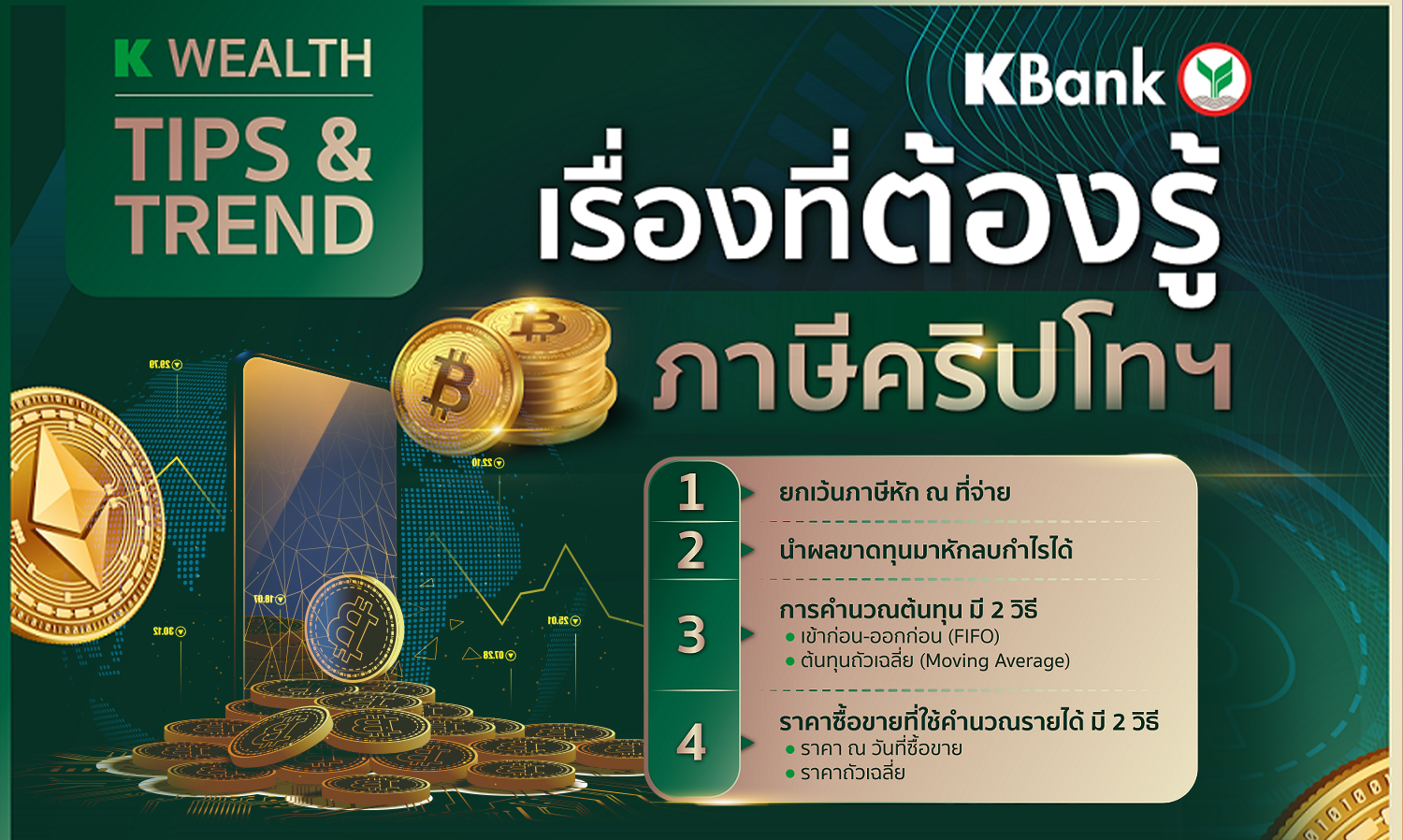
1. Exemption from 15% withholding tax because currently, cryptocurrency trading through Exchange Platforms cannot identify the recipients and the amounts to be withheld, making it difficult to verify accuracy and apply the tax correctly. Therefore, withholding tax is not necessary.
2. Losses can be offset against profits within the same tax year for income calculation, a change from the previous rule that only allowed profit items to be considered, which received significant criticism for being unfair to investors.
3. Cost calculation methods can be done in two ways:
1) Using the “First In, First Out” (FIFO) method.
2) Using the Moving Average Cost method. For example, on February 1, you buy 1 coin of cryptocurrency A at 10,000 THB/coin, and on February 3, you buy another coin at 12,000 THB. If you use the FIFO method to calculate costs when selling 1 coin, you will use the price of the coin purchased first, which is 10,000 THB. However, if you use the Moving Average Cost method, both coins will have an average cost of 11,000 THB, calculated by summing the purchase prices and dividing by the number of coins.
4. The valuation of digital assets should be measured at the time of acquisition or at the average price.

The collection of value-added tax is a specific business tax for digital assets that are considered securities. This specific business tax is an indirect tax levied on buyers and is typically applied to goods or services that are difficult to add value to, making it more suitable for calculating income and collecting cryptocurrency taxes than withholding tax.
Moreover, the guidelines regarding the exemption from withholding tax and the combination of profits and losses for tax calculation will only apply to trades conducted through Exchange Platforms regulated by the SEC. Investors must still combine their cryptocurrency income with other income, such as salaries and business income, deducting expenses and other allowances to file their annual taxes and pay taxes at progressive rates of 5-35%. K WEALTH recommends that investors prepare for tax filing by summarizing profit/loss accounts for trading, staking coins, and maintaining detailed records of mining costs.
Those interested can follow various topics, including investment stories and good financial management tips, at www.kasikornbank.com/kwealth.