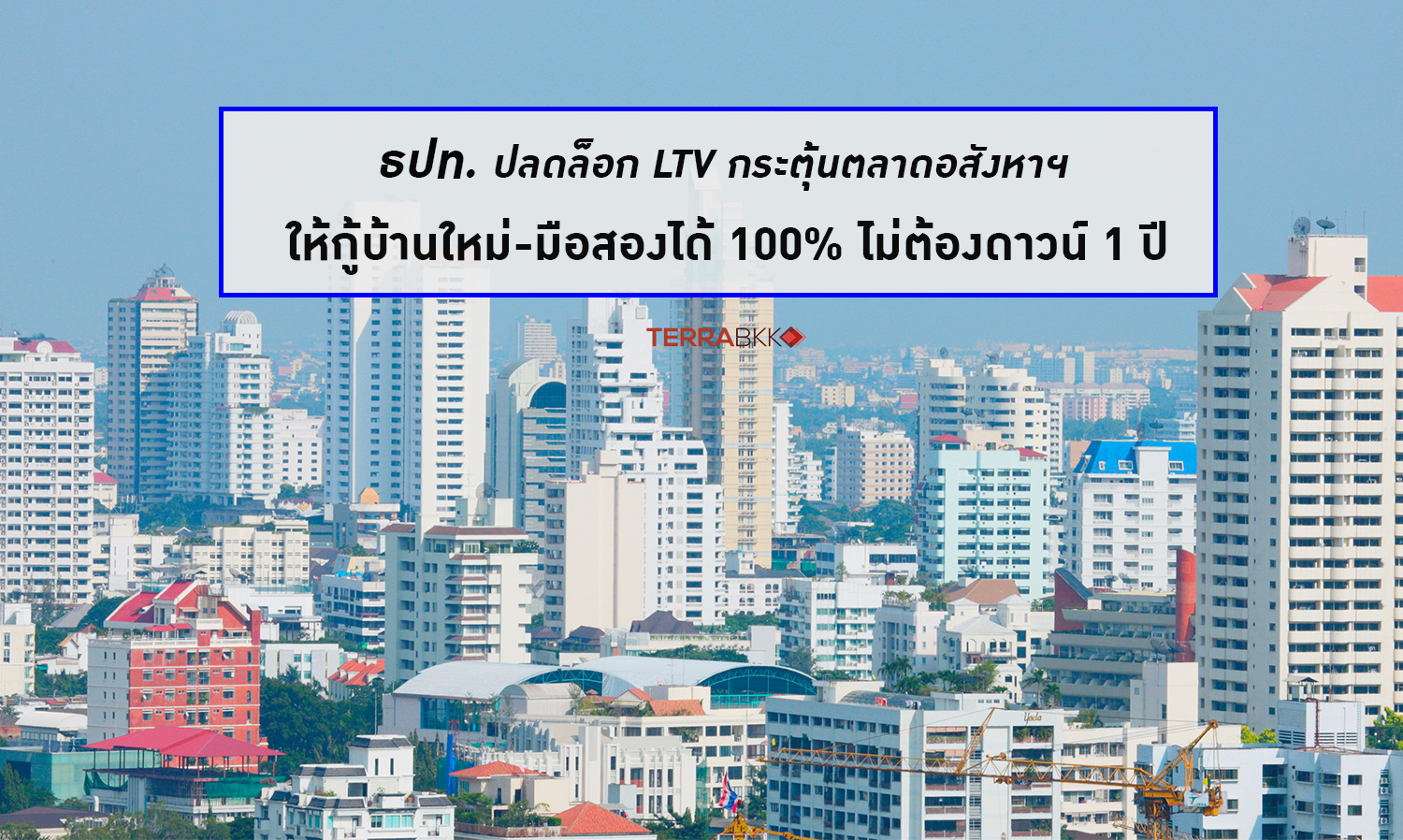
Bank of Thailand Eases LTV Measures to Stimulate Real Estate Market, Allowing 100% Loans for New and Second-Hand Homes Without Down Payment for One Year
"Bank of Thailand" has temporarily eased the LTV measures to allow 100% loans for housing purchases for contracts signed from October 20, 2021, to December 31, 2022, aiming to stimulate economic activity and support employment by injecting new funds into the economy through the real estate sector.

Ms. Rung Mallikamas, Assistant Governor of the Financial Institutions Policy Group at the Bank of Thailand (BOT) stated that the Thai economy has been impacted by the prolonged COVID-19 pandemic. Although there are signs of gradual recovery due to vaccine distribution and the easing of control measures, the recovery remains fragile due to high uncertainties and the financial conditions of some businesses and households, particularly those related to tourism. Meanwhile, the real estate sector is experiencing stagnation due to weak demand and the construction sector's struggles due to the pandemic.
The BOT has assessed that to stimulate economic activity and support employment, it is necessary to accelerate the injection of new funds into the economy through the real estate sector, which has many related businesses, especially from groups with strong financial positions or those capable of taking on more debt, by relaxing the regulations on housing loans and related loans (LTV measures) temporarily.
Mr. Don Nakornthap, Senior Director of the Financial Stability Department at the BOT mentioned that initial estimates suggest that the relaxation of LTV measures, along with additional economic stimulus measures from the government, could support the injection of approximately 50 billion baht into the economy through new loans, which would help the real estate sector grow by 7% in 2021, based on an expected transaction value of 800 billion baht this year.
This will positively impact other economic activities related to the real estate sector, as it is an industry with a supply chain encompassing construction, building materials, loans, and insurance, with related businesses accounting for 9.8% of GDP and creating over 2.8 million jobs.
The BOT is not concerned that the relaxation of LTV measures will lead to an increase in NPLs in the real estate sector, as financial institutions currently maintain strict lending standards, focusing on borrowers' long-term repayment capabilities.
Therefore, the BOT assesses that the risk to financial stability from speculation in the real estate sector in the coming year is limited. While the overall household debt in Thailand is high, a closer look reveals that most of it consists of credit card debt and personal loans, while real estate debt remains at a low level.
In the past, the use of LTV measures has not shown significant speculation in real estate, and the ability to manage borrowers has been effective, along with stricter lending practices by financial institutions, which is why the LTV can be relaxed.
It is considered a golden opportunity for homebuyers now, as it is expected that there will be no extension of these measures into 2023, believing that the economy will begin to recover robustly. At the same time, there are concerns abroad about potential real estate bubble issues in 2023.
Nevertheless, the BOT will monitor the economic recovery and the real estate sector, the lending standards of financial institutions, and the ability of the public to borrow or purchase housing at reasonable prices to ensure timely and appropriate adjustments to the measures.
The relaxation of the LTV measures is temporary and applies to loan contracts from the date of this letter until December 31, 2022.
In cases where loan applications are received by financial institutions and SFIs by December 31, 2022, but contracts cannot be signed in time, the loan approval will still be eligible under the relaxation measures, which include the following key points:
1. The ceiling for the loan-to-value (LTV) ratio for housing loans combined with other related loans is set at 100%.
- For collateral valued below 10 million baht, this applies from the second contract onward.
- For collateral valued at 10 million baht and above, this applies from the first contract onward. (For the first housing loan contract with collateral valued below 10 million baht, the LTV ratio ceiling for housing loans and related loans remains at 100% and 10%, respectively.)
Additionally, for refinancing loans or other related loans granted after the refinancing loan of the aforementioned contract sequence, the amount must not exceed the outstanding balance of the original housing loan or the LTV ratio ceiling of 100%, whichever is higher.
2. For calculating credit risk assets for capital adequacy, commercial banks, finance companies, and SFIs should use the LTV ratio ceiling as stated in this letter to replace the LTV ratio ceiling in section 5.2.3 (1.1.4) of the BOT's announcement regarding the regulations on housing loans and related loans, allowing loans that are not of inferior quality to receive a risk weight of 35%.