Baht Weakens Towards the End of the Week as Thai Stocks Decline, Yet Remains Above 1,600 Points
Summary of Baht Movements
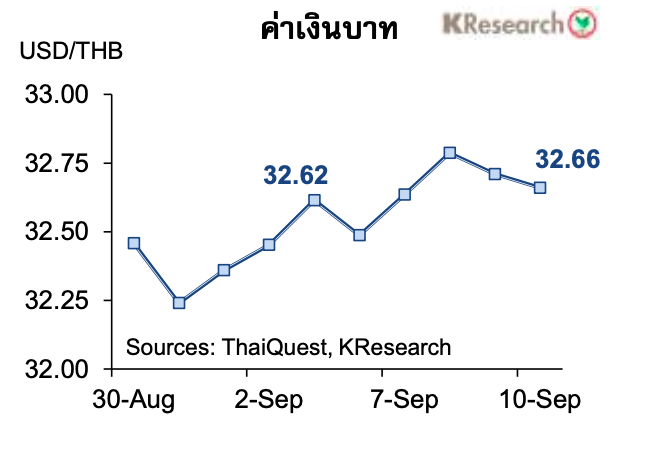
- The baht slightly strengthened towards the end of the week after depreciating earlier in the week due to net selling of Thai stocks and bonds by foreign investors. Meanwhile, the dollar strengthened as a safe-haven currency amid concerns over the global economic outlook affected by the Delta variant of COVID-19. However, the baht reduced its depreciation and gradually appreciated towards the end of the week, following the yuan and other Asian currencies, while the dollar faced pressure from declining U.S. bond yields and signals of asset purchase adjustments through the European Central Bank's (ECB) emergency asset purchase program.
- On Friday (September 10), the baht was at 32.66 baht per dollar compared to 32.62 baht per dollar the previous Friday (September 3).
For the upcoming week (September 13-17), Kasikorn Bank forecasts the baht's movement range to be 32.50-33.00 baht per dollar, while the Kasikorn Research Center assesses key factors to watch, including foreign investment flows and the COVID situation in Thailand. Important U.S. economic figures to monitor include the Consumer Price Index, Import/Export Price Index, industrial production data, August retail sales, the New York Fed's manufacturing survey, the Philadelphia Fed's manufacturing survey, the preliminary Consumer Confidence Index for September, and weekly unemployment claims. Additionally, the market is also awaiting China's housing price index, unemployment rate, retail sales, industrial production, and fixed asset investment figures for August.
Summary of Thai Stock Market Movements
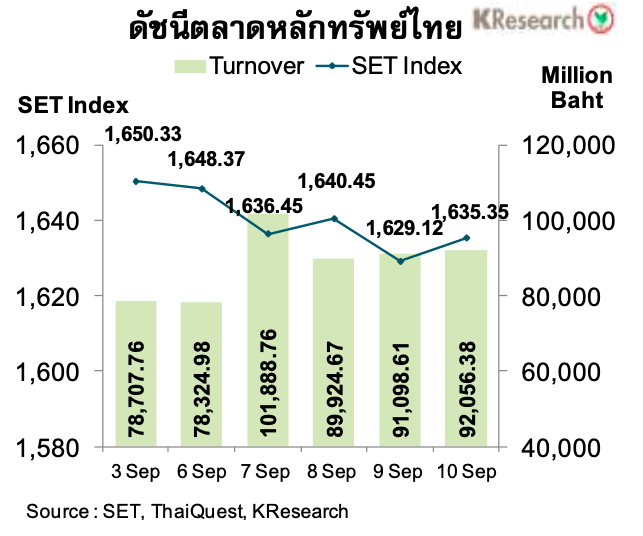
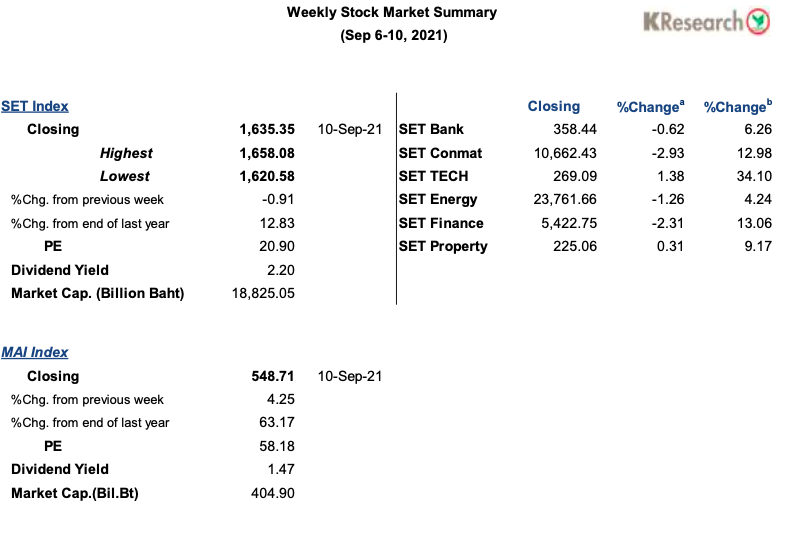
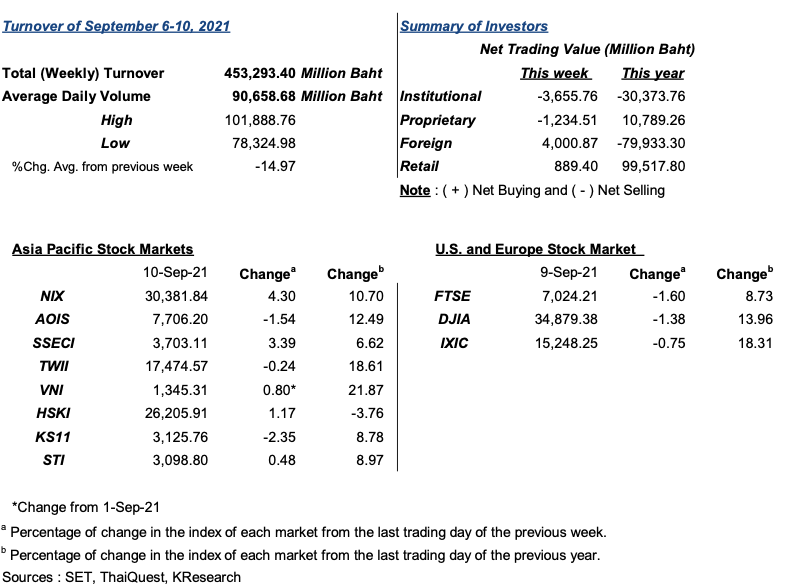
- Thai stocks declined from the previous week, with the SET index closing at 1,635.35 points, down 0.91% from the prior week, while the average daily trading value was 90,658.68 million baht, a decrease of 14.97% from the previous week. The mai index, however, increased by 4.25%, closing at 548.71 points.
- Overall, Thai stocks fluctuated downward throughout the week due to profit-taking by investors after a significant rise in response to positive factors earlier. However, Thai stocks briefly rose mid-week due to buying from foreign investors and recovered again towards the end of the week in line with regional markets following news that U.S. President Joe Biden had a phone conversation with Chinese President Xi Jinping. Additionally, there was buying interest in certain stocks that may benefit from the accelerated vaccination rollout aiming to cover at least 50% of the population in every province.
For the upcoming week (September 13-17), Kasikorn Securities Co., Ltd. anticipates that the Thai stock index will have support at 1,620 and 1,610 points, while resistance is at 1,645 and 1,655 points, respectively. The Kasikorn Research Center assesses key factors to monitor, including the COVID situation both domestically and internationally, domestic political issues, and the direction of foreign investment. Important U.S. economic data includes the Consumer Price Index, retail sales, industrial production, and August import and export values. Other foreign factors include Japan's Producer Price Index for August, the Eurozone's Consumer Price Index for August, and industrial production data for July, along with China's economic data for August, such as retail sales and fixed asset investment.