KR-ECI Index Remains Low in August
KR-ECI Index Remains Low in August
The index remains close to its historic low due to pandemic control measures. The economic and household living conditions index is still lower than during the nationwide lockdown last year.
• In August 2021, households continue to express concerns about the economic situation and their living conditions. The household economic and living conditions index (KR-ECI) stands at 33.0, still below the levels seen during last year's nationwide lockdown. Most households are increasingly worried about expenses excluding debt burdens, while concerns about income and employment persist. However, support measures for affected businesses and employees in nine sectors, along with a stabilization in daily infection rates towards the end of the month, may help the household economic and living conditions index (KR-ECI) to slightly improve to 35.5 from 33.8 in July, although it remains low compared to the same period last year.
• The Kasikorn Research Center conducted additional surveys regarding government assistance measures. It found that most households view the reduction in water and electricity bills as accessible and helpful during this period, while the 'use more, get more' program is largely unknown and seen as ineffective in alleviating impacts. Nonetheless, these government measures were introduced when the pandemic situation was not severe, and there were no heightened restrictions in place.
• At the beginning of September, the government eased strict pandemic measures in 29 dark red provinces, which may allow some economic activities to resume. However, the high number of infections, low vaccination rates concentrated in certain areas, and ongoing COVID-19 outbreaks remain significant risks to the economy and household living conditions in the near future. Therefore, accessible and targeted relief measures, along with vaccine procurement and accelerated vaccination efforts, remain essential.
In August 2021, the pandemic situation remains concerning, with high daily infection and death rates persisting. Additional strict measures were implemented, including lockdowns in 29 high-risk provinces starting in early August, continuing to impact various economic activities within the country.
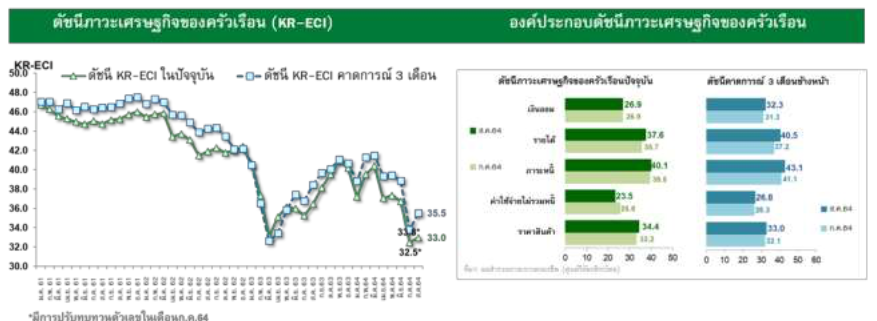
Increased strict measures and prolonged situations have pressured the household economic and living conditions index to remain low at 33.0 in August 2021. Households are concerned about expenses excluding debt burdens, as some have rushed to buy more goods during the lockdown, while also worrying about future economic conditions, leading to reduced current spending. This aligns with the private consumption index (PCI Index) in July 2021, which slowed down by -8.1% YoY.
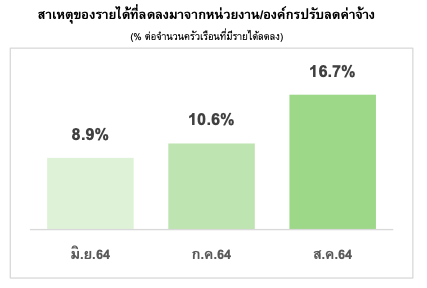
Additionally, households are worried about rising consumer goods prices, reflected in the inflation rate for eggs and dairy products (+3.82% YoY) and cooking ingredients (+3.99% YoY). Meanwhile, perceptions of income and employment have been somewhat supported by government assistance measures for businesses and employees through the social security system, which began disbursing funds on August 4. However, when considering the components of the index, the employment and income situation remains concerning, as surveys indicate an increasing number of organizations have reduced wages since June 2021 due to the worrying COVID-19 situation and ongoing strict pandemic measures, indicating a fragile employment environment. This factor will continue to affect household purchasing power. The household economic and living conditions index for the next three months is projected to be 35.5, showing a slight improvement likely due to the stabilization of daily infections towards the end of August, coupled with expectations of lockdown easing in September. Nevertheless, the index remains low compared to the beginning of the year, indicating that households still harbor concerns about their living conditions and future livelihoods.
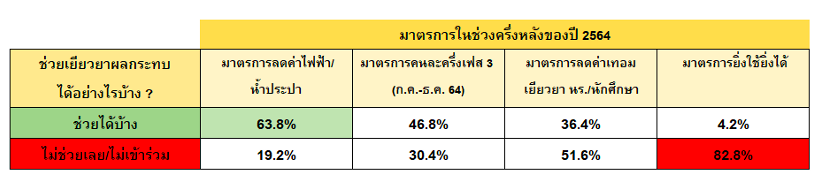
The Kasikorn Research Center conducted further surveys on the effectiveness of economic relief and stimulus measures in the latter part of the year. The survey indicated that the reduction in electricity and water bills (August-September 2021) is a measure that has somewhat alleviated impacts (63.8%), likely because it is accessible to all households without conditions or registration, and addresses the monthly expenses that many households currently face due to reduced incomes. In contrast, the 'use more, get more' measure was deemed ineffective and not participated in by 82.8% of respondents, as it was introduced when the pandemic situation was not severe and there were no strict measures in place.
Source: Household Living Conditions Survey (Kasikorn Research Center)
How have government measures helped alleviate the impacts of the COVID-19 pandemic for you?
Source: Household Living Conditions Survey (Kasikorn Research Center)
Even though some lockdown measures were eased in early September, the economic situation and living conditions for households in the near future remain highly uncertain. The labor market continues to show signs of fragility, particularly in the service sector, such as tourism, which has not fully recovered. This factor will impact household spending. Additionally, the ongoing pandemic situation, with high infection rates and low vaccination rates, may hinder a full economic recovery, as reflected in the Google Mobility Index (report dated September 4, 2021), which indicates that retail and recreational travel has not returned to positive levels (-19% from normal). Furthermore, the situation abroad shows that even with high vaccination rates, infection numbers continue to rise. Therefore, uncertainty from the pandemic will continue to pressure the economy.
Currently, targeted and easily accessible economic relief measures from the government are essential to mitigate the impacts and support household livelihoods, alongside efforts to control the situation, such as proactive testing and the procurement, distribution, and administration of effective vaccines.
In summary, the current household economic and living conditions index (KR-ECI) in August 2021 and the forecast for the next three months indicate ongoing concerns about household livelihoods. The government should implement targeted and easily accessible relief measures while accelerating efforts to control the situation, including vaccination, to alleviate the pandemic and restore confidence in the economy.