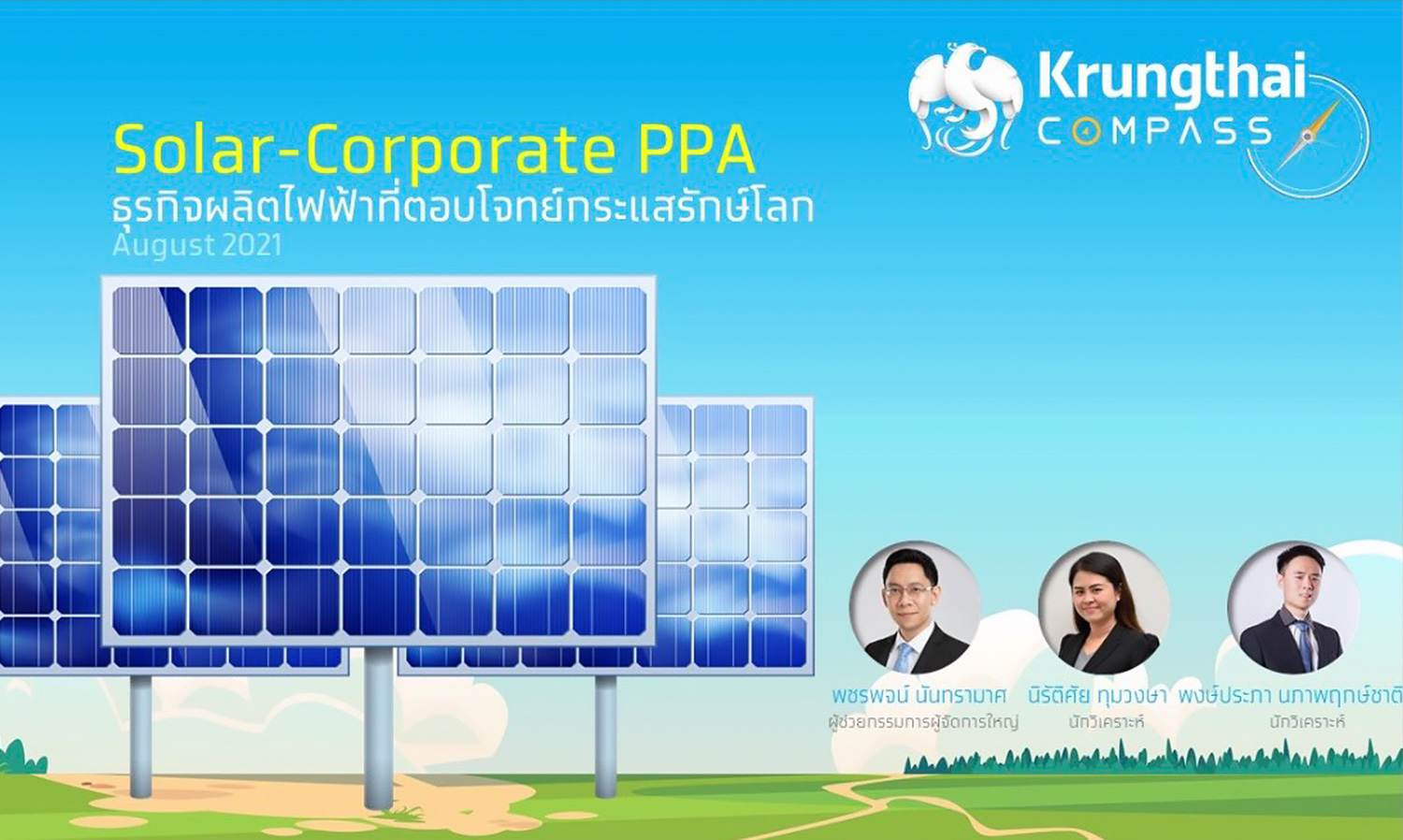
Krungthai COMPASS Highlights Solar-Corporate PPA as a Sustainable Power Generation Business
Krungthai Bank Research Center reveals that Solar-Corporate PPA is a clean energy business with high growth potential, catering to electricity users who want to save on costs without making their own investments. It is estimated that the revenue from the Solar-Corporate PPA business in Thailand could expand to between 37.7 and 118.2 billion baht by 2037, representing a growth of 17.5 to 54.8 times since 2020. Potential operators in this business include those involved in solar panel installation, solar panel manufacturing, and solar power plants.
Dr. Pacharaporn Nantharamat, Assistant Managing Director of Krungthai COMPASS, stated that there is a global awareness of the goal to reduce greenhouse gas emissions in line with the Paris Agreement, which positively impacts the clean energy sector, especially solar power generation. The cost of installing solar systems has significantly decreased. Besides solar power plants, the Solar-Corporate PPA business also shows potential, as operators invest in generating electricity from solar panels for clients or electricity users, charging them later at rates often lower than those from state utilities.
“Solar-Corporate PPA is expected to grow alongside the global solar power generation capacity, which is projected to increase to 8,541 thousand megawatts by 2050, up from 714 thousand megawatts in 2020, representing a growth of up to 12 times. In Thailand, this business has the opportunity to grow in response to the demand for solar power from both households and industries. Additionally, the Solar-Corporate PPA business is supported by government policies, including tax and non-tax incentives,” she added.
Ms. Nirattisay Tumwongsa, Senior Analyst, noted that there are currently three models of this business:
1) Synthetic model: Electricity is produced and delivered from the producer's power source through a distributor, with a centralized market overseeing production and distribution.
2) Sleeved model: Electricity is produced and sent directly from the producer to the electricity user, renting transmission lines from the government for distribution.
3) Private wire model: Electricity is produced on the premises of the electricity user directly. This is the model currently used in Thailand, where there are still few operators, resulting in low competition. Furthermore, this business has high profitability, with an average EBIT margin of 22.8% from 2017 to 2019, while solar panel installers and manufacturers have average EBIT margins of only 4.0% and 3.3%, respectively.
Mr. Pongprapa Napaphrukchat, Analyst, added that Krungthai COMPASS expects the revenue from the Solar-Corporate PPA business in Thailand to potentially expand to between 37.7 and 118.2 billion baht by 2037, compared to 2020, or grow by 17.5 to 54.8 times. The growth of Solar-Corporate PPA depends on three key issues that the government should consider: 1) Increasing the proportion of electricity purchases specifically from Solar Rooftop in the PDP 2022 plan, which would expand the customer base from the private sector and households wanting to generate their own electricity and sell excess power; 2) Allowing the leasing of transmission lines in public areas, enabling producers to send electricity directly to multiple users simultaneously, thus facilitating the Sleeved Solar-Corporate PPA model in Thailand; and 3) Promoting a centralized electricity trading market between producers and users, leading to the Synthetic Solar-Corporate PPA model in Thailand.
If services in the Sleeved and Synthetic models are added to the Private wire model, it will diversify services and broaden the customer base, supporting the growth of this business in the future.