New Wave of COVID-19 Disrupts International Tourism Worldwide and in Thailand for the Remainder of 2021
• The new wave of COVID-19 is impacting the recovery of international tourism globally and in Thailand for the remainder of 2021, with the number of foreign tourists visiting Thailand this year likely to drop to 150,000, lower than previously expected.
The trend of international tourism worldwide is facing challenges again as many countries are experiencing outbreaks of the Delta variant of COVID-19, which is spreading rapidly. The number of new COVID-19 cases is rising in several countries, marking what can be described as the fourth wave of the pandemic globally. This situation inevitably affects the continuity of the recovery of international tourism worldwide.
In the first seven months of 2021, international tourism activities recovered in some regions and countries due to the easing of COVID-19 situations and increased vaccination coverage. This led many governments to relax various measures and open up to foreign tourists, implementing vaccine passport systems for fully vaccinated travelers to reduce barriers to international travel, as well as low-risk international travel agreements like Travel Bubbles. In many countries, there has been an increase in international travel, particularly in Europe, supported by events such as the Euro 2020 football championship hosted by several European nations. According to the latest statistics from the United Nations World Tourism Organization, the number of international travelers worldwide from January to May 2021 was 78.59 million.
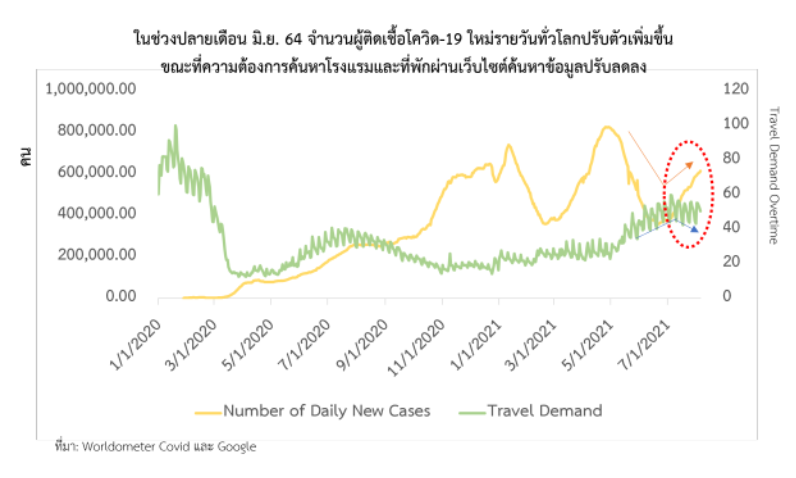
However, the direction of international tourism worldwide for the remainder of 2021 is highly fragile, as the rapid spread of the Delta variant in many countries raises concerns about travel once again. This is reflected in global tourism activity indicators such as Google Destination Insight, which shows that the demand for international travel has decreased as searches for hotels and accommodations declined following the rise in COVID-19 cases.
Additionally, many governments have had to elevate travel restrictions for foreign tourists and issue warnings to citizens regarding travel abroad, which further impacts international travel. Despite the use of vaccine passport systems to help reduce travel barriers, there are still other conditions, such as the types of vaccines accepted in each country. In some cases, even if tourists are vaccinated, they may still need to quarantine if they come from high-risk countries. Given this situation, Kasikorn Research Center predicts that international tourism worldwide in 2021 is likely to contract by about 45% from the previous year, amounting to approximately 220 million travelers compared to 399 million in 2020. The prolonged COVID-19 situation suggests that the recovery of international tourism globally will take a longer time, potentially more than four years, or until after 2025, for the global tourism market to return to pre-pandemic levels.
• The number of foreign tourists visiting Thailand in the remainder of 2021 faces increased risks from domestic factors, including COVID-19 and political issues, leading to a potential drop in foreign tourist numbers for the entire year.
The outlook for foreign tourists visiting Thailand in the remainder of 2021 is increasingly challenging due to various factors. The ongoing high number of COVID-19 cases in the country has necessitated the Thai government to implement control measures that are not conducive to tourism activities. At the same time, many governments have raised travel warnings for their citizens planning to visit Thailand.
In the first seven months of 2021, foreign tourists under the Special Tourist Visa (STV) continued to travel to Thailand, and in July 2021, the Phuket Sandbox project received positive responses from foreign tourists, resulting in over 10,000 foreign tourists visiting Thailand within ten months after the country reopened to foreign travelers.
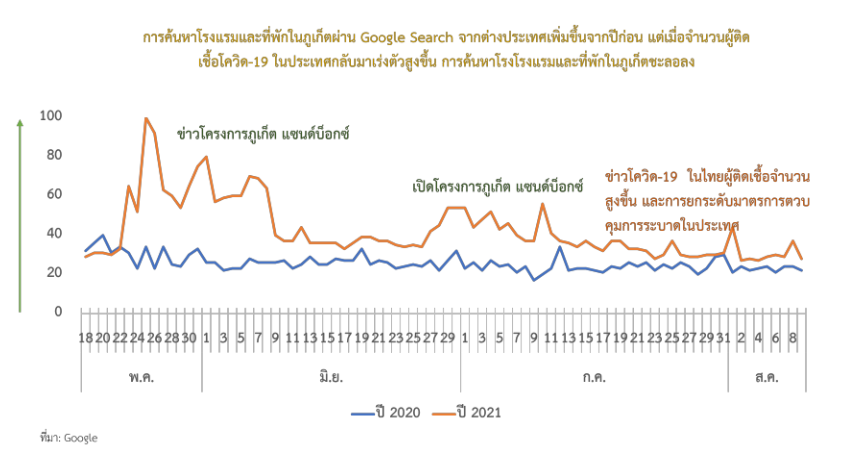
However, the ongoing COVID-19 outbreaks both domestically and internationally, with high numbers of new cases and no immediate signs of resolution, create concerns that affect tourists' decision-making. This is evident from tourism indicators such as searches for accommodations through various websites. Google Destination Insight shows that as the number of cases in the country rises, the demand for hotel searches in Phuket declines.
Simultaneously, authorities in many countries have elevated travel warnings for travel to high-risk countries, including Thailand. For instance, the U.S. Centers for Disease Control and Prevention (CDC) has issued warnings that are unlikely to favor the tourism market trend for the remainder of this year, as U.S. tourists represent a significant market for Thai tourism at this time. Since Thailand opened to foreign tourists under the STV program from October 2020 to June 2021, 5,921 tourists from the U.S. have traveled to Thailand, making it the largest group of foreign tourists visiting Thailand.
With the COVID-19 situation remaining highly uncertain, including the risk of mutations, various impacts will continue to affect plans for easing restrictions on foreign tourists. Additionally, Thai tourism faces risks from further political tensions, leading Kasikorn Research Center to view that the market for foreign tourists visiting Thailand in the remainder of this year may be lower than previously expected. This could result in a total of 150,000 foreign tourists for the entire year, compared to the original estimate of around 250,000 to 650,000. However, if authorities can effectively control the COVID-19 outbreak in targeted tourist areas such as Phuket, Krabi, and Surat Thani in the remaining months of the year, the tourism situation may gradually improve in the last quarter of this year.
• Tourists prioritize low COVID-19 risk when choosing destinations and attractions.
The direction of the foreign tourist market for the remainder of this year and beyond will heavily depend on building tourists' confidence. This requires not only widespread vaccination coverage but also cooperation in controlling the spread of the virus as quickly as possible, along with the readiness of strict and swift measures from all parties to manage the situation after COVID-19 improves. The tourism environment is changing rapidly, and the pandemic has affected tourists' behaviors and preferences.
It has been observed that tourists prioritize choosing travel destinations that are safe from COVID-19 and have local measures in place to control outbreaks. They seek natural attractions, avoid crowded tourist spots, and many tourists who are ready to travel abroad are willing to spend time searching for safe travel locations. Once they find such destinations, the booking period for accommodations and travel is significantly shorter, averaging about 2 weeks or approximately 2-4 weeks, compared to the average of 8-10 weeks before the pandemic.
Therefore, the reopening to foreign tourists when the number of cases decreases to a safe level in the future will require preparedness, including effective communication to tourists, access to information, clear government measures in case of unforeseen events like outbreaks in the area, along with marketing efforts to stimulate tourism concurrently to create understanding and awareness among tourists deciding to travel to Thailand.
Analysis by Kasikorn Research Center