Real Estate Data Center Reports COVID-19 Heavily Impacting Real Estate, Recovery Expected to Take Up to 6 Years
.jpg)
Mr. Vichai Viratakphan, Inspector of the Government Housing Bank and Acting Director of the Real Estate Data Center, stated that the Real Estate Data Center has revised its forecasts to align with the current situation, predicting that the housing market in 2021 will continue to decline as it adjusts towards a more balanced state in terms of supply and demand. The residential real estate market is expected to return to pre-COVID-19 conditions around 2025-2027, or approximately 5-6 years from now.
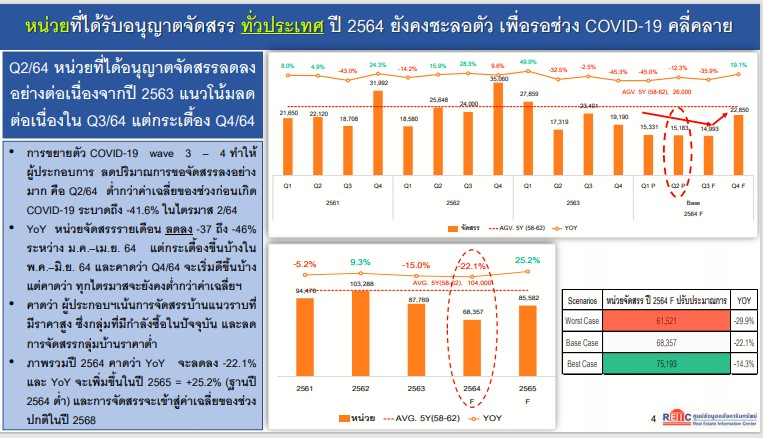
For the overall allocation permit issuance in 2021, a decrease of -22.1% is anticipated, with an increase of about 25.2% expected in 2022, reflecting a recovery from the low base of 2021. The allocation is projected to return to average levels by 2025. Meanwhile, the trend for new project launches is expected to drop to 43,051 units, a decrease of -35.0% from the previous year, with condominium projects declining by as much as -44.3%, while housing projects decrease by -27.4%. However, the overall market is expected to increase by 38.5% in 2022 due to the low base, with new housing unit launches returning to average levels by 2025-2026.

In terms of transfer units, 2021 may see a decrease to only 270,151 units, down 24.6% from 2020 and -25.2% below the average. A recovery is expected in 2022, with a return to average levels by 2027.
In the second quarter of 2021, COVID-19 spread significantly, leading to a continuous economic downturn in Thailand for 2021, with no clear signs of recovery impacting consumer purchasing power. In the real estate sector, operators have significantly reduced their allocation requests, with the second quarter of this year falling below the pre-COVID-19 average by -41.6% compared to the same period last year.
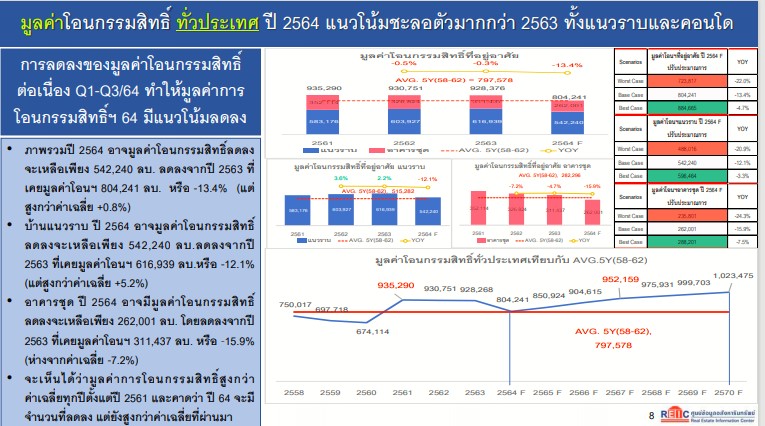
It is expected that the fourth quarter of 2021 will show some improvement, but in every quarter, figures are likely to remain below average. Some operators are adjusting their strategies to focus on developing higher-priced housing projects, which cater to buyers with purchasing power. The issuance of land allocation permits nationwide continues to decline from 2020, with approximately 30,514 permits issued in the first half of 2021, below the 5-year average (2015-2019) for every quarter.
New launches are significantly below the pre-COVID-19 average by -76.4%, and compared to the same period in 2020, they have contracted by -46.2%. It is anticipated that the third and fourth quarters may see an increase in numbers to compensate for the units sold in the past.
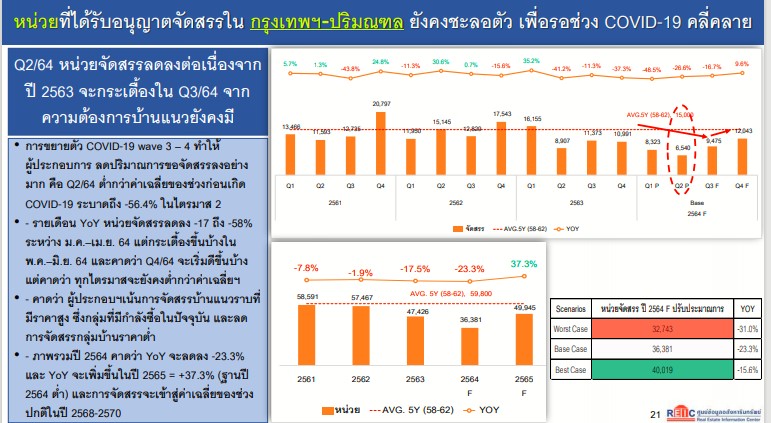
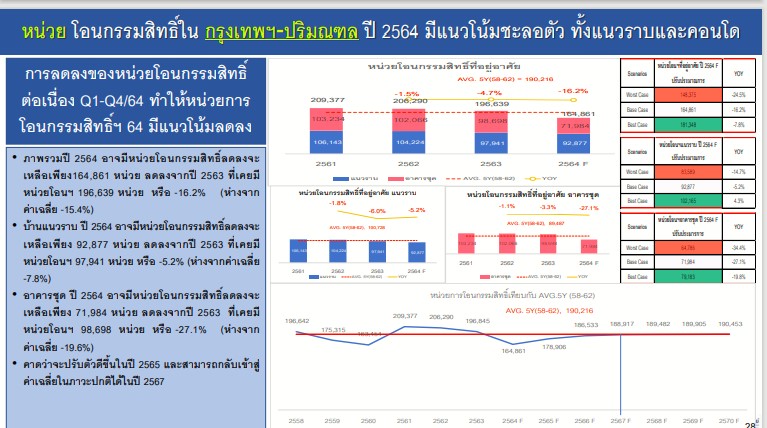
However, the overall economic slowdown has impacted sales figures from 2019-2020, which is clearly reflected in the transfer of ownership in the first half of 2021. In the second quarter, both units and values were below the 5-year average by -31.2% and -16.5%, respectively, and are expected to continue declining in both units and value, but are projected to increase again in the fourth quarter of 2021, with units and values expected to rise closer to average levels. However, in terms of growth compared to the same period in 2020, both units and values will still remain negative at approximately -5.7% and -6.2%, respectively.
The total residential ownership transfers nationwide in the first half of 2021 amounted to 120,023 units, a decrease of -28.8%, with a value of 377.52 billion baht, down -10.7% compared to the same period in 2020, which had an average of 90,233 units and a value of 232.86 billion baht per quarter.
Source: Real Estate Data Center