Commercial Banks Indicate Lockdown Affects Confidence, Worst Case Scenario for Thai Economy This Year is Negative Growth
The damage from the lockdown, aimed at reducing COVID-19 infections, may be too slow to be effective. The Delta variant has become the dominant strain in Thailand, complicating efforts to control the outbreak. The effectiveness of the vaccines we have is decreasing, and the expected supply of vaccines is lower than anticipated, placing an even greater burden on the public health system. The heavy impact has fallen on the "Thai economy," where it is clear during this COVID crisis that public confidence is lacking, purchasing power has significantly decreased, and people are only spending on essential goods.
The Bank of Thailand (BOT) has conducted an assessment titled "Examining the Thai Economy Amid the COVID Crisis" to evaluate the economic damage from the latest lockdown. The BOT found that the Thai economy has suffered damage both broadly and deeply. In-depth analysis reveals that the damage from the second and third waves of the outbreak has caused the economy to plunge close to the damage experienced during the first lockdown. However, what is concerning is that the graph could still decline further. In terms of breadth, the impact of the lockdown measures, even though this time it is limited to 13 provinces, has also led to a reduction in economic activities and spending in other areas of the country, similar to the lockdown zones.
“Surveys of analysts, the public, and businesses indicate that households believe it will take until the second half of 2022 to return to normal life, while businesses hope to resume normal operations in the first quarter of 2022. However, based on the current vaccine situation, the herd immunity that was originally expected by the end of this year is likely to be delayed, and it remains unclear whether herd immunity can be achieved next year.”
The BOT has assessed the damage from the lockdown and the uncertainties that pose higher risks in the future in three scenarios: In the best-case scenario, if the lockdown measures are effective and lead to a 40% reduction in infections by August without a new outbreak, the Thai economy will suffer a contraction of -0.8%.
In the worst-case scenario, if the outbreak continues to rise but can be controlled to a 20% reduction by the end of the year, the damage will result in a 2% contraction in economic growth.
In the most likely scenario at present, the lockdown will cause the economy to contract by 1.2%. However, this figure does not account for the positive factors from additional government relief measures and improved exports. The BOT will incorporate this damage assessment into its next economic forecast, which is expected to impact growth projections significantly.
Currently, there is still high volatility and uncertainty because the delay in achieving herd immunity could lead to renewed outbreaks if the speed of vaccine procurement and distribution is not sufficient, or if complacency sets in. Therefore, the BOT has not assessed the worst-case scenario because the situation can still evolve, and it believes that both monetary and fiscal measures may not be sufficient to handle a severe scenario, necessitating maximum preparedness in both areas.
Kasikorn Bank Estimates Economy May Contract, Advises Government to Use Policies to Reduce Utility Costs for Citizens
Mr. Kobsit Silpa-Charoen, Head of Economic and Capital Market Research at Kasikorn Bank Public Company Limited stated at the seminar “Global Economic Trends Amid the Return of COVID-19” that Thailand's GDP this year has a chance of contracting if COVID-19 mutates and resurges severely, and if the United States cannot control the outbreak, it will impact Thailand's exports. If the outbreak continues in this manner, the tourism industry will face long-term impacts, as evidenced by only 500 tourists entering Thailand in May and just 5 hotel rooms occupied, reflecting the difficulties faced by the tourism sector, including hotels and restaurants.
However, if the outbreak is not severe, Thailand's GDP could grow by 1% this year, provided that effective vaccines are administered to meet the targets and sufficient treatment drugs are available. It is estimated that Thailand's tourism will recover in the second half of 2022.
Additionally, the issue of debt should be given more importance, as it is expected that the government will need to find ways to help citizens reduce expenses and increase income. There have been calls for reducing utility costs, which should be revisited as a policy to alleviate the problems faced by citizens without income during this period.
EIC Lowers Thailand's Economic Growth Forecast for 2021 to 0.9%, Indicates Relief Funds May Be Insufficient
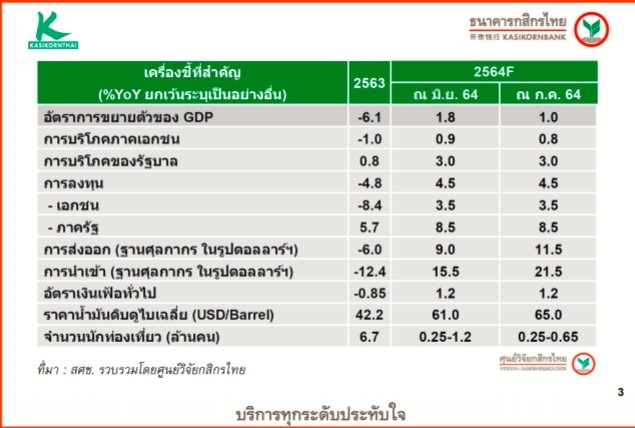
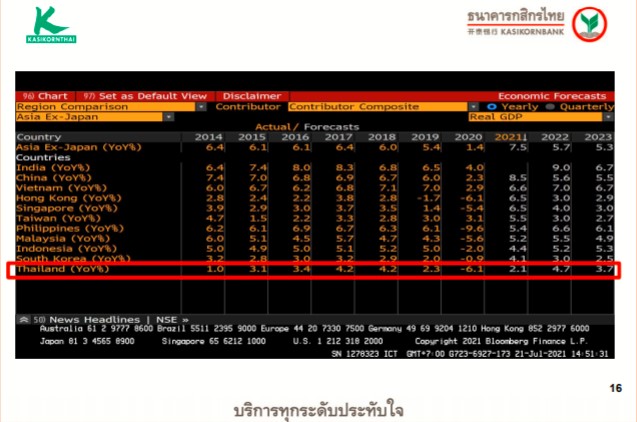
The Economic and Business Research Center of Siam Commercial Bank estimates that the economy this year will grow only 0.9%, down from the previous forecast of 1.9%, due to the worsening COVID-19 outbreak, a decrease in tourists entering Thailand, increased damage to consumption, and the private sector being affected by the closure of worker camps. Although it is expected that the government will have more funds to support the economy than previously anticipated, it will still be insufficient, with the worst-case scenario indicating a contraction of -0.4% for the Thai economy.
Private consumption will be significantly impacted in the third quarter before slowly recovering towards the end of the year, as the domestic outbreak is in a crisis state, reflected by the increasing number of daily infections, severe cases, and deaths, as well as the slower-than-planned vaccination rollout and reduced effectiveness against the highly transmissible Delta variant. Therefore, the EIC expects it will take until the end of November for daily infections to drop below 100, which is over 8 months since the outbreak began in April (originally predicted to take only 4 months to control the disease). This is likely to cause damage to private consumption exceeding 770 billion baht (about 4.8% of GDP), primarily due to the effects of lockdown measures, public concerns about infection, and significantly increased economic uncertainty, along with reduced income for businesses and workers in many sectors.
Furthermore, the government measures implemented to date are still insufficient in terms of coverage, duration, and total funding. The economic impacts are widespread across all provinces, as reflected by the Facebook Movement Range indicating that travel and economic activities have decreased in every province, even those not under lockdown, due to public concerns about infection. The duration of the impact is also expected to be prolonged, at least through the third quarter.
Therefore, the latest income compensation measures for workers and businesses, which only cover the provinces under lockdown and provide compensation for just one month, are unlikely to be sufficient to offset the overall economic impact. The EIC anticipates that, in the baseline scenario, the government will need to introduce additional economic support measures of at least 150 billion baht, totaling around 200 billion baht this year from the 500 billion baht borrowing bill.
KKP Research Predicts Lockdown for at Least 3 Months Risks Thailand Entering Another Economic Recession
KKP Research, part of Kiatnakin Phatra Financial Group estimates that the current outbreak in Thailand will require at least a 3-month lockdown before the situation can ease. This will severely impact the economy due to reduced consumption and investment in the third quarter, leading to negative growth for annual consumption and affecting the GDP forecast for 2021, reducing it from a growth of 1.5% to only 0.5%, even if exports improve. When combined with the GDP forecast for 2022 at 4.6%, the overall economic growth for this year and next year at 5.1% will not be sufficient to offset the contraction of 6.1% in 2020, and Thailand's economy will take until the first half of 2023 to return to pre-COVID levels.
However, in a worst-case scenario, if a lockdown longer than three months is necessary or if stricter lockdown measures are implemented affecting production and exports, which are the last hopes for the Thai economy, KKP Research estimates that the Thai economy will suffer an additional -1.3%, leading to a contraction of 0.8% this year.
Delayed and Uncertain Vaccine Plans Increase Economic Costs from Additional Lockdowns
Currently, only 3.5 million Thais have received two doses of the vaccine, representing just 5% of the population, and nearly all have received the Sinovac vaccine (3.3 million people), which research shows has limited efficacy against the Delta variant and is likely to result in waning immunity. The uncertainty in vaccine procurement is creating risks for achieving overall immunity. KKP Research predicts that by the end of this year, only 35% of the population will have received two doses of the vaccine.
The delayed vaccination rollout increases economic costs through additional lockdowns. A study by OECD countries found that having a population vaccinated with two doses can reduce transmission equivalent to some lockdown measures. For example, if 7% of the population is fully vaccinated, it can reduce the average transmission risk equivalent to school closures, stay-at-home orders, or international travel bans. However, if more than 13% of the population is fully vaccinated, it can reduce transmission equivalent to workplace closures. Given that Thailand's vaccination rate is still very low, the remaining option is inevitably stricter lockdown measures, which will significantly increase economic costs.
A Harvard study across 152 countries indicates that lockdown measures have significant limitations: the effectiveness of measures peaks within the first two months. After 60 days of enforcement, the results diminish significantly due to reduced compliance (lockdown fatigue). The economic and social constraints make successful lockdowns challenging and time-sensitive. Additionally, even with strict lockdowns, it is crucial to concurrently implement measures to expedite the resolution of the situation, such as 1) enhancing testing capabilities, such as distributing or subsidizing rapid antigen tests and facilities for home isolation, and 2) procuring highly effective vaccines against the Delta variant.