8 Alternatives for 'Debt Restructuring' Before Becoming Bad Debt
8 Alternatives for "Debt Restructuring" - The Bank of Thailand Suggests Turning Crisis into Opportunity, Don't Wait Until Debt Becomes Bad. If You Feel You Can't Make Payments, Contact Financial Institutions Quickly to Avoid Damaging Your Credit History.
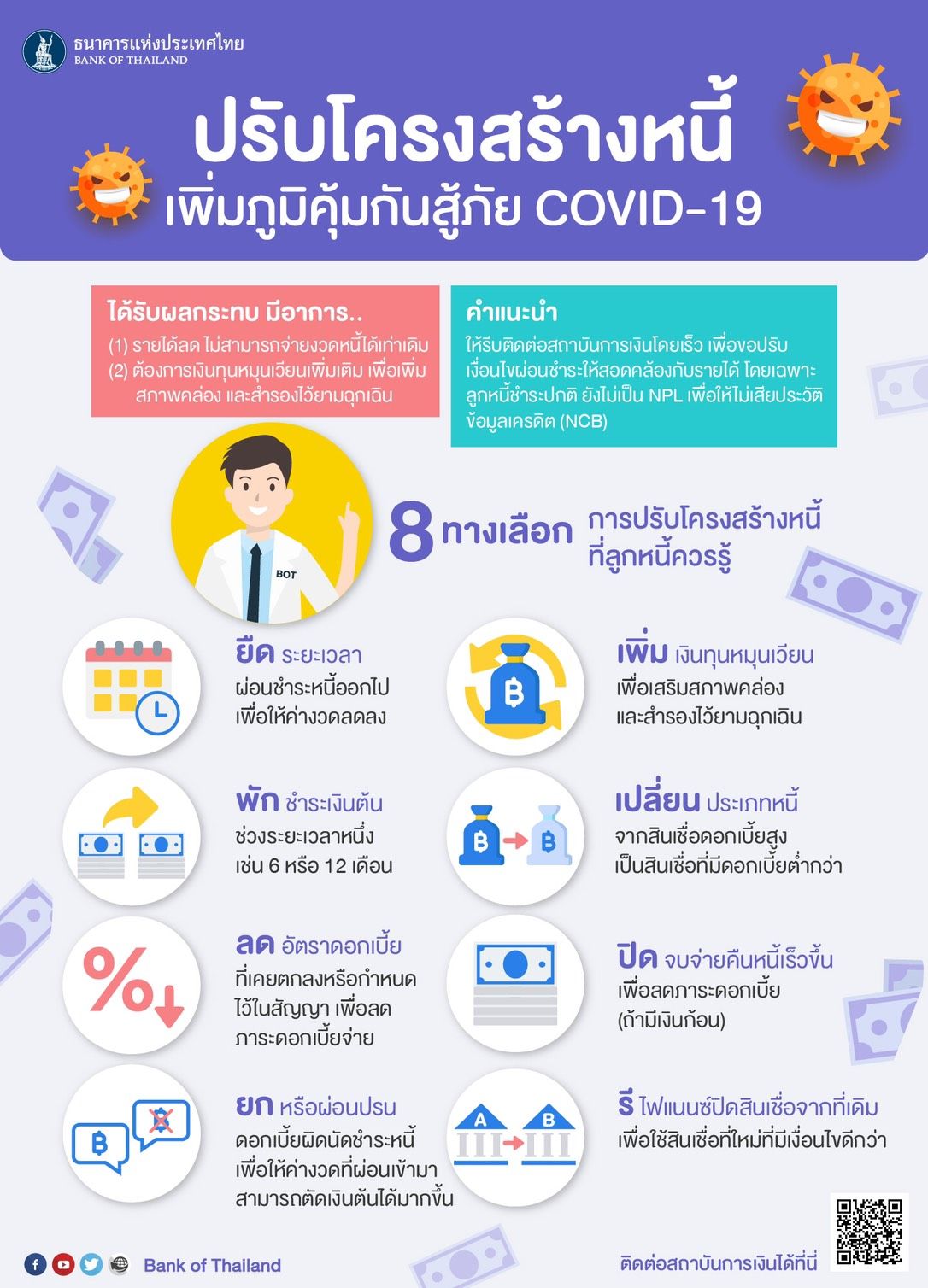
The Bank of Thailand has published an article titled "Debt Restructuring: Turning Crisis into Opportunity", recommending 8 methods for debt restructuring, including extending, deferring, reducing, waiving, increasing, changing, closing, and refinancing debts. These options can help individuals or businesses continue operating after the COVID-19 situation. The Bank of Thailand encourages debtors and financial institutions to collaborate in negotiating debt restructuring and finding mutual solutions to reduce the chances of good debtors becoming bad debtors.
The 8 Debt Restructuring Options are as follows:
1. Extend Debt - Extending or lengthening the repayment period is the most commonly used method to help align payment burdens with reduced income. For example, if a loan has a repayment period of 10 years and 6 years have already been paid, leaving 4 years, and the debtor is struggling to make payments, they can request an extension to lower monthly payments.
- Financial institutions may consider the borrower's age as a factor. Historically, the average repayment period after debt restructuring is around 8 years.
2. Defer Principal Payments - This temporarily reduces the payment burden. Typically, monthly payments consist of two parts: principal and interest. For instance, if a loan agreement specifies a monthly payment of 20,000 THB, which includes 8,000 THB principal and 12,000 THB interest, deferring the principal payment would reduce the monthly payment to 12,000 THB. However, during this deferral, the principal does not decrease, which may result in a larger balloon payment at the end of the contract or prolong the debt and interest burden.
- Financial institutions may consider deferring principal payments for 3–6 months. When the situation improves, debtors may use lump-sum payments to reduce debt before the contract's due date, which will lower interest payments and expedite debt clearance. Recently, the central bank has also promoted fairer practices regarding early repayments.
3. Reduce Interest Rates - A decrease in loan interest rates allows more of the monthly payment to go towards reducing the principal. As the principal decreases, the interest burden also reduces. For example, if a borrower has a loan with an interest rate of MOR+2% per year and is unable to continue payments due to economic impacts, they can request a reduction in the loan interest rate.
- Financial institutions will consider whether to grant a reduction based on various factors, such as the institution's costs, the borrower's repayment history, the type of loan, and collateral.
4. Waive or Reduce Default Interest - At the beginning of 2020, the central bank announced that financial institutions should calculate default interest based only on the actual missed payments to ensure fairness and to focus more on the debtor's repayment ability.
- Financial institutions can set default interest rates but must ensure they do not impose an unreasonable burden on debtors or cause the debt burden to increase significantly, leading to bad debt later.
5. Increase Working Capital - In uncertain future conditions, working capital is crucial for sustaining businesses during tough times, allowing for a quicker recovery later. The central bank encourages financial institutions to provide new working capital loans to viable businesses, separating this from other loans that may already be classified as NPLs, thus allowing businesses to maintain normal credit accounts.
- Borrowers should prepare justifications and estimates of expenses expected in the next 6–12 months, such as employee wages, raw material purchases, and other operational costs like utilities and office rent, to assist financial institutions in considering loan amounts.
- Financial institutions will evaluate repayment history, such as how much the debtor has paid in principal and interest over the past year and what proportion the requested additional working capital represents of the total debt burden.
6. Change Debt Type - High-interest debts should be converted to lower-interest debts. For example, SMEs using credit cards and cash withdrawal cards as working capital sources may face high-interest rates of 18% and 28%, or have fully utilized overdraft limits.
- Financial institutions may consider converting these high-interest revolving loans into term loans with lower interest rates.
7. Settle with a Lump Sum - If a debtor can gather a lump sum from savings, borrowing from friends or family, or selling assets, even if it's less than the total debt, they can negotiate for a discount sufficient to settle the debt entirely, eliminating one monthly payment burden.
- Financial institutions may require settlement within a short period, such as 6 months or just 1–2 installments. However, negotiating a settlement with a discount can be challenging if there is collateral worth more than the debt.
8. Refinance - This involves closing a loan with the original creditor and switching to a new creditor offering better terms, such as lower interest rates, using the new loan to pay off the existing debt. In Thailand, refinancing for home loans and secured business loans is already familiar. However, the central bank has started to support the development of a refinancing market for credit card debts, cash withdrawal cards, and personal loans. At the beginning of 2020, several financial institutions introduced refinancing products for credit card debts, including the Government Savings Bank, which offers refinancing for financially disciplined debtors with good repayment histories.
SOURCE: www.bangkokbiznews.com