
COVID-19 Virus Impacts Thailand's GDP Severely, First Half at Risk of Negative Growth, Full Year at 0.5%
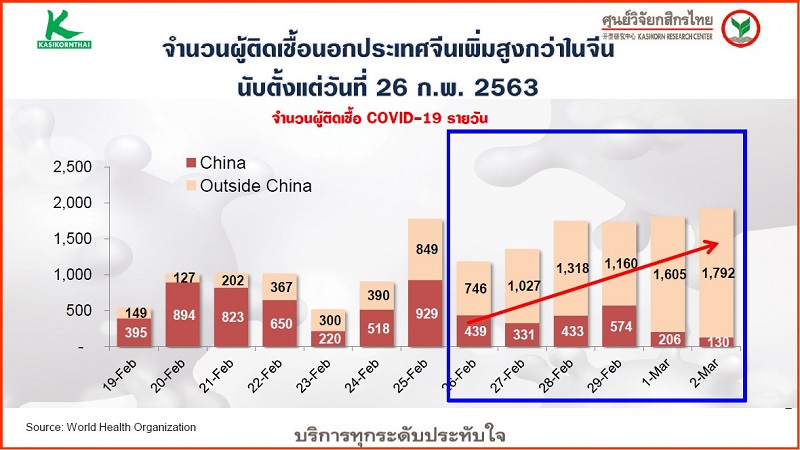
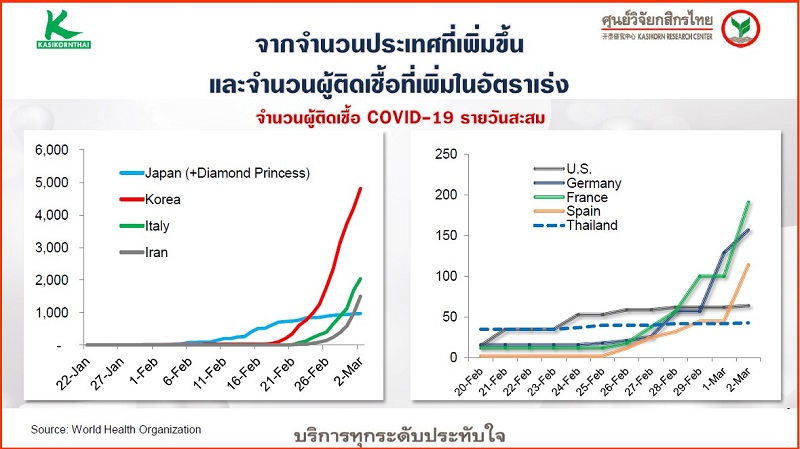
The Kasikorn Research Center is concerned about the COVID-19 virus outbreak, which appears to be intensifying and spreading more widely around the world, especially with a rapid increase in cases outside of China. This unpredictable situation complicates the assessment of its impact on the overall economy.
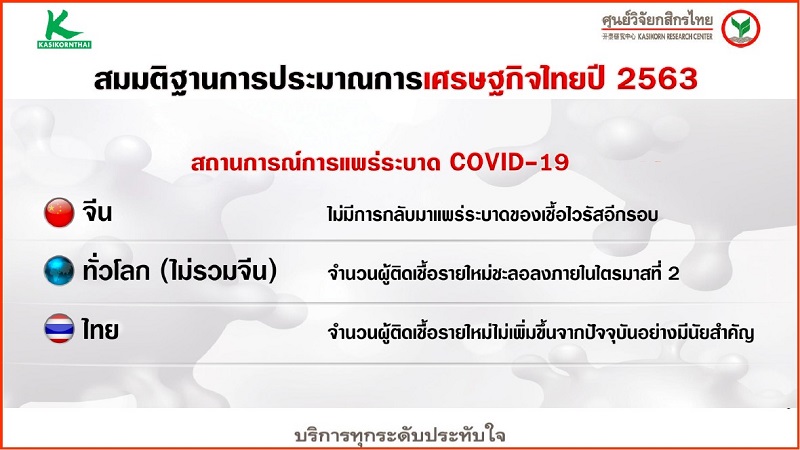
Ms. Natthaporn Treeratnasilkul, Assistant Managing Director of Kasikorn Research Center Co., Ltd. stated that the COVID-19 outbreak in China has affected the global economy and Thailand's economy. The Kasikorn Research Center predicts that this year, Thailand's GDP will grow only 0.5%, down from the previous estimate of 2.7%. Although this figure seems significantly reduced, it reflects an assessment based on rapidly changing circumstances. If the outbreak shows signs of easing within the first half of the year, according to assumptions: 1. The COVID-19 outbreak in China can control the increase in cases within the next 1-2 months; 2. Other countries, especially Italy and South Korea, can control their situations in the second quarter; and 3. Thailand does not experience a rapid increase in cases in a short time.
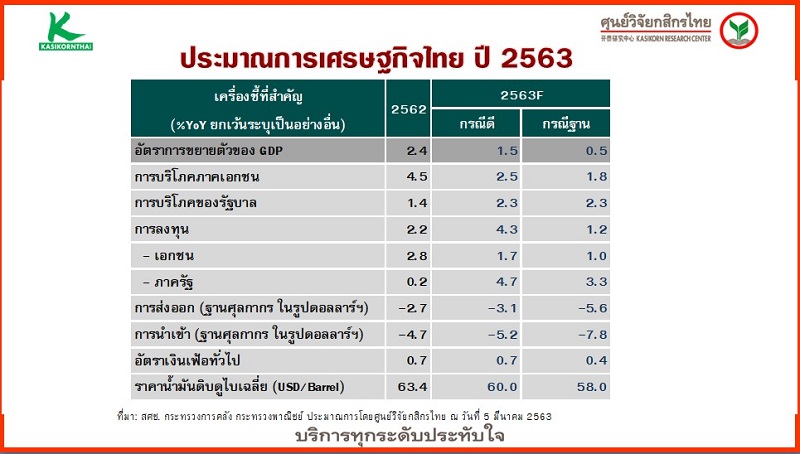
Initially, it is expected that during the first and second quarters, the overall GDP will be negative, but it may recover in the second half of the year, potentially leading to a positive GDP in the fourth quarter. This situation is different from 1997 because this time it is a severe event caused by external factors, while in 1997, it stemmed from imbalances in economic mechanisms and the business sector, which are harder to resolve and recover from.
The most severe impact is likely to be on the tourism sector, where it is estimated that foreign tourist revenue will drop by 410 billion baht, accounting for 2.4% of GDP. The number of tourists is expected to decrease by 8.3 million, or a contraction of -20.8% from the previous year, potentially resulting in over 200,000 job losses.
Additionally, the international trade sector in Thailand is expected to see exports contract deeper to -5.6%, down from the previous estimate of -1.0%. The widespread outbreak has led to a downturn in the global economy and reduced demand for Thai exports, as well as impacting supply chains, especially from China, which affects Thailand's manufacturing sector. Meanwhile, domestic consumption and investment are also expected to slow down as consumers avoid spending and going out, leading to a projected impact of at least 100 billion baht on Thai retail businesses this year. All of this necessitates close monitoring of business liquidity issues and employment situations, which are immediate concerns that the government must address as a priority. Furthermore, it is essential to track budget disbursements and the possibility of additional budget allocations.
While the option to reduce interest rates may not be a miracle cure to quickly revive economic activity in such an unusual situation, it can help alleviate the financial burden on businesses and households to some extent. The measures to mitigate the impact of the COVID-19 outbreak, amounting to over 100 billion baht, which the Ministry of Finance is preparing to propose to the Cabinet on March 6, will be another measure for the government to support the economy with a significant amount of funding as quickly as possible to keep domestic activities moving forward and reduce the risk of a widespread economic collapse.
Regarding monetary policy, it is expected that the impacts will gradually become clearer through the temporary contraction of GDP in the first and second quarters of the year, leading the Bank of Thailand to further reduce the policy interest rate by at least 0.25-0.50% for the remainder of the year, which will be followed by a reduction in commercial bank interest rates.
For Thai commercial banks, especially in the first half of the year, there will be impacts on revenues, both from interest income and fee income, particularly from interest income on loans, which will face both the impact of further interest rate reductions and a revised growth forecast for loans down to no more than 1% in 2020 (previously estimated at a lower bound of 3.0%), compared to 2.2% at the end of 2019. Meanwhile, the cost of setting aside provisions for non-performing loans may increase in line with the rising NPL ratio, which may shift from 2.98% at the end of 2019, depending on the situation and the first-quarter figures under the new accounting standards to reassess the direction clearly.
"However, the more important task for Thai commercial banks at this time is to assist customers through various measures in cooperation with the authorities to help them get through this difficult period. The impact on this year's performance is something that investors are already aware of to some extent, and it aligns with the direction of financial institutions worldwide."
Thank you for the information: Kasikorn Research Center Co., Ltd.