AOT Compensates Operators at 6 Airports... Is It Quietly Robbing Shareholders and the Treasury?
After the bidding process concluded with King Power winning the duty-free and airport management concessions, the Airports of Thailand Public Company Limited (AOT) stated that the proposal submitted offered higher compensation than what AOT had previously received and exceeded their expectations.
Although the new contract has not yet started, AOT has already provided a two-year advance discount.
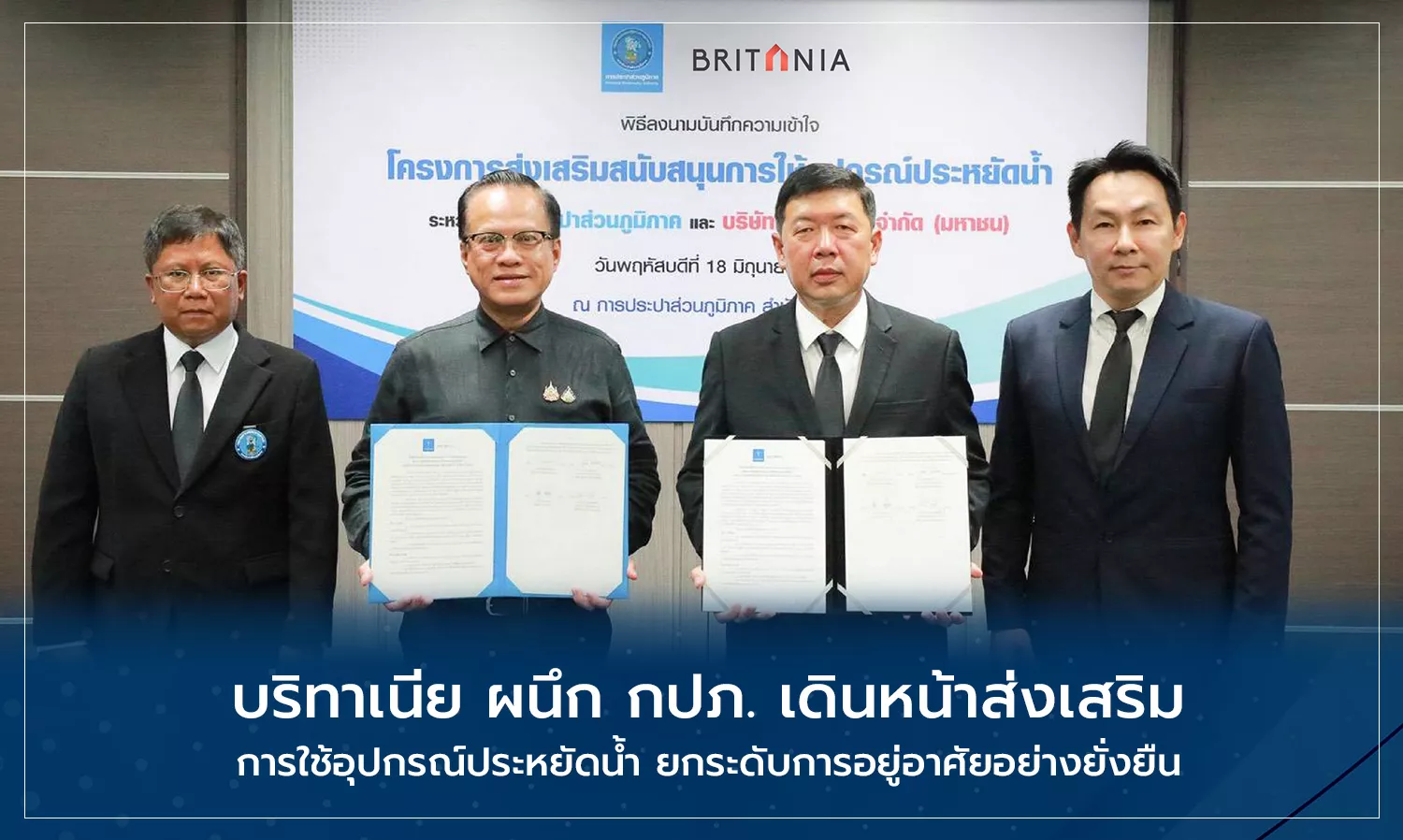
Recently, during the AOT board meeting on February 19, 2020, it was approved to implement measures to support operators at six airports: Suvarnabhumi, Don Mueang, Phuket, Chiang Mai, Hat Yai, and Mae Fah Luang in Chiang Rai, citing the impacts of the COVID-19 pandemic and directives from the Prime Minister to reduce compensation for operators, effective from February 1, 2020, to March 31, 2022.
After AOT announced the board meeting results to the media and notified the Stock Exchange on February 19, 2020, the next day, the website "Invest Man" analyzed how "AOT's assistance to operators caused the stock to drop by 6%". On the morning of February 20, 2020, AOT's stock value plummeted by 6%, amounting to over 60 billion baht, which is expected to be a result of the announced relief measures.
The key points of AOT's relief measures are as follows:
Group 1: A 20% reduction in fixed monthly compensation or rent for one year, starting from February 1, 2020, to January 31, 2021. For the following year, AOT will review the reduction rate again to align with the situation.
Group 2: For contracts without fixed compensation, the AOT board decided to waive the collection of minimum monthly and annual compensation, maintaining only percentage-based compensation for two years, from February 1, 2020, to March 31, 2022.
Group 3: A six-month deferment of compensation payments and waiving penalties for operators who request such deferments, effective from February to July 2020.
How AOT Collects Compensation
The concern among investors leading to a 6% drop in AOT's stock likely stems from the measures in Group 2.
First, it is essential to understand that AOT, which is a state enterprise, has two methods for collecting compensation from concessionaires:
Method 1: Collecting monthly compensation as a percentage, such as the current duty-free concession, which collects at a rate of 20% of sales revenue before deducting expenses, taxes, and fees.
Method 2: Collecting minimum monthly and annual compensation (Minimum Guarantee) as specified in the contract.
Whichever method yields more revenue for AOT will be used. For example, if a concessionaire has sales revenue of 50 billion baht, the 20% compensation would amount to 10 billion baht. However, if this amount is less than the Minimum Guarantee of 14.5 billion baht, the concessionaire must pay the difference of 4.5 billion baht. Conversely, if sales increase to 80 billion baht, the 20% compensation would be 16 billion baht, and no additional payment would be required for the Minimum Guarantee. This illustrates the principle of collecting compensation for contracts with variable compensation.
Looking back to mid-2019, it is remembered that King Power Group was approved by the AOT board as the winner of the concession bidding at all airports. King Power Duty Free entered into a duty-free concession contract with AOT by offering a Minimum Guarantee of 15.419 billion baht for the first year, nearly double that of competitors like Lotte and Duty Free.
For the commercial space management concession at Suvarnabhumi Airport, King Power Suvarnabhumi won the bid by proposing a first-year minimum compensation of 5.798 billion baht, and for three regional airports, King Power Duty Free also won by offering a first-year minimum compensation of 2.331 billion baht, totaling 23.548 billion baht across three contracts. Investors had anticipated that AOT would see increased revenue from concessions as soon as the new contracts took effect on September 28, 2020, until March 31, 2031.
The COVID-19 phenomenon prompted the AOT board to decide to suspend the collection of minimum monthly and annual compensation from operators for two years, only collecting percentage-based compensation going forward.
Suspension of Minimum Compensation for 2021 Affects AOT Revenue by Over 10 Billion
Investors had previously expected AOT's concession revenue to increase to 23.5 billion baht in 2021, but this may not align with AOT's earlier statements, as the board canceled the minimum compensation collection before it even began on September 28, 2020, extending it until March 31, 2022.
The question arises... Is this quietly robbing shareholders and the Ministry of Finance?
Moreover, the Ministry of Finance may face a double blow, both as a shareholder and in terms of revenue contributions to the state.
Another point, which is well-known, is that King Power won the bidding by offering nearly double the first-year minimum compensation compared to competitors, following the criteria approved by the AOT board and the selection committee at that time. However, before any payments began (scheduled to start after September 2020), the AOT board decided to cancel this, raising questions about fairness to other bidders.
The next question is why the AOT board did not opt for a six-month suspension, as in Group 3's deferment measures, or just one year, as in Group 1's 20% reduction of fixed compensation.
Thus, the question remains... How did the AOT board know that the COVID-19 outbreak would have a two-year impact?
AOT operates as both a state enterprise and a publicly listed company. While it can implement relief policies, excessive measures may lead to benefits that disadvantage shareholders.
Another point of concern is that commercial areas in airports are primarily owned by King Power Suvarnabhumi, while various retailers in the airport are not direct contracting parties with AOT. Therefore, the question arises whether King Power has proportionately reduced rental rates for subletting retailers.
This raises a loud question: Is the "relief measure" a tool for providing benefits or genuine support, and if it is genuine support, does it need to last for two years?
Relief Measures Are Not a New Tool
AOT's current relief measures for operators are not new. Previously, in 2008, the People's Alliance for Democracy led protests that resulted in the closure of Suvarnabhumi and Don Mueang airports for ten days (from November 26 to December 5, 2008), affecting tenants, operators, and airlines.
In March 2009, the AOT board approved relief measures for operators at Suvarnabhumi Airport by reducing compensation and extending contracts for all operators by six months to two years.
For the compensation reduction measures approved by the AOT board in March 2009, for contracts specifying both percentage-based compensation and minimum compensation, the board decided to collect only the percentage-based compensation from sales from January to December 2009, while the minimum compensation for 2009 was waived and deferred to the next year until the contract's expiration.
Additionally, the board approved extending the contract duration for all operators at Suvarnabhumi Airport by six months to two years for contracts exceeding ten years.
The result of these measures allowed King Power Group to have their contract extended by another two years.
Shortly after AOT implemented these relief measures, political unrest occurred again, with the United Front for Democracy Against Dictatorship (UDD) leading protests against the government of Abhisit Vejjajiva. The situation escalated, leading to the dissolution of protests in early 2010, prompting various countries to warn their citizens against traveling to Thailand, resulting in a decrease in passenger numbers, compounded by a volcanic eruption in Iceland in April 2010, which led to the cancellation of inbound and outbound flights.
By late 2010, AOT announced additional relief measures for operators at Suvarnabhumi Airport, which included both compensation reductions and contract extensions, waiving the minimum compensation for 2010 while still collecting percentage-based compensation from total sales and extending the contract duration for operators by another two years.
As a result of these measures, King Power Group received an extension of their concession contract until September 27, 2020.
Phatra Downgrades AOT Stock Recommendation to Underperform
Meanwhile, Phatra Securities released an analysis of Airports of Thailand Public Company Limited (AOT) on February 20, 2020, downgrading its earnings forecast for AOT and adjusting its recommendation to underperform.
According to Phatra's analysis, the downgrade in AOT's earnings forecast is due to reduced revenue from concessions, as the company voluntarily offered financial assistance to tenants and concessionaires to mitigate the impacts of the COVID-19 outbreak.
Over 20 Billion Lost in Three Years
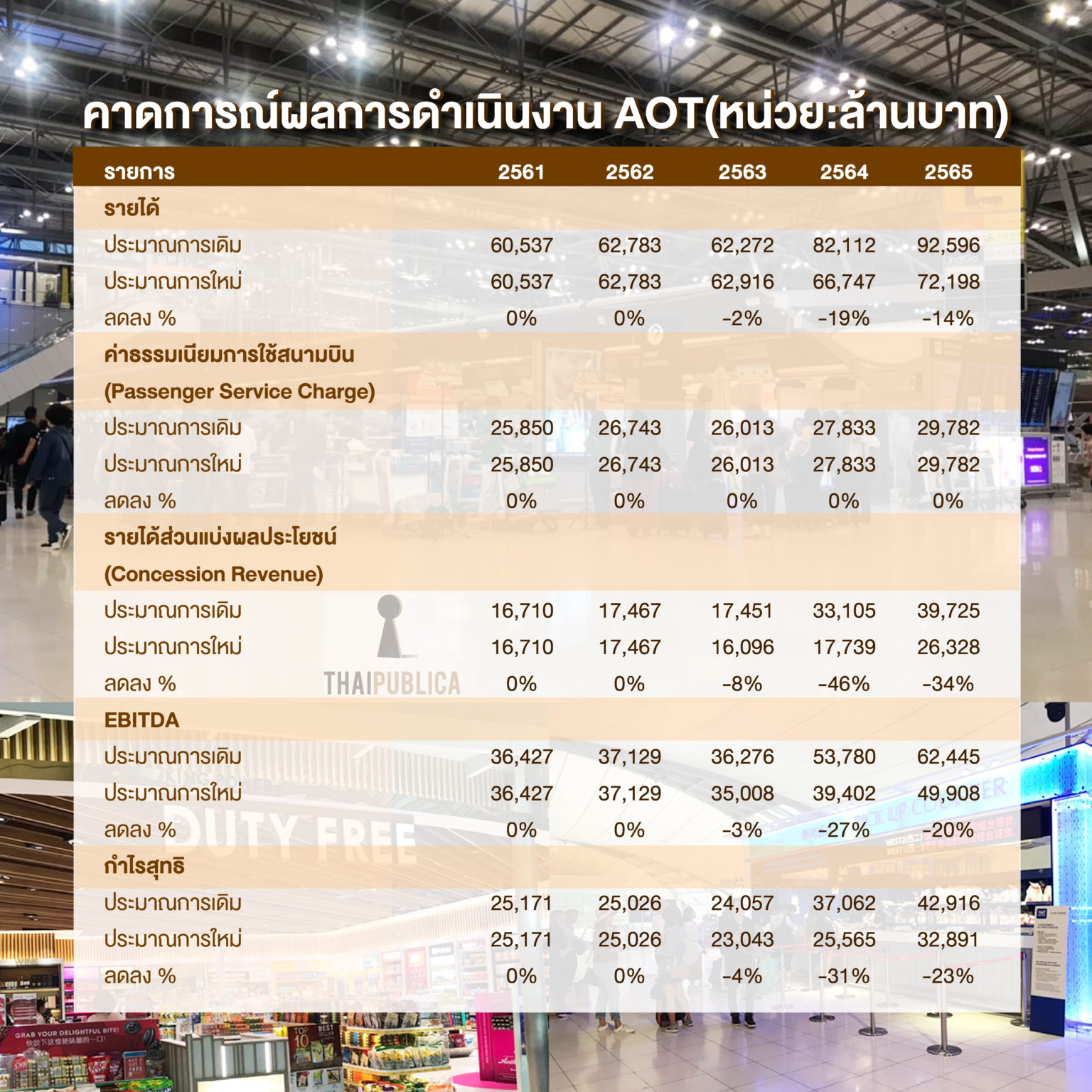
AOT's relief measures announced are considered more extensive than anticipated, leading to significant adjustments in previous forecasts. The profit forecast for 2020 was reduced by 4%, for 2021 by 31%, and for 2022 by 23%.
Phatra Securities adjusted its profit forecast for AOT in 2020 to 23.043 billion baht from 24.057 billion baht (a 4% decrease), for 2021 down by 31% to 25.565 billion baht from 37.062 billion baht, and for 2022 down by 23% to 32.891 billion baht from 42.916 billion baht.
SOURCE: www.thaipublica.org