
Enhancing Intellectual Property Protection: Advancing Towards a Knowledge-Based Economy
Research by the Geneva Network indicates that Thailand is one of the ASEAN countries that must elevate its intellectual property rights (IPR) framework and law enforcement mechanisms to align with global standards, enabling the country to progress towards becoming a high-income nation.
The research titled “The Importance of Intellectual Property for Development: Insights for Reform in ASEAN Countries” highlights that Thailand needs to improve in various areas, such as patent examination and protection, to drive economic growth and avoid the middle-income trap, while also advancing towards a higher-income economy. The Geneva Network, a research and policy advocacy organization from the UK, states that issues related to innovation development, trade, and a robust intellectual property protection framework are crucial drivers for the country to transition to a knowledge-based economy. Furthermore, these factors are essential for attracting foreign investment, creating high-value jobs, and expanding domestic businesses. Stronger patent and trademark protection laws positively impact the economy; for instance, industries that prioritize trademarks contribute significantly to the country's GDP, accounting for 22%, while creative industries rely on copyright protection for survival.
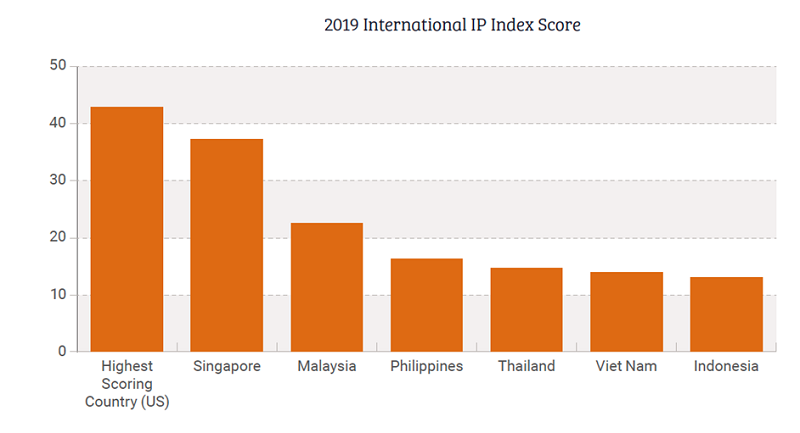
Graph showing country rankings based on intellectual property protection scores
The report also indicates that Thailand can improve its ranking in the intellectual property rights index (currently below global standards) by strengthening the enforcement of intellectual property protection measures, accelerating the patent examination process, and reducing gaps in copyright and trademark law protection. The survey found that Thailand takes an average of 14 years to examine biotechnology-related patents, and patents often receive approval only a few months or weeks before they expire.
However, the Thai government has supported significant changes in several key areas, such as addressing online data theft and counterfeiting. Both the Prime Minister and the Deputy Prime Minister chair several intellectual property committees, while the Department of Intellectual Property has hired additional patent examiners, resulting in a 20% reduction in the backlog of pending patent examinations in 2018.

Karn Yunyong, Managing Director of Siam Intelligence Unit stated, “Thailand should advance towards becoming a knowledge-based economy to attract new investments and growth, as well as to develop into a high-income country. This requires a clear intellectual property protection framework. Although Thailand has made significant progress in this area over the past few years, additional measures are necessary to ensure we do not fall behind our regional neighbors.” Siam Intelligence Unit is a private organization that brings together Thai thinkers and scholars in economics, politics, public policy, and international relations.