Economic Slowdown, Interest Rates Down... Why is the Baht Still Strong? (1)
Report by Kantaphon Amornrat and Duangrat Prajaksilpa, TMB Analytics
The strengthening of the Thai Baht has been a continuous topic of discussion throughout this year, as the Baht has appreciated steadily since the beginning of the year, despite the slowdown in the Thai economy due to the trade war and the global economic slowdown.
However, the situation of the Thai Baht has not improved significantly compared to the beginning of the year. The Thai Baht has appreciated by over 6.75% against the US dollar, reaching 30.48 Baht per US dollar (as of September 23, 2019). In the week prior, it even strengthened to 30.38 Baht per US dollar, marking the lowest level of the currency in six years.
Moreover, the Thai Baht has appreciated more than other currencies, including those of neighboring countries like Singapore or developed countries with strong economic fundamentals like Japan. Even though their currencies have strengthened, they have not appreciated as much as the Baht. When comparing the Thai Baht to other major currencies in Asia and around the world, it has consistently appreciated.
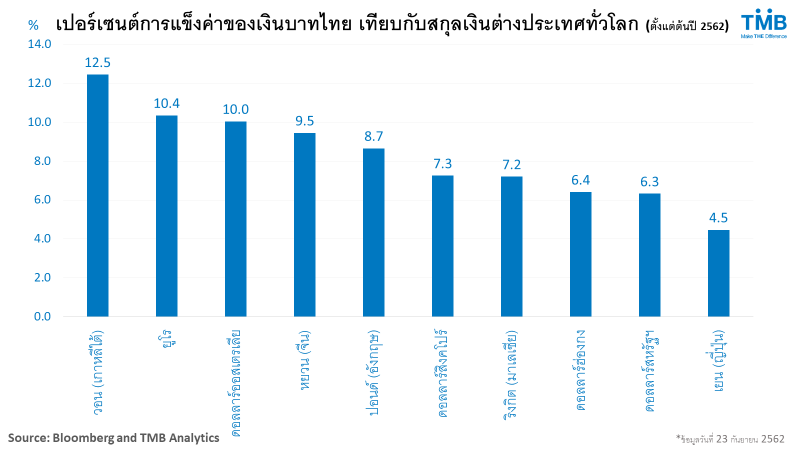
This information aligns with the NEER (Nominal Effective Exchange Rate) index of the Baht, which compares the Baht against other currencies of Thailand's trading partners. The Baht index has increased by over 6.8% since the beginning of the year, clearly indicating that the Thai currency has appreciated.
Furthermore, since the beginning of 2019, the Thai Baht has been one of the strongest currencies in the world. Among 140 currencies globally, the Thai Baht has appreciated the fourth most and is the strongest in Asia.
Today, we would like to help explain how we can better understand the Thai Baht.
A Strong Baht = Everyone Wants Thai Baht
Before we search for the reasons behind the appreciation of the Thai Baht, we should first understand what “the appreciation of the Thai Baht” really signifies. To put it simply, the appreciation of the Thai Baht indicates that the Baht has increased in value. For instance, at the end of last year, the exchange rate was approximately 32.4 Baht per US dollar, meaning we needed to use 32.4 Baht to exchange for 1 US dollar. Now, we only need 30.5 Baht for the same exchange, indicating that the Baht has gained value due to its appreciation.
The increase in the value of the Baht is related to economic principles such as supply (Demand) and demand (Supply). Prices of goods rise due to two scenarios: when the demand for purchasing those goods increases and when the supply of those goods decreases. In the case of the Baht, the increased demand for holding or using the Baht will naturally lead to an increase in its value compared to other currencies, resulting in the appreciation of the Baht.
What Drives the Increased Demand for the Baht?
We can understand the demand for the Baht by studying what is known as the Balance of Payment, which is an account that indicates the amount of foreign currency flowing in and out of Thailand through various channels, showing how much demand there is for the Baht. The Balance of Payment consists of two main components:
- 1. Current Account, which is the foreign currency flowing in through trade in goods and services, including the trade balance (exports minus imports) and the service balance (income from foreigners visiting Thailand minus expenses incurred by Thais traveling abroad), as well as income from Thai companies investing abroad minus income that foreign companies in Thailand remit back to their home countries.
2. Financial Account, which is the foreign currency flowing in through foreign companies investing in Thailand minus investments made by Thai companies abroad, including direct investment, investment in financial assets, and other financial assets such as trade credits and loans.
The Balance of Payment of each country varies in characteristics, details, and size, depending on the economic conditions of each country. In the ASEAN region, we see similarities in economic patterns, where each country relies more on exports than imports, resulting in a positive trade balance for Indonesia, Vietnam, and Singapore.
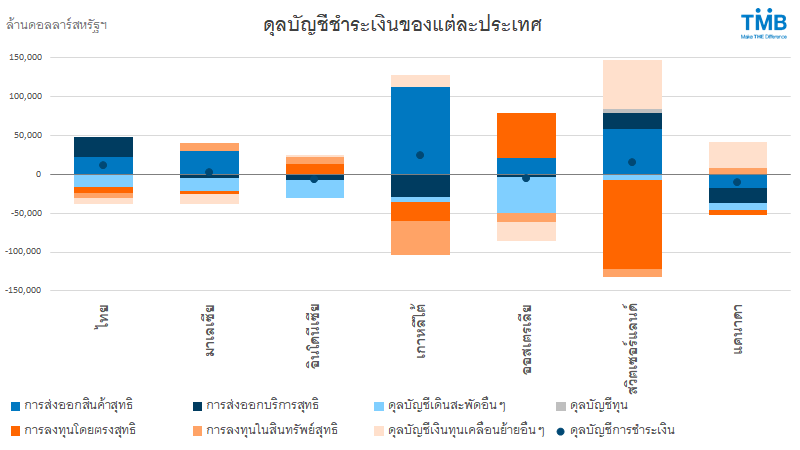
In theory, the exchange rate will not change if the Balance of Payment is zero, as the amount of foreign currency flowing in matches the amount flowing out, resulting in no change in the demand for the Baht. However, if the Balance of Payment is in surplus, it means that more foreign currency is flowing into Thailand, leading to an increased demand for the Baht, which results in the appreciation of the Baht. Therefore, a surplus in the Balance of Payment indicates a trend of the Baht appreciating. Conversely, the Baht is likely to depreciate if the Balance of Payment begins to show a deficit.
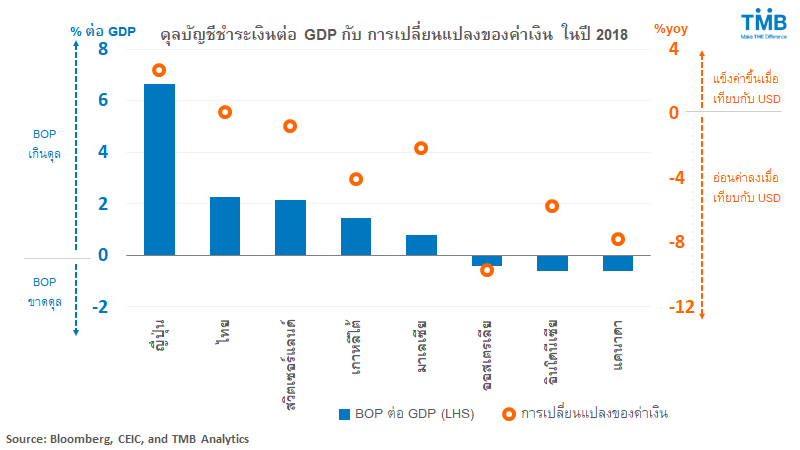
Countries with a higher surplus in their Balance of Payment tend to appreciate more (or depreciate less) compared to countries with a smaller surplus or a deficit.
What is the Development of Thailand's Balance of Payment?
If we examine the trends in Thailand's Balance of Payment, we find that it has undergone continuous changes over the past decade. Specifically, the current account of Thailand has consistently been in surplus for the past five years, starting from 2014. The main factor contributing to this continuous surplus is the rapid growth of Thailand's tourism sector in recent years, leading to an influx of foreign currency into Thailand. The value of income from Thai tourism, which was around 8 billion US dollars per quarter in 2012, has surged to 16 billion US dollars today, significantly boosting the value of service exports. The value of service exports, which had a deficit of 400 billion Baht in 2008, turned into a surplus in 2013 and has continued to grow, reaching a net service export surplus of 800 billion Baht in 2018. In the first half of 2019, the value of service exports was nearly 400 billion Baht in surplus.
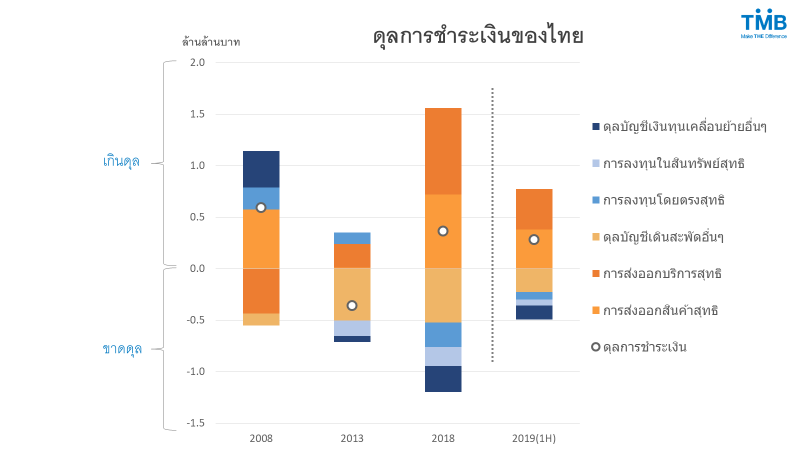
Meanwhile, Thailand's financial account, although smaller than the current account, has shown a contrary trend over the past five years. The financial account has been in deficit since 2013, partly due to increased foreign investments by Thai companies. As a result, Thailand currently has a net surplus in its Balance of Payment, with a surplus of 7.2 billion US dollars in 2018, or approximately 2.3% of GDP.
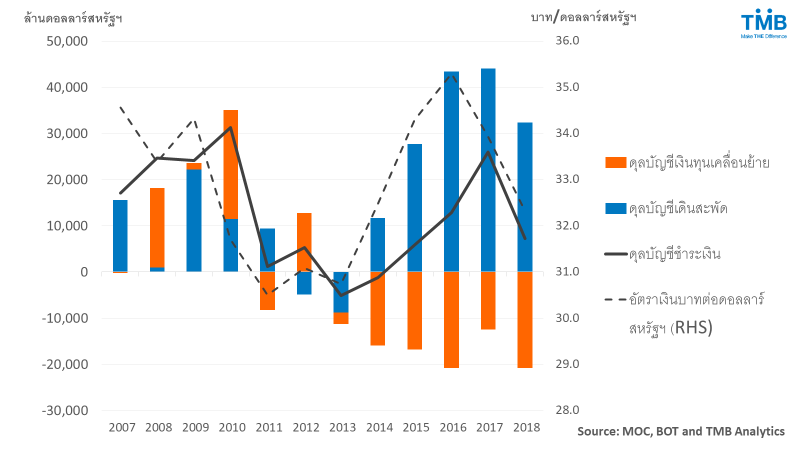
When we compare the movement of the Thai Baht over the long term, we can see that it moves in accordance with the Balance of Payment. That is, during periods when Thailand's surplus increases, the demand for the Baht rises, resulting in the appreciation of the Baht. Conversely, if Thailand experiences a deficit in its Balance of Payment, the Baht is likely to depreciate as well.
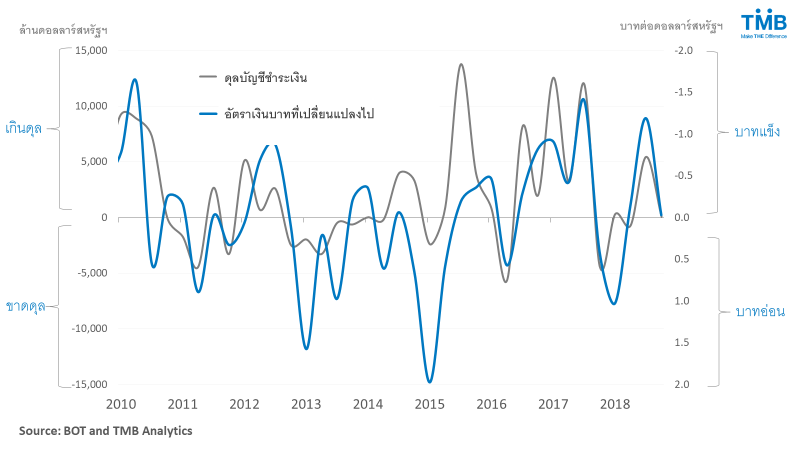
Therefore, initially, we can see that the Balance of Payment is a useful tool for understanding the direction of the Baht. If we want to understand the movements of the Baht in more detail, we should further study the internal components of both the current account and the financial account.
In the next installment, we will examine which components of the current account or financial account have contributed to the significant appreciation of the Baht over the past year.
Thank you for the information from thaipublica.org