
The Federation of Thai Industries Proposes Government to Consider New Minimum Wage Increase, Fearing Impact on SMEs Leading to Business Closures
The Federation of Thai Industries (FTI) has proposed that the government consider a new minimum wage increase, indicating that it could disrupt the entire wage structure and potentially lead to the closure of SMEs. The real beneficiaries of this increase would be the over 3 million foreign workers across the country. The FTI urges the government to focus on developing skilled labor to foster innovation and enhance the quality of Thai workers, emphasizing that an immediate minimum wage increase cannot improve the economy.
Mr. Suphan Montakulsuth, President of the Federation of Thai Industries stated that raising the minimum wage to 400 baht per day nationwide would directly impact small and medium-sized enterprises (SMEs), potentially forcing them to shut down due to the inability to cope with the increased wage costs. He noted that the proper process for adjusting the minimum wage should involve a resolution from the tripartite committee, and that wage rates should vary by region according to local economic conditions, making a uniform national wage impractical.
Currently, the labor situation in Thailand (as per the National Statistical Office's labor survey for June 2019) shows a labor force of 38.82 million, comprising 38.38 million employed individuals, 363,000 unemployed, and 83,000 seasonal workers. Compared to the same period in 2018, the number of employed individuals increased by 10,000 (from 38.37 million to 38.38 million), while unemployment decreased by 63,000 (from 426,000 to 363,000). The total number of foreign workers in Thailand (according to the Department of Employment's statistics for June 2019) stands at 3,268,285, including 2.98 million general foreign workers, 179,000 skilled workers, 241 permanent workers, 62,000 minority group workers, and 43,300 seasonal workers.
It is evident that the primary beneficiaries of this wage increase would be foreign workers who would send money back to their home countries, meaning this wage increase would not contribute to the domestic economy. It is observed that the current wage rates for most Thai workers are already reasonable. The FTI advocates for a skill-based wage system (Pay by Skill) that supports wage payments according to skill levels, allowing different industries and provinces to set wages based on market mechanisms, thus opposing an immediate nationwide wage adjustment.
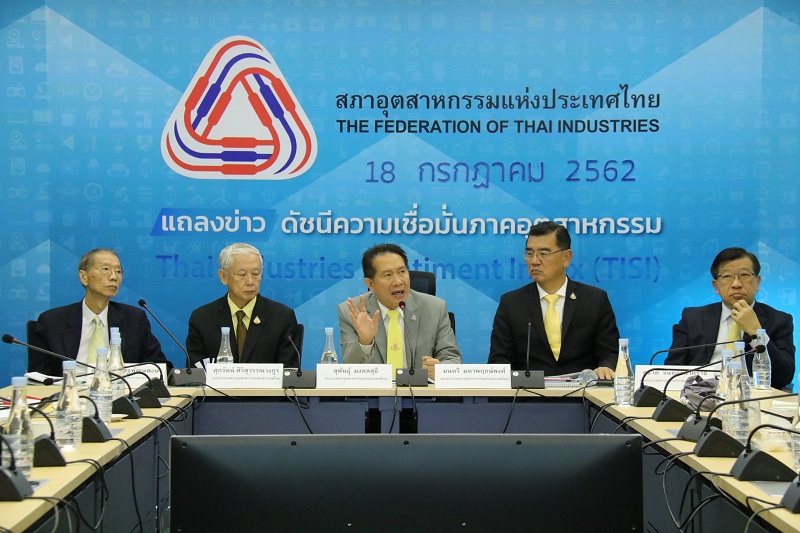
Mr. Suchart Chantharanakraj, Vice President of the Federation of Thai Industries stated that the FTI proposes a “wage policy and the enhancement of the quality of Thai labor,” which is a priority for the private sector focusing on three main areas:
1) Wage Adjustment The adjustment of the minimum wage should correlate with productivity increases and comply with legal requirements (Labor Protection Act). Additionally, it should encourage employers and entrepreneurs, especially SMEs, to adopt a salary structure (salary scale), with the Ministry of Labor conducting surveys and providing reference data for businesses, as well as promoting the use of wage rates according to labor skill standards set by the Ministry of Labor.
2) Increasing Labor Productivity and Skill Development Enhancing labor productivity should be a national agenda. There should be promotion for Re-Skilling and Up-Skilling aligned with labor market needs, incentivized by the government, incorporating technology and innovation with increased tax incentives, allowing the private sector to participate in budget allocation policies, establishing a central agency between the government and the private sector, restructuring workforce production, expanding cooperation between the private sector and educational institutions to align curricula with labor market demands, and allowing individuals to deduct labor productivity enhancement expenses from taxes at double the rate.
3) Increasing Replacement Labor A Re-Employment system for older workers should be established, reforming the national wage system to enhance labor productivity by promoting flexible hiring and allowing deductions based on actual wages, while studying the demand for labor and the necessity for foreign workers of other nationalities to replace foreign workers from three countries (Cambodia, Laos, and Myanmar).