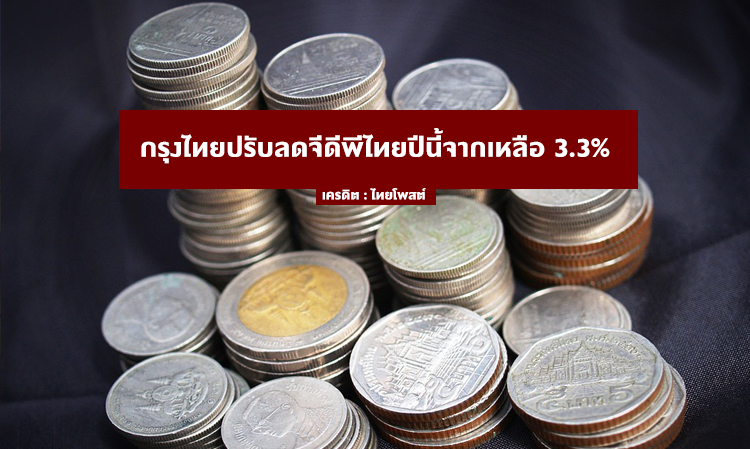
Krung Thai Bank Lowers Thailand's GDP Growth Forecast to 3.3% This Year
Mr. Pacharapoj Nantaramas, Senior Director of Global Business Development and Strategy at Krung Thai Bank, revealed that the ongoing trade war between the United States and China has become increasingly evident and severe, with more products being subjected to tariffs and an expanded scope to gain an advantage in future technologies. This has led to a slowdown in international trade and private sector investment globally, impacting Thai businesses that rely on China, particularly in the electronics, automotive, and real estate sectors. Additionally, domestic private consumption is under pressure from rising household debt and declining agricultural incomes due to drought earlier this year. As a result, the bank estimates that Thailand's economy will grow by 3.3% this year, down from the previous estimate of 3.8%, with a projected growth of 3.6% next year. Export growth has also been revised down to just 0.8% from an earlier forecast of 4%, while next year's export growth is expected to be 2.5%, facing further challenges as Vietnam gains increased tax benefits for exports to Europe.
“Although the U.S. and China agreed to a temporary truce following the G-20 meeting in early July, it is expected that the U.S. will still impose tariffs on $300 billion worth of Chinese goods in the fourth quarter, which will continue to pressure the export sector. Government stimulus measures are quite limited, aside from assistance for low-income earners. It is anticipated that investment funds under the transportation action plan to drive the country's infrastructure will only be disbursed at 77 billion baht this year, which is less than planned but will gradually increase in the following years. Moreover, the annual budget for 2020 may not be fully disbursed in the early part of the fiscal year. Additionally, housing market stimulus measures are only attractive for properties priced below 1 million baht, while unsold units and new listings are concentrated in the 1-5 million baht price range, indicating a need to prepare for a slowing housing market,”
said Mr. Mana Nimitravanich, Director of Global Business Development and Strategy, who further commented on the outlook for the money and capital markets. He noted that in the second half of the year, global monetary policy will ease. The U.S. Federal Reserve has shifted its monetary policy towards easing and announced plans to end balance sheet reduction this September. From the latest meeting in June, it was clearly stated that they are ready to take appropriate actions to maintain the growth rate of the U.S. economy, in line with major countries such as the European Union, Japan, and China, which have signaled readiness to further ease monetary policy.
“Regarding the direction of Thailand's policy interest rate, it is expected that the Monetary Policy Committee will maintain the rate at 1.75% throughout the year to support the economy under low inflationary pressures. No interest rate hikes are anticipated, as increasing rates would strengthen the baht further, exacerbating challenges for exporters. While there are concerns about household debt, it is believed that the Bank of Thailand is likely to address specific issues through Macro Prudential measures. In the second half of the year, additional measures may be introduced beyond controlling real estate loans. Given the recent volatility in exchange rates, businesses involved in exports and imports should prioritize managing exchange rate risks more effectively,”
Thank you for the information from www.thaipost.net