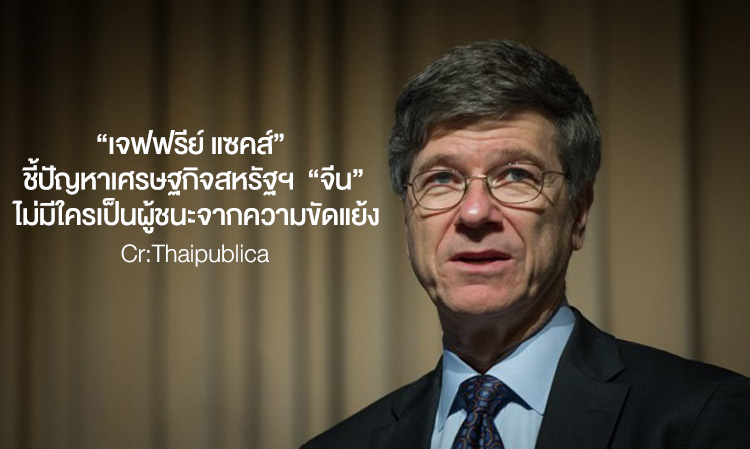
Jeffrey Sachs, a professor at Columbia University and director of the university's Center for Sustainable Development, wrote an opinion piece for CNN on May 27, 2019, titled "China is not the source of our economic problems — corporate greed is".China is not the source of our economic problems — corporate greed is
Jeffrey Sachs begins by stating that China is not an enemy but merely a country striving to improve living standards through education, international trade, infrastructure investment, and technological development. In short, China is doing what every country must do when it has previously been very poor and far from being a superpower. However, the Trump administration aims to halt China's development, which could harm both the U.S. and the world at large.
Sachs also views China as a scapegoat for the increasing inequality in the U.S. During a time when U.S.-China trade relations benefited both sides, some segments of the U.S. workforce were left behind, particularly in factories in the Midwest, where workers faced competition due to higher productivity and comparatively lower labor costs in China, even though they are rising.
"Instead of blaming China for this normal market competition, we should tax the soaring profits of our own multinational corporations and use that tax revenue to support working-class households, improve our crumbling infrastructure, promote new job skills, and invest in new science and technology," the article states.
"We must understand that China is merely trying to make up for lost time due to prolonged backwardness caused by international political conflicts and economic failures," Sachs notes, providing historical context to aid understanding of China's economic development over the past 40 years.
In 1839, Britain attacked China after it refused to allow British traders to sell opium, a drug, to the Chinese any longer. However, Britain persisted aggressively, resulting in China's humiliating defeat in the First Opium War, which ended in 1842, and was part of the reasons for the uprising against the Qing Dynasty, known as the Taiping Rebellion (the deadliest rebellion in world history), which claimed over 20 million lives. The Second Opium War, where China fought against both Britain and France, led to a decline in China's power and domestic instability.
Later, in the late 19th century, China lost wars due to Japan's new industrial revolution and became a target of unilateral demands from Europe and the U.S. regarding trade. This humiliation led to another revolutionary uprising, but China was defeated again at the hands of foreign powers.
The Qing Dynasty fell in 1911 after China surrendered power to military warlords, leading to domestic unrest and the Japanese invasion beginning in 1931. World War II ended but was followed by a civil war, leading to the establishment of the People's Republic of China in 1949. Subsequently, there were issues with the uprising of followers of Taoism, including the deaths of millions from starvation due to the Great Leap Forward policy, which ended in the early 1960s, as well as political instability from the Cultural Revolution, which continued until 1977.
China's rapid development from a market economy base began in 1978 when Deng Xiaoping came to power and announced economic reform policies (from a command economy to a market economy through the Four Modernizations). While China has experienced significant growth over the past 40 years, it still bears the scars of a century-long legacy of poverty, instability, and foreign invasion and intimidation.
Chinese leaders want to do the right thing this time, which means they are unwilling to bow to the U.S. or Western powers any longer.
Today, China is the world's second-largest economy when measured by gross domestic product (GDP) at market prices, but it is still a country in the process of catching up after escaping poverty. In 1980, data from the International Monetary Fund (IMF) showed that China's GDP per capita was only 2.5% of that of the U.S., but by 2018, it had risen to 15.3% of the U.S. GDP per capita.
When measuring GDP using purchasing power parity (PPP) based on international price levels to assess the value of GDP across countries, China's per capita income in 2018 was at 28.9%, slightly higher than that of the U.S.
China's development strategy is similar to that of Japan, South Korea, Taiwan, Hong Kong, and Singapore. From an economic perspective, China, as a country striving to catch up, is not doing anything unusual.
The U.S. consistently taking action to stop China's technology theft is an oversimplification.
Many developing countries have upgraded their technology in various areas, including education, imitation, purchasing, mergers, foreign investment, and extensive use of patent knowledge. And of course, there is copying, and given the rapid changes in technology, conflicts over intellectual property arise, which is a reality even among U.S. companies today. This type of competition is merely a part of the global economic system. Technology leaders themselves realize that they cannot maintain leadership solely through protection but must also innovate.
In the early 19th century, the U.S. also extensively adapted British technology, and when it sought to close the technology gap, it sought knowledge or know-how from abroad.
The U.S. ballistic missile program, well-known today, was developed with the help of former Nazi German rocket scientists whom the U.S. hired after World War II.
If China were an Asian country less known and appreciated than others, such as South Korea, and had just over 50 million citizens, it would be hailed by the U.S. as a good example of successful development, which is true, as China has succeeded in its development.
But the issue is that China is very large, and it rejects the claim of the U.S. to global governance. The U.S. itself has only 4.2% of the world's population, less than a quarter of China's population.
The truth is that no country is in a position to lead the world today because technology and know-how have spread more rapidly around the globe than ever before.
Trade with China has provided the U.S. with consumer goods at very low prices and of higher quality, and it has also resulted in job losses in sectors that directly compete with China, such as manufacturing. But that is the nature of trade.
Accusing China of unfair trade is incorrect. Many American companies profit immensely from producing goods in China and exporting them from China. American consumers themselves benefit from improved living standards due to cheap goods from China.
The U.S. and China should negotiate and continuously improve trade regulations for both bilateral and multilateral trade, rather than engaging in a trade war by threatening each other and making accusations.
The fundamental lesson from trade theory, practices, and policies is not to stop trade, which leads to lower living standards, economic crises, and conflict.
On the contrary, we must share the benefits of economic growth so that those who benefit can compensate those who lose out.
Under American capitalism, which has strayed from the spirit of cooperation of the New Deal for a long time, the current winners refuse to share benefits straightforwardly, and the result of this refusal to share is that American politics is filled with trade conflicts, with greed guiding U.S. policy comprehensively.
The real battle is not with China but with large American corporations, many of which rank high on Fortune's lists but do not pay fair wages to workers.
American business leaders and the wealthy push for tax cuts, increased monopoly power, and expansion abroad, among other things, to maximize profits while rejecting any policies that would help make American society more equitable.
President Trump has attacked China, believing that China will bow to Western power again, and has targeted successful companies like Huawei by abruptly changing international trade rules unilaterally.
China has played by Western rules for the past 40 years but has gradually caught up in the same way that other Asian allies of the U.S. have done in the past. Now, the U.S. is trying to inflict losses and stagnation on China by opening a new Cold War.
If there are no better ideas, we will lead ourselves into conflict with China, first economically, followed by international politics and military, causing harm to everyone. No one wins from conflict.
We are on a path of superficiality and political corruption. A trade war with China does not solve our economic problems. Instead, we need a domestic approach, including accessible healthcare programs, higher-quality schools, modern infrastructure, higher minimum wages, and addressing corporate greed.
Through this process, we will learn that we can gain more through cooperation with China rather than provocation and unfair practices.
According to the Columbia University website, Jeffrey Sachs is interested in the relationship between international trade and economic growth, the phenomenon where resource-rich countries have better living standards than those with fewer resources and less resource extraction industries, public health, the history of economic development, economic geography, strategies for economic reform, international financial markets, macroeconomic policy, global competitiveness, climate change, the role of universities in economic development, and poverty alleviation.
Jeffrey D. Sachs is a globally renowned economics professor, a leader in sustainable development, a senior advisor to the United Nations, a bestselling author, and a columnist for monthly magazines in over 100 countries worldwide. He has also co-received the Blue Planet Prize in 2015, received the Environmental Leadership Award, and has been named one of the most influential people by Time magazine twice.
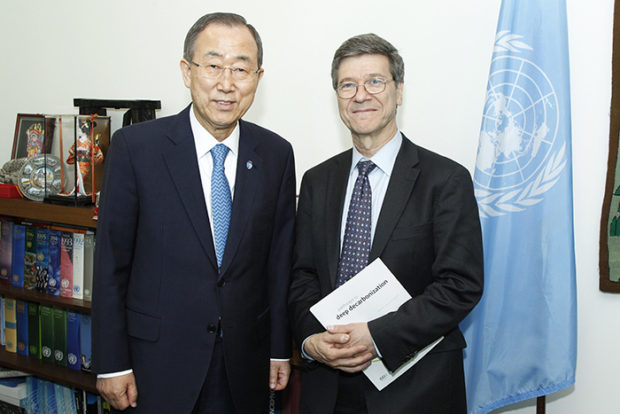
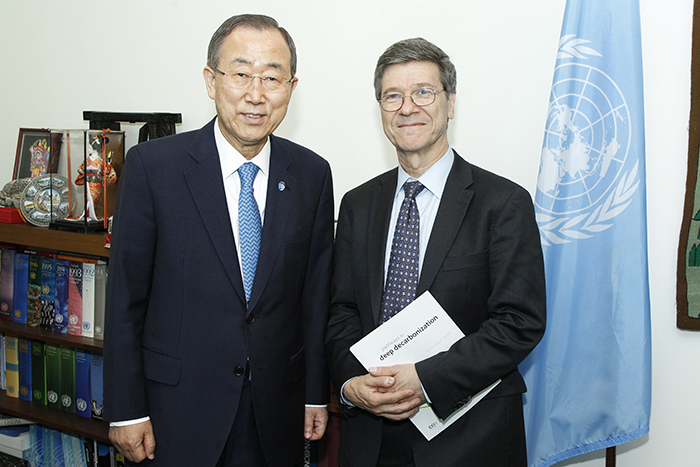
From 2002 to 2016, Professor Sachs held the position at the Earth Institute at Columbia University, during which he led over 850 scientists and policy experts from various organizations to support sustainable development. He played a role in incorporating sustainable development courses into the university's doctoral programs and served as a special advisor on the 17 Sustainable Development Goals of Ban Ki-moon, former UN Secretary-General, and as an advisor to Kofi Annan, former UN Secretary-General on the Millennium Development Goals.
Professor Sachs is known for his leadership in economic development, global economics, and poverty alleviation, with his work on poverty alleviation, economic stabilization, and promoting economic growth spread across over 125 countries worldwide. He is also the only external advisor to Pope John Paul II in the preparation of the encyclical Centesimus Annus. He currently collaborates with the Pontifical Academy of Sciences and the Pontifical Academy of Social Sciences.
Before joining Columbia University in 2002, Professor Sachs had nearly 20 years of experience at Harvard University.
Professor Sachs was born in 1954 in Detroit, Michigan, graduated with honors from Harvard in 1976, and earned his master's and doctoral degrees in 1978 and 1980, respectively.