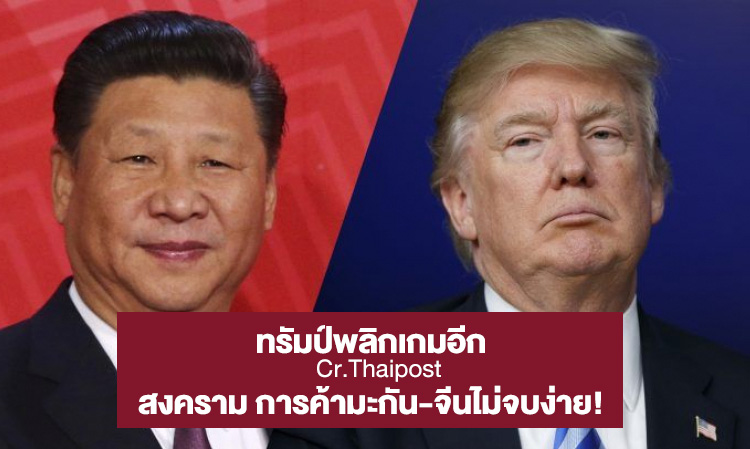
Trump Turns the Tables Again... The US-China Trade War is Far from Over!
Out of the blue, Donald Trump announced via Twitter earlier this week that Chinese goods worth over $200 billion entering the US market would see an increase in tariffs from 10% to 25%
Anyone following the news on the trade war between the US and China would naturally be surprised by this announcement, especially since just a few days prior, Trump himself had reported that "good news" was on the way and that a positive update on the negotiations between the two sides would be announced this coming Friday.However, Trump shocked the world by stating that he would proceed with the tariff hike on Chinese goods entering the US this Friday.
Trump's reasoning was brief and blunt: "Because the negotiations are moving too slowly."
This is yet another display of Trump's negotiating style, where he shows no regard for anyone, not even Xi Jinping of China, whom Trump has always referred to as a "close friend."
With a friend like Trump, one might not need enemies, as he shows no respect for his negotiating counterpart whatsoever.
In fact, Trump had announced a new tariff increase on Chinese goods entering the US from 10% to 25% some time ago, but initially, it was clear to everyone that this was merely a tactic to pressure China.
Xi Jinping did not show any fear of that threat, responding by stating that China does not wish to engage in a trade war with America, but if the US resorts to intimidation and threats, China will not be afraid and will respond in kind.
At that moment, Trump backed down and sent a team to negotiate, which Beijing welcomed, stating that finding a solution through dialogue was something China desired, as it did not want to engage in a conflict with America.
Subsequently, we received periodic updates that China was willing to increase purchases from America to reduce the trade surplus with the US, demonstrating China's sincerity in wanting to resolve the issues together.
Initially, Trump seemed to view China's willingness to compromise as a victory for himself, tweeting that he and Xi Jinping were about to announce a significant agreement.
Trump always referred to the agreement as a "deal."
The term "deal" is typically used by businesspeople employing tactics to maximize their benefits, but for world leaders, it can carry a negative connotation, suggesting that one side is using various tricks to gain an advantage over the other.
But Trump doesn't care, as he grew up with the belief that regardless of one's position, victory is measured by the deal, not by ensuring that both negotiating parties benefit, as the Chinese refer to it as a win-win.
When Trump displayed such bluntness, the Chinese negotiating team, led by Vice Premier Liu He, indicated they were considering postponing their trip to Washington, which was originally scheduled for this week.
They were supposed to meet again to reach a conclusion and announce a "ceasefire," as had been reported earlier.
However, with Trump flipping the script, China would likely need to regroup and adjust its strategy on how to engage with Trump.
It is quite strange that the US leader has become the "rebellious child" who can throw tantrums at any moment, while Xi Jinping plays the role of the adult, remaining calm and trying to avoid the "punch-for-punch" approach that previous Chinese leaders had used in international dealings.
Trump fired off a series of tweets regarding this matter.
After tweeting about the tariff increase on Chinese goods worth $200 billion from 10% to 25% this Friday, he also announced that the US is considering adjusting tariffs on another set of imports from China valued at $325 billion.
Later, Trump tweeted again:
"America has been running a trade deficit for several consecutive years, ranging from $600 billion to $800 billion annually with China alone. We have a deficit of $500 billion already. Sorry, but we will not allow this to continue any longer."
And so, the world remains in a state of uncertainty, as Trump considers himself a "master negotiator" who still has not bested Xi Jinping!
Thanks for the information from www.thaipost.net