Monetary Policy Committee Keeps Interest Rate at 1.75% Amid Increased Economic Volatility – Concerns Over Financial System Stability Remain Fragile
On February 6, 2019, Mr. Titthanat Mallikamas, Assistant Governor of the Monetary Policy Group at the Bank of Thailand (BOT) and Secretary of the Monetary Policy Committee (MPC), announced after the first MPC meeting of 2019 that the committee voted 4 to 2, with one member absent, to maintain the policy interest rate at 1.75% per annum. The majority reasoned that the current accommodative monetary policy supports economic growth and aligns with the inflation target framework.
Meanwhile, the two dissenting members advocated for a 0.25% increase in the policy interest rate from 1.75% to 2% per annum, arguing that the economy continues to grow close to its potential. They believed that even with a 0.25% increase, the overall financial conditions would remain accommodative and supportive of economic growth. Thus, they recommended raising the policy interest rate this time to mitigate financial system stability risks and build policy space for the future.
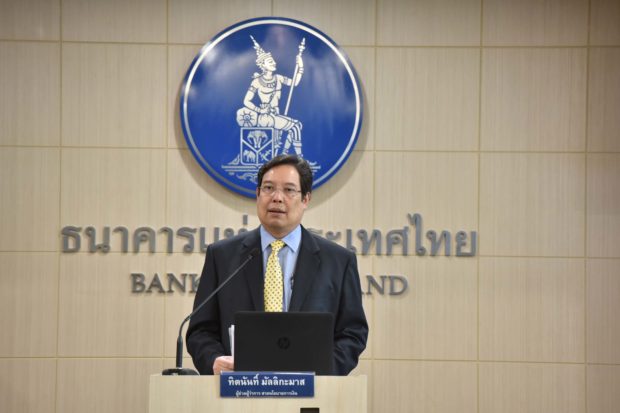
Mr. Titthanat Mallikamas, Assistant Governor of the Monetary Policy Group at the Bank of Thailand (BOT) and Secretary of the Monetary Policy Committee (MPC), announces the MPC's decision.
“The weight of the reasons for the MPC's decision to maintain the policy interest rate this time is due to the committee's desire to monitor the increasing uncertainties in the future financial economy more clearly. These issues change rapidly; for instance, the trade war that seems to have quieted down may still be under negotiation, and the outcomes could improve or worsen. After the last meeting, we observed more volatile developments, resembling a fog that obscures our long-term view. Therefore, the committee may wait for more data and clarity before making a decision. On the other hand, the committee agrees that the stability of the financial system remains fragile despite previous interest rate hikes and various measures implemented earlier, which are the primary risk factors of concern. This is partly due to the declining growth weight of the economy, as it continues to grow in line with its potential, including the rising household debt in the second and third quarters of 2018 after previously slowing down, especially in the automotive sector. Recent data from commercial banks also indicates that the trend will continue to rise, or the real estate sector must be monitored for results after the measures are enforced. Therefore, the committee must trade off these two issues in policy implementation. Two members believe that even with a 0.25% increase, it would not significantly impact economic dynamics and could alleviate concerns about financial system stability,” Mr. Titthanat stated.
Overall, the Thai economy shows a continuous growth trend close to its potential, despite facing increased downside risks due to exports affected by a slowing global economy, trade barriers between the U.S. and China, and the slowdown in the electronics cycle. Meanwhile, tourism is showing signs of improvement, particularly from Chinese tourists recovering faster than expected. Domestic demand continues to grow, with private consumption expected to expand in line with improved household income both in and outside the agricultural sector, partly supported by government measures, but still pressured by high household debt.
Private investment is expected to grow as production bases shift to Thailand and through public-private partnership infrastructure projects. However, public spending is anticipated to grow at a lower rate than previously estimated due to actual disbursement and budget constraints for both current and investment expenditures, as well as delays in some state enterprise investment projects. Regarding future risks, the MPC sees external risks from trade barriers between the U.S. and China, the growth trend of the Chinese economy, and the progress of significant infrastructure investments, which may impact private investment and the overall economic growth trend going forward.
“The MPC's economic outlook for the near future is difficult to answer. If we look at the latest data from December 2018, we see several indicators declining, such as exports, but many aspects are expanding better than expected, such as tourism. Many issues still require monitoring for clarity, such as the impact of production base relocations and the continuity of investments,” Mr. Titthanat remarked.
General inflation is under pressure from falling energy prices and increasing downside risks from volatility in energy and fresh food prices. Core inflation is gradually expected to rise due to increasing demand pressures. The MPC believes that structural changes, such as the impact of the growth of e-commerce businesses, increased price competition, and technological developments that reduce production costs, will result in inflation rising more slowly than in the past.
The previous financial conditions were accommodative and supportive of economic growth. Liquidity in the financial system remains high, and financial institutions are gradually adjusting interest rates in line with the policy rate, particularly deposit rates. Real interest rates have risen but remain low, allowing the private sector to continue raising funds. Credit has expanded in both business loans and consumer loans. Regarding exchange rates, the Thai baht appreciated against the U.S. dollar due to the weakening of the dollar, with the baht strengthening in line with currencies of emerging market countries and regional currencies in the near future. Exchange rates are still expected to fluctuate due to uncertainties abroad, and the MPC believes it is essential to closely monitor exchange rate situations and their impacts on the economy.
“The volatility of the baht in the past has been considered weak due to the strengthening of the U.S. dollar, which aligns with the region. The Thai baht remains moderately strong compared to many countries. There is a common understanding that interest rate hikes lead to capital inflows, strengthening the baht. However, if we look at the trading volume of foreign investors, we find that from the beginning of the year until February, there was a net outflow of 5.6 billion baht, consisting of a 12 billion baht outflow from bonds and a 6.4 billion baht inflow into stocks. Regarding currency management policy, the aim is to allow the baht to move freely, except in cases of excessive volatility deviating from economic fundamentals. The BOT is closely monitoring this as it significantly impacts monetary policy goals, including inflation, economic growth, and financial system stability. The BOT is equipped with tools to manage this,” Mr. Titthanat stated.
Overall, the financial system is stable, but risks that may create fragility in financial system stability in the future must be monitored, especially the search for higher yields in a low-interest-rate environment, which may lead to underpricing of risks. The MPC believes that the measures taken to maintain financial system stability and the previous interest rate hikes will help manage the accumulation of vulnerabilities in the financial system to some extent, but monitoring developments in the housing loan market, adjustments in the real estate sector, the expansion of cooperative assets, and the direction of household debt and large business borrowing that may underestimate risks is still necessary.