The Office Space Market in Bangkok Over the Last 30 Years
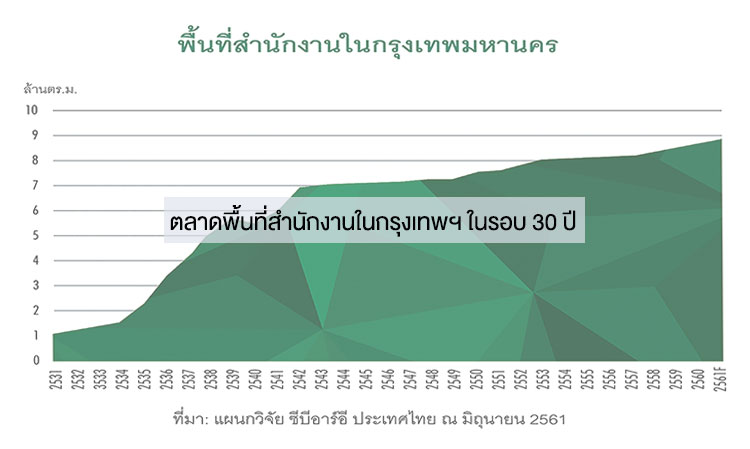
Thirty years ago, when CBRE first established its office in Bangkok, the total office space in the city was less than 1 million square meters, with rental prices at 250 baht per square meter per month. At that time, Bangkok had no Grade A office buildings, with the best quality buildings being Sathorn Thani, Sindhorn Tower 1, and Amarin Tower. Fast forward 30 years, and the total office space has nearly reached 9 million square meters, with average rental prices for Grade A offices in Bangkok's Central Business District (CBD) slightly below 1,000 baht. The top three highest rental buildings are Gaysorn Tower, Park Venture Ecoplex, and Phyathai Tower at EmQuartier.
Office Space in Bangkok
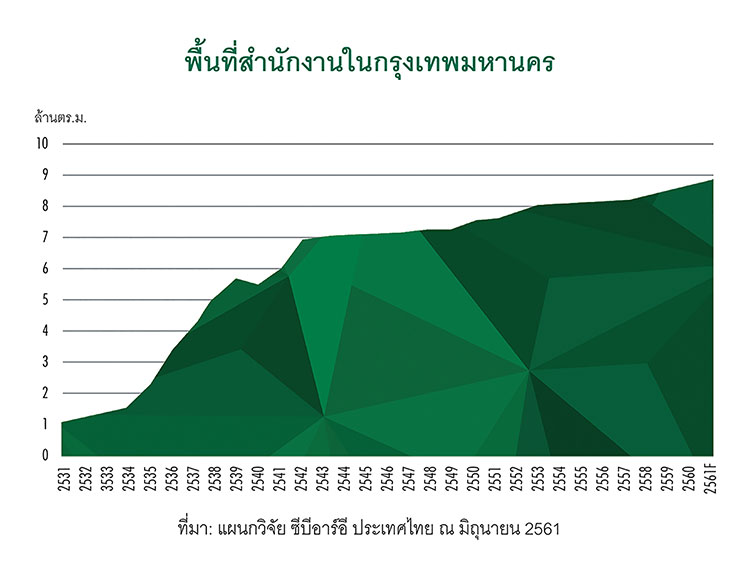
Source | Research Department, CBRE as of June 2018
The first Grade A office building in Bangkok was the Ditthaphong Towers on Wireless Road, completed in 1992 and now known as GPF Wireless Towers, which can be rented for over 800 baht per square meter per month. This building was the first to feature a Variable Air Volume (VAV) system, an air conditioning system that maintains a consistent temperature throughout each floor.
The financial crisis of 1997 significantly impacted the office market in Bangkok. The closure of various financial institutions and workforce reductions led to a decrease in office space usage by nearly 300,000 square meters in 1998, with vacancy rates soaring to almost 40%. Rental prices for most office buildings halved upon lease renewal, with only 2004 seeing Grade A office rents return to levels achieved in 1994.
Additionally, significant changes occurred in the design and material selection for office buildings. Thai developers listened to tenant demands for column-free spaces, standard floor shapes, ceiling heights exceeding 2.8 meters, sufficient passenger elevators, and efficient air conditioning systems. The best quality office buildings in Bangkok, such as Gaysorn Tower, Park Venture Ecoplex, and AIA Sathorn Tower, share about 80% of their features with leading office buildings abroad. Approximately 80% of the total office space in Bangkok is in single-owner buildings, with no developments of co-owned office buildings or office condominiums for over 20 years, as tenants prefer single-owner buildings for better management and easier negotiations for space expansion.
Tenant usage of office space has also changed significantly. Most supervisors no longer have private offices, and office layouts have shifted to open and flexible spaces. Some companies have designed their workplaces to be activity-based workspaces, where employees do not have assigned desks, allowing for greater capacity, which necessitates more efficient air conditioning and elevator systems.
Ms. Rungrat Veerapakarn, Director of the Office Space Department at CBRE Thailand, revealed that "Tenants are seeking more diverse services from property owners and do not want to pay rent just for empty space." Tenants want to choose higher quality materials, "They want to be able to adjust the temperature and lighting levels for each area themselves, as well as require more amenities beyond just coffee shops and convenience stores," Ms. Rungrat added. "Some tenants are looking for flexible spaces within buildings, such as serviced offices and co-working spaces."
Thirty years ago, tenants primarily sought basic features like fire sprinkler systems, but today, demands have become more complex, requiring higher quality and diverse materials. Many multinational corporations and large Thai companies prioritize sustainable development and seek energy-efficient buildings certified to LEED standards.
New office buildings in Bangkok are currently in the design phase, with construction set to begin from 2018 onwards. These buildings will need to accommodate increasingly complex tenant demands, including a wider range of services within the building. Tenants expect higher standards of service from building management in terms of maintenance, security procedures, and customer service. Location remains a crucial factor, but since the BTS Skytrain system was completed in 1999, tenant priorities have shifted. "Nowadays, almost every tenant that is a CBRE client wants to be near the Skytrain, especially with direct connections to the stations," Ms. Rungrat added.
Rental prices are another key factor tenants consider when looking for new office space, followed by location, particularly proximity to the CBD and Skytrain stations. Today, selecting an office building is not just about location and rent anymore. Attracting the best employees is a challenge, and having a workplace that appeals to talent in terms of location, building quality, and workplace design is increasingly important. This means that the quality of design, material selection, amenities, and building services are becoming more critical.
Thank you for the information from www.cbre.co.th