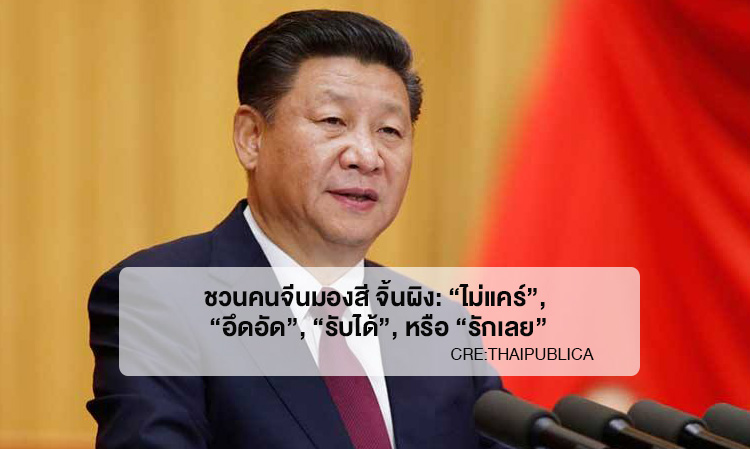
Inviting Chinese Perspectives on Xi Jinping: 'Indifferent', 'Uncomfortable', 'Acceptable', or 'Love It'
Recently, I had the opportunity to talk with several Chinese friends about the consolidation of power by leader Xi Jinping. The more I conversed and exchanged ideas, the better I understood China and the diversity of thought within it.
Engaging in discussions with ordinary people sometimes helps us understand a society better than reading books or listening to expert lectures. However, my conversations with my Chinese friends have their limitations, as I only spoke with a few individuals, and they cannot represent the feelings and thoughts of all Chinese people. Nonetheless, my small group of Chinese friends has provided a thought-provoking glimpse into the diversity of perspectives in China.
Since I am currently studying in the United States, the group of Chinese friends I exchanged opinions with consists of educated young people who are likely influenced by democratic and liberal Western ideas. On one hand, my Chinese friends cannot represent the grassroots population in China, but on the other hand, these friends have the potential to become significant contributors to Chinese society. Their views on comparing the Chinese system with Western systems are also quite interesting.
I would like to share the political perspectives of four Chinese friends, which vary greatly. The names I use in this article are all pseudonyms, but the opinions expressed are genuinely reflective of the diverse views of young Chinese people I have had the chance to engage with.
Perspective #1: 'Indifferent' because Chinese politics feels distant
When I asked about their feelings regarding the constitutional amendment allowing Xi Jinping to be a lifelong leader, 'Xiao Yang' replied that he didn't feel much about it because he is generally uninterested in politics. Chinese politics feels very distant to him.
He mentioned that ordinary Chinese people prioritize their livelihoods above all else. As long as the economy is doing well and they can make a living, they are satisfied. For him, his current focus is on his studies and how to find a job and opportunities after graduation. The competition pressure is immense due to the vast population, so just dealing with the pressures of studying and working leaves little time to pay attention to politics.
He doesn't see the point in engaging with politics when there is no space for criticism. Even though he might post critiques of government policies, he cannot criticize the leader himself. If he were to post negative comments about President Xi Jinping on social media, those posts could easily be deleted. If authorities perceive him as politically radical or an adversary of the Communist Party, he could be monitored or even harassed. There is no benefit to this.
Moreover, he feels he has nothing to critique because there is a lack of information. Chinese politics is like a 'black box'; the internal struggles within the Communist Party are things outsiders cannot know. The news that comes out is the result of internal battles that have already reached conclusions. When watching news from China, there are no dissenting voices, making it seem like the Communist Party is entirely united. However, he believes that within the Communist Party, there are indeed fierce political struggles, akin to a war for the throne in a Chinese film, but these do not make the news. What people gossip about are merely rumors that are not very credible. When one knows little about the leader and Chinese politics, how can they critique anything?
He stated that ordinary Chinese people feel that under Xi Jinping's leadership, politics has been stable, and citizens have opportunities to make a living. The economy has been progressing smoothly, and they believe the government has been doing a good job. Therefore, no one feels there is a reason to be dissatisfied with this government. As for Xi Jinping's consolidation of power, he sees it as an internal party matter. He is more interested in how the government will address various issues in China. He cares about government policies because they affect his life and work, but he does not feel interested in the individual leader since he has no right to vote anyway.
Perspective #2: 'Uncomfortable' because Chinese society is an illusion
'Xiao Hui' seems to be the most progressive Chinese friend I spoke with, which is not surprising since she researches human rights. However, she chose to focus on women's rights, which is not a highly sensitive political issue. She stated that the Chinese Communist Party and the Chinese government already support women's rights, but if she chose to work on political rights, her life in China would likely be much more difficult.
She admitted to feeling uncomfortable with the restrictions on freedoms in China and often wonders, 'Are we really going to live like this?' because Chinese society feels like an illusion. The Chinese government tightly controls the media, so the news that comes out is always positive, showcasing the country's progress, government policies, measures, and the government's commitment. However, various problems in China are hidden under the rug, with no reporting and no one knowing about them. Official news is uniformly positive. She encouraged me to read Chinese newspapers about Xi Jinping's continued leadership and I would find only articles praising the leader.
She acknowledged that most Chinese people prefer a strong leader. If you ask the general public, they tend to favor Xi Jinping and feel that the previous president, Hu Jintao, was weak. However, she insists that if you talk to intellectuals, including progressive Chinese people, they would feel that China is regressing in terms of political development because Xi Jinping has restricted political freedoms more than previous leaders. Anyone marked as an enemy or potentially problematic for the Communist Party could easily disappear.
She recounted that among progressive people in China, there has been a question of whether it is possible to attempt political reform under the current system, such as gradually allowing more political freedom, or whether sustainable political reform can only occur after the Communist Party is overthrown, which could lead to bloodshed and chaos. However, currently, neither seems likely. The Communist Party is increasingly aggressive in dealing with political enemies, yet at the same time, it has gained significant popularity among ordinary Chinese people. If you ask Chinese people now, many might even see the Chinese system as better than Western democracy. Given the foolishness of President Trump or the chaotic political situation in Taiwan, ordinary Chinese people might feel that the Chinese system is superior, capable of solving livelihood issues and maintaining social stability. So why would they want political freedom?
Perspective #3: 'Acceptable' because the Chinese system suits Chinese society
'Xiao Fan', another Chinese friend of mine, resembles the typical Chinese student studying abroad, often trying to respond to questions about Chinese politics in a neutral manner, suggesting that the Chinese system has both advantages and disadvantages, but overall, she believes this system suits China.
I told Xiao Fan that Thailand is currently in an abnormal situation and we are trying to return to normalcy through elections. She asked me why ordinary Thais feel that the current situation is abnormal. I replied that it is because we have been instilled with the values of democracy since childhood. Xiao Fan said that my answer made her think that the instillation of political ideology seems to influence people's thoughts a lot. In contrast, Chinese people have been taught since childhood that this system is suitable for China, supported by Marxist-Leninist ideology, and has a proud history of nation-building struggles. She and ordinary Chinese people feel that the leadership of the Communist Party is normal, and China must be governed this way. If it were to change to democracy, that would be the abnormal state and would lead to chaos.
She stated that a one-party dictatorship is suitable for China because it is a large country with a vast population. If elections were to occur, it would likely lead to chaos. Many Chinese people fear that China could break apart like it has in history or that there could be severe conflicts between classes if a leader adopts populist policies that appease the grassroots, conflicting with the middle and upper classes, as seen in Latin America (she cited Latin America because she may not be familiar with Thai politics).
Ordinary Chinese people cannot imagine what a democratic China would look like. When they cannot envision it and there are no clear alternatives, no one wants to risk overthrowing the current stable system.
Xiao Fan told me that the Chinese system resembles a large bureaucratic system more than a dictatorship. It is not easy to become a leader in China. For example, Xi Jinping had to accumulate diverse experiences, starting from rural work and gradually rising through the ranks. Central leaders must have experience in both impoverished and developed provinces, as well as experience managing state-owned enterprises. Therefore, she feels that Chinese leaders understand the complexities of Chinese society and the grassroots, perhaps even better than leaders in countries with elections. She gave the example of U.S. leaders who come from elite backgrounds and win elections, who might not understand rural America at all. For her, inexperienced leaders like Obama or celebrity-businessman leaders like Trump do not compare to Chinese leaders like Xi Jinping, who have endured various experiences over a long time.
Perspective #4: 'Love It' because he admires President Xi
As for my last friend, 'Xiao Ping', he is a fan of the Communist Party and President Xi. He was very pleased with the news of extending Xi Jinping's leadership indefinitely. He stated that it is not easy to find a prominent and capable leader, so when one is found, why limit his term?
Xiao Ping argued that extending Xi Jinping's leadership is necessary because there seems to be no new leader with comparable abilities. Xi Jinping has done well and won the hearts of the people. Firstly, Xi Jinping responds to the nationalistic feelings of Chinese people, who are starting to feel that China is becoming strong. Why should they continue to follow the West? They should take a leading role on the world stage and take pride in their own system, in which Xi Jinping stands out globally.
Another point is the anti-corruption campaign, which every Chinese person can feel has genuinely changed the behavior of government officials. In the past, if you didn’t slip an envelope to officials, you wouldn’t receive service. Nowadays, not only do officials hesitate to accept bribes, but they also genuinely strive to serve the public well. Furthermore, those who engage in corruption or have inexplicably amassed wealth have been imprisoned, with many examples to see.
Even though Xiao Ping is a fan of Xi Jinping, he assured me that he does not idolize him like people used to idolize Chairman Mao. China has moved past that era of leader worship. No one sees Xi Jinping as a god; everyone simply views him as a capable and highly skilled leader.
He made an interesting observation that after the devastation of the Cultural Revolution during Chairman Mao's time, Chinese people today have lost interest in ideological worship. Therefore, no one is interested in debating whether to be democratic or dictatorial, or whether to be capitalist or socialist. The fanaticism for ideology during Mao Zedong's era led to madness, instability, and economic backwardness. Thus, if we look at 'Xi Jinping Thought' (which has just been incorporated into the constitution), aside from emphasizing the leadership of the Communist Party, the remaining thoughts are all about public policies that address real issues in China, such as corruption, the environment, inequality, etc. There is no content that revives the ideological fanaticism of the Mao era.
Conclusion: Common Ground in Diversity
The four perspectives above may help answer the questions many have about how Chinese people accept the Communist Party's dictatorship and how they view Xi Jinping's consolidation of power. It is evident that there are those who are indifferent, those who view it negatively as a regression, and those who see it positively as a welcome development.
However, all four perspectives share a common sentiment: a widespread feeling in China that politics is not for ordinary people. The era of political ideology has ended, and there is no hope (and no one expects) for political freedom. At the same time, in terms of the economy, everyone acknowledges that China seems to be doing well, growing richer by the day.
This creates a paradox, both delightful and sorrowful for China—a country that is wealthy but does not desire freedom. Sometimes it makes one ponder whether we would want to live in such a society.
Xiao Yang, who is uninterested in politics, hopes to find a job in the U.S. because he admits he enjoys the free atmosphere here. Although he acknowledges that being middle class in China seems to offer a better quality of life than being middle class in the U.S. (except for one issue: the high rent in China), in other aspects, the cost of living in the U.S. is significantly higher.
Xiao Hui, who feels uncomfortable with the illusion of progress in China, intends to marry and settle in the U.S. Since coming to the U.S., she feels she has emerged from her shell and begun to see many dark sides of China.
Xiao Fan, who finds the Chinese system acceptable because it suits China, says she is ready to be anywhere as long as she has a good job and good pay.
As for Xiao Ping, the Communist Party fan, he intends to return to China after graduation because he sees opportunities there and believes the world will soon revolve around China again.
Thank you for the information from thaipublica.org