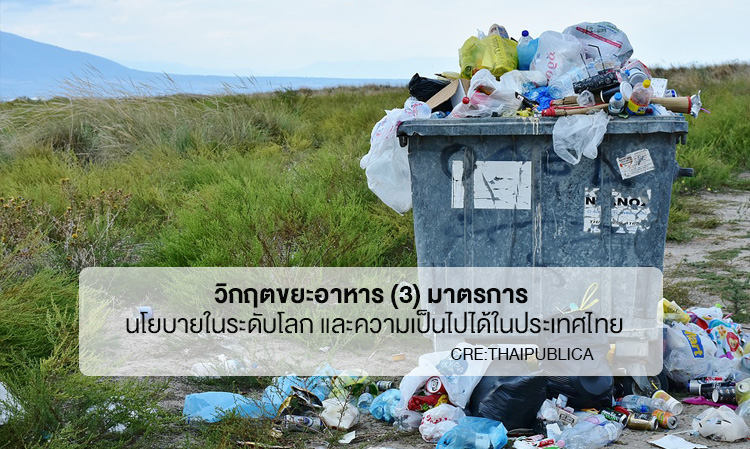
Food Waste Crisis (3): Global Measures, Policies, and Possibilities in Thailand
As the world views the issue of food waste as a “crisis” (read more in Food Waste Crisis Part 1 and Part 2), the increasing amount of food waste not only costs the world a tremendous budget each year to manage this waste but also significantly impacts climate change in terms of greenhouse gas emissions. If compared to countries, food waste ranks as the third-largest emitter of greenhouse gases, following the United States and China.
This is why, in the past 2-3 years, the issue of “food waste” has been raised as one of the global agendas, such as in Goal 12.3 of the Sustainable Development Goals (SDGs), which states that countries around the world must collectively achieve the goal of halving food waste by 2030.France and the Law Against Disposing of Edible Food

Recently, there has been movement from various countries regarding efforts to address this issue. At the event Food Waste Crisis: An Unpalatable Truth, organized by Tesco Lotus and the online news agency Thai Publica, Dr. Ampai Horkhunarak, Director of the Thailand Environment Institute and a sustainability scholar, raised the issue of France's recent legislation on food waste, which is considered progressive. This law prohibits supermarkets from disposing of or destroying leftover or expired food, mandating that it must be donated to charities or used as animal feed.
The passing of this law by the French government is an effort to reduce food waste in the country by half by 2025, following a previous study that indicated the average French citizen wastes about 20-30 kilograms of food per year, with approximately 7 kilograms being perfectly packaged food. This behavior generates around 7.1 million tons of food waste and costs the country up to 20 billion euros annually.
Dr. Ampai noted that many countries are intensively addressing food waste management, such as Hong Kong, which has various measures under a sustainable resource use blueprint, the United States, which has high food waste and employs legislation alongside consumer incentives, aiming to reduce food waste by 5% by 2030, and even Pakistan, which focuses on reducing food loss from the source by creating storage facilities for fruits and vegetables to minimize loss during packing and transportation, etc. All of these reflect policies and measures to address food waste that depend on different conditions and challenges.
“The context of each country is different. Developed countries like the United States or those in Europe have relatively high food waste, while developing countries, including Thailand, experience food loss in two parts: the production or transportation phase and the part that is discarded. The production phase is the larger portion. Therefore, management measures may vary,” Dr. Ampai stated.
Reading the Food Waste Blueprint and Lessons from Hong Kong
In advanced countries, Hong Kong serves as an example of prioritizing food waste issues. Since facing a waste crisis in 2012, the government issued a policy under a sustainable resource use blueprint from 2013 to 2025, aiming to reduce food waste by 40% by 2025.
Food waste is considered the largest component of waste in landfills. In 2012, 9,278 tons of waste were discarded daily, with 3,337 tons or 36% being food waste. Most of the discarded food came from industrial production and processing sources, including restaurants, hotels, and fresh markets. In the ten years leading up to the implementation of measures, the amount of this waste continuously increased.
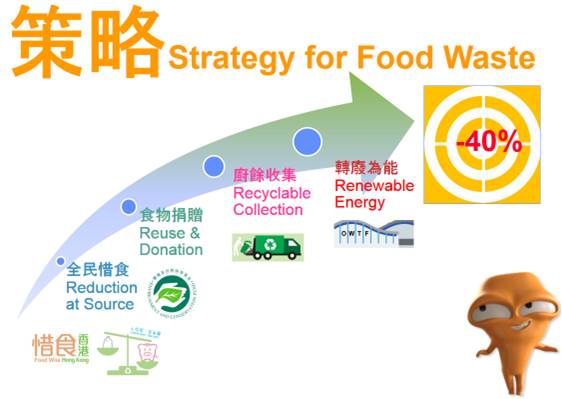
Going back to around February 2014, the Hong Kong Environmental Bureau launched the “Waste and Sewage Management Plan for Hong Kong 2014-2022,” which is a comprehensive plan outlining strategies, goals, policies, and operational plans for waste disposal and landfill areas.
The plan also set management goals to reduce food waste in landfills and established four strategies to manage food waste, including:
- 1. Reduction at Source
- 2. Reuse & Donation
- 3. Recyclable Collection
- 4. Converting Food Waste into Renewable Energy
The government places the highest importance on avoiding and reducing waste at the source where food is discarded. A committee was established, and the Food Wise Hong Kong initiative was launched to campaign against food loss nationwide, targeting both commercial and industrial operations as well as households to reduce food waste generated from the source.
The UK and the New Platform “FoodShare FoodCloud”
In addition to the push from government policies and measures, the drive to address food waste in the UK has become a model platform for reducing food waste, working collaboratively between civil society and the business sector. Tesco in the UK partnered with FoodShare, a charity organization, to develop the online application “FoodCloud”, which reroutes surplus food from stores to provide millions of meals to local charities and community groups across the country. This application was developed by graduates from Trinity College Dublin, enabling staff at each Tesco store to collect data on surplus food at the end of the day. This information is then shared with local charities so they can pick up the food and utilize the leftover quality food. Thus, in addition to reducing food waste, donating surplus food through this platform also helps reduce costs for local charities.
Currently, Tesco has become the first retailer in the UK to achieve the goal of not wasting edible food from all its branches nationwide and has also been the first retailer to disclose its food waste data since 2013.
“Dave Lewis,” CEO of Tesco, stated, “In retail, we always have surplus food because it is very complex to balance consumer demand with the supply we have, and that’s why we volunteered to take this on.”
Source: https://www.edie.net/news/5/Tesco-launches-UK-wide-rollout-of–FoodCloud–waste-donation-platform/
Measures and the Future of “Food Waste” in Thailand
In Thailand, there are currently more visible examples of awareness from the private sector, such as Tesco Lotus managing its supply chain or the Royal Project at Doi Inthanon, which has improved fruit packaging by using better packaging to preserve vegetables and fruits before sale and has planned with farmers to reduce food loss during cultivation, etc.
However, the challenge for Thailand in the future is to drive concrete solutions to this issue with clear goals, especially operations that require cooperation from all sectors.
Although currently, the issue of waste has become a national agenda and a government policy, and although the Ministry of Agriculture and Cooperatives, through the Office of Agricultural Economics, has developed a 10-year food security strategy framework focusing on ensuring food security, having sufficient food, and using it without waste as a working framework.
In practice, there may still be a need for significant efforts regarding food waste data, measures, disposal technologies, as well as cooperation from the business sector and changing consumer behaviors and attitudes.
Associate Professor Dr. Jedsada Dentuangboriphan, a faculty member of the Faculty of Science at Chulalongkorn University, stated, “The major problem of the food waste crisis is that societal awareness is still quite low. Therefore, how can we make the public more aware, starting with everyone adjusting their consumption or purchasing behavior? If we can do that, I believe the situation will start to change for the better.”
“So, if we start from recognizing that we are part of the problem, buying too much, wasting food, and not knowing that this food can benefit others, there are many people who want it, and there are organizations that can utilize it well. If we can understand this, the situation will start to change because I believe that ultimately, government recommendations and laws will follow, but we must start with ourselves first,” Dr. Jedsada stated.
To unlock the food waste problem in Thailand, we may need to return to the point that “food waste” is an issue, and it is time for all of us to be aware and be part of the solution together.
Thank you for the information from thaipublica.org